


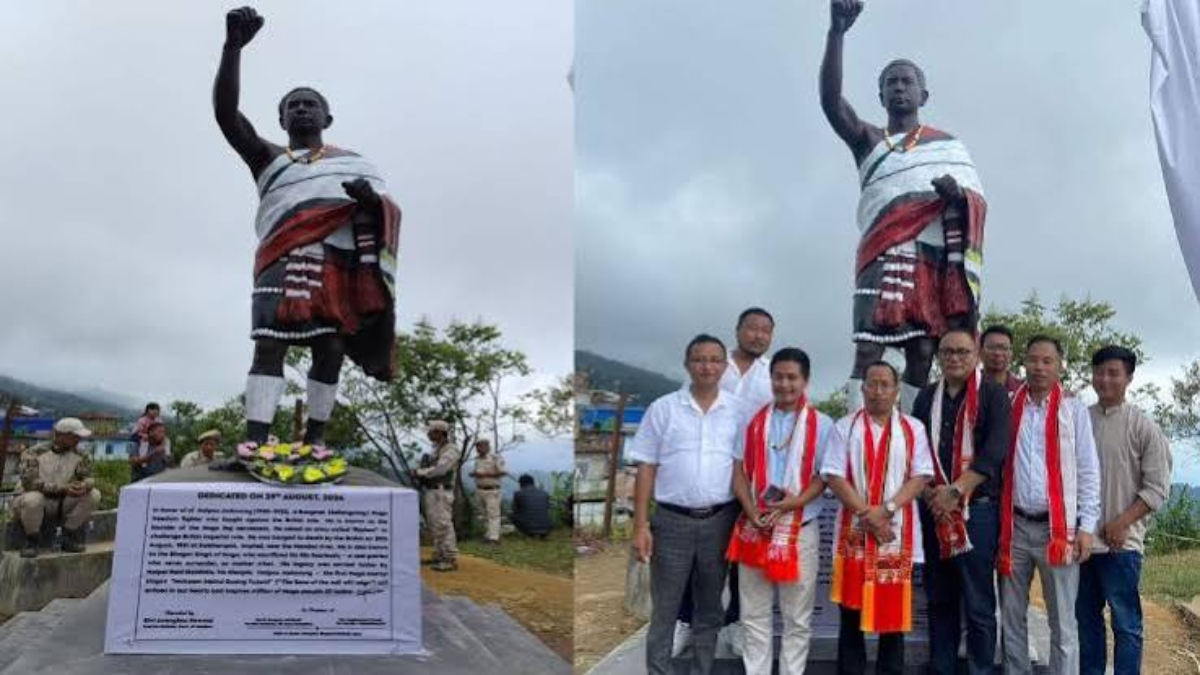
Haipou Jadonang Martyrdom Anniversary was observed at Tamenglong headquarters on Saturday, August 29, marking 95 years since the Zeliangrong Naga leader and freedom fighter was executed by the British colonial government in 1931. The observance brought together community leaders, social organisations, women and youth representatives to remember Jadonang’s contribution to the struggle against colonial rule and his efforts to preserve indigenous identity and traditions.
Haipou Jadonang Martyrdom Anniversary observed in Tamenglong
The programme at Tamenglong headquarters was organised by the Joint Tribes Council, Manipur (JTCM), representing the Inpui, Liangmai, Rongmei and Zeme communities. Before the main programme, participants gathered at Jadonang Park for a floral tribute ceremony at the statue of Haipou Jadonang.
Community leaders, social leaders, women and youth representatives from the Zeliangrong communities paid floral tributes to the late leader. Among those present were N Abonpou Christopher MES, ZEO, Tamenglong; Kaningai Riamei, chairman of the Christian Heritage Institute; Aku Newme, general secretary of JTCM; KC Savio, president of the Rongmei Naga Council Manipur and co-convenor of JTCM; and Anupum Atari, 2IC of the 6th Assam Rifles.
The gathering highlighted the continuing importance of Jadonang’s legacy among communities in the region, particularly his role in resisting British colonial authority and promoting unity among the Zeliangrong people.
Remembering a prominent freedom fighter
Haipou Jadonang was born in 1905 at Puiluan, also known as Kambiron village, in the present-day Tamenglong-Noney region of Manipur. He emerged as a spiritual and political leader during a period when British policies, taxation and administrative measures were affecting communities in the hill areas.
Jadonang became associated with a movement for social reform, cultural revival and resistance to colonial rule. His activities eventually brought him into direct conflict with the British administration.
British authorities arrested Jadonang in February 1931. Following a trial, he was sentenced to death. He was hanged on August 29, 1931, in Imphal at the age of 26. His execution turned him into an enduring symbol of resistance for the Zeliangrong community and wider sections of Manipur.
Legacy of unity and cultural identity
Jadonang’s legacy extends beyond his resistance to British rule. He is also remembered for his efforts to strengthen social unity and revive indigenous traditions at a time of considerable political and cultural change.
His movement later influenced the work of Rani Gaidinliu, who had been associated with Jadonang and went on to become a prominent leader in the resistance against British rule. The connection between the two figures has helped establish Jadonang’s place in the broader history of resistance movements in Northeast India.
The annual observance therefore serves both as a remembrance of his sacrifice and as an opportunity for younger generations to learn about the history of the Zeliangrong people.
Jadonang Park remains a key memorial site
The Tamenglong observance also carries added significance because Jadonang Park has become an important memorial space. In 2024, a life-size statue of Haipou Jadonang was unveiled at the park during the 93rd death anniversary observance.
The statue was unveiled by Water Resources Minister Awangbow Newmai in the presence of Hill Areas Committee chairman Dinganglung Gangmei and Tamenglong MLA Janghemlung Panmei. The event was attended by large numbers of members of the Zeliangrong community.
This year’s programme at the park continued that effort to preserve Jadonang’s memory in his home region.
Tributes held at other locations
The 95th death anniversary was also observed at other locations across Manipur. At Jadonang Park in Keishampat, Imphal, floral tributes and traditional rituals were conducted in memory of the freedom fighter. Participants included Nungba MLA Dinganglung Gangmei, representatives of civil society organisations and community bodies.
At Puiluanh, also known as Kambiron village, in Noney district, the anniversary was observed at the place regarded as Jadonang’s birthplace. These parallel programmes reflected the continued significance of his memory across Zeliangrong-inhabited areas.
As the 95th anniversary is observed, Haipou Jadonang remains an important figure in Manipur’s history. His resistance to colonial rule, emphasis on community unity and commitment to indigenous traditions continue to shape annual commemorations. The gatherings in Tamenglong and elsewhere underline the community’s continuing effort to preserve his history and pass his legacy to future generations.