


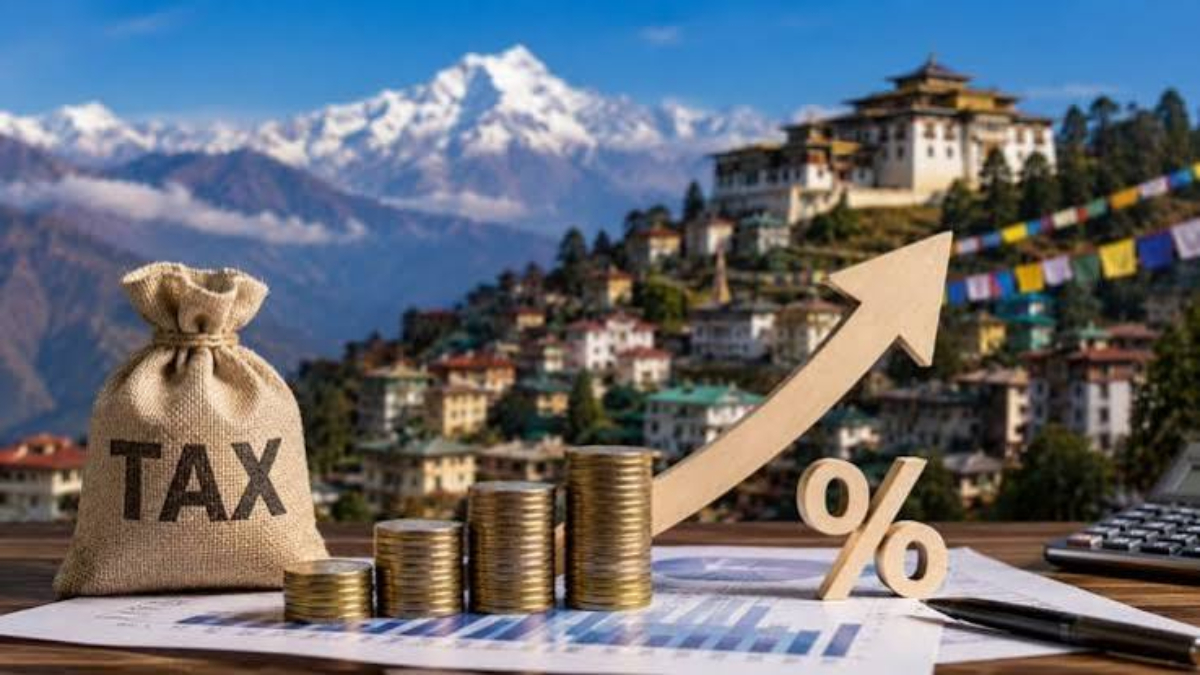
Sikkim tax revenue has recorded a sharp increase over the past decade, highlighting a significant improvement in the Himalayan state’s own resource mobilisation, according to data examined by the Comptroller and Auditor General of India (CAG). The rise has placed Sikkim among the states showing strong growth in tax collections, even as the state continues to rely substantially on transfers from the Centre.
The latest CAG data on state finances provides a broader picture of Sikkim’s fiscal performance. The CAG’s Sikkim audit records include the State Finances Report for 2024-25, released on July 23, 2026, offering the latest official assessment of the state’s finances.
Sikkim tax revenue shows a major rise
The growth becomes clear when tax collections are compared across the decade. Sikkim’s own tax revenue stood at about Rs 525 crore in 2013-14, according to earlier CAG data. By 2022-23, own tax revenue had climbed to nearly Rs 1,497 crore.
The increase continued into 2023-24. Finance Accounts show that Sikkim’s own tax revenue rose to roughly Rs 1,748 crore during the year. Major contributors included State GST, state excise, taxes on sales and vehicles, and stamp and registration fees.
The decade-long expansion reflects a substantial increase in the state’s ability to generate resources internally. While the exact multiple varies depending on the financial years and accounting series used, the broad trend points to roughly a threefold-plus increase.
GST emerges as a key driver
One of the most important changes in Sikkim’s tax structure has been the growing role of State GST. In 2022-23, SGST contributed about Rs 804 crore to own tax revenue. State excise generated nearly Rs 298 crore, while taxes on sales and vehicles contributed around Rs 249 crore and Rs 50 crore respectively.
The 2024-25 budget estimated SGST collections at Rs 1,265 crore, representing 58% of the state’s projected own tax revenue. The budget also projected a 31% increase in SGST over the revised estimate for 2023-24. State excise was expected to rise 43% to Rs 450 crore.
These figures indicate how consumption, services and formalisation of economic activity have become increasingly important to the state’s revenue base.
Strong revenue performance but continued Centre dependence
The growth in Sikkim tax revenue should be viewed alongside the state’s dependence on central transfers. For 2024-25, Sikkim budgeted total revenue receipts of Rs 10,749 crore. Of this, around Rs 3,091 crore was expected to come from the state’s own resources, while Rs 7,659 crore was projected from the Centre through tax devolution and grants.
This means stronger own-tax collection does not eliminate the importance of central support. Sikkim’s geographical constraints, small population and limited industrial base continue to shape its fiscal capacity.
NITI Aayog’s fiscal assessment also underlines this structural issue. For 2022-23, Sikkim’s own tax revenue was equivalent to 3.4% of GSDP, below the median for Indian states. At the same time, the state recorded a revenue surplus of 2% of GSDP.
What is driving the growth?
Several factors appear to have supported the expansion of Sikkim tax revenue. The introduction and consolidation of GST have strengthened the state’s indirect-tax framework, while increased economic activity has expanded the taxable base.
Tourism remains another important pillar of the economy. Higher visitor activity supports businesses across transport, accommodation, food services and retail, indirectly widening the tax base. Excise collections have also become increasingly significant, with state budget estimates pointing to strong growth in this category.
The state’s own financial documents show that own tax revenue has increased as a share of GSDP over recent years. The 2025-26 Medium Term Fiscal Plan projected own tax revenue at around 3.8% of GSDP for 2024-25, compared with 3.2% in 2018-19.
A positive signal for fiscal management
The rise in Sikkim tax revenue is significant because stronger own-resource mobilisation gives the government greater flexibility in financing public services and development programmes. It can also reduce vulnerability to fluctuations in grants and other central transfers over the longer term.
However, the figures also show that Sikkim still has considerable ground to cover. Own tax revenue remains a relatively modest share of the state economy compared with many larger states, while central transfers continue to account for a substantial portion of total receipts.
The latest CAG assessment therefore offers a mixed but largely positive fiscal picture: Sikkim has substantially expanded its tax base over the decade, but sustaining that momentum will require continued economic diversification, better tax administration and stronger private-sector activity.
For a small Himalayan state facing geographical and economic constraints, the growth in Sikkim tax revenue nevertheless marks a notable improvement in fiscal capacity. The challenge now is to convert higher collections into durable economic growth, stronger public infrastructure and greater financial resilience.