


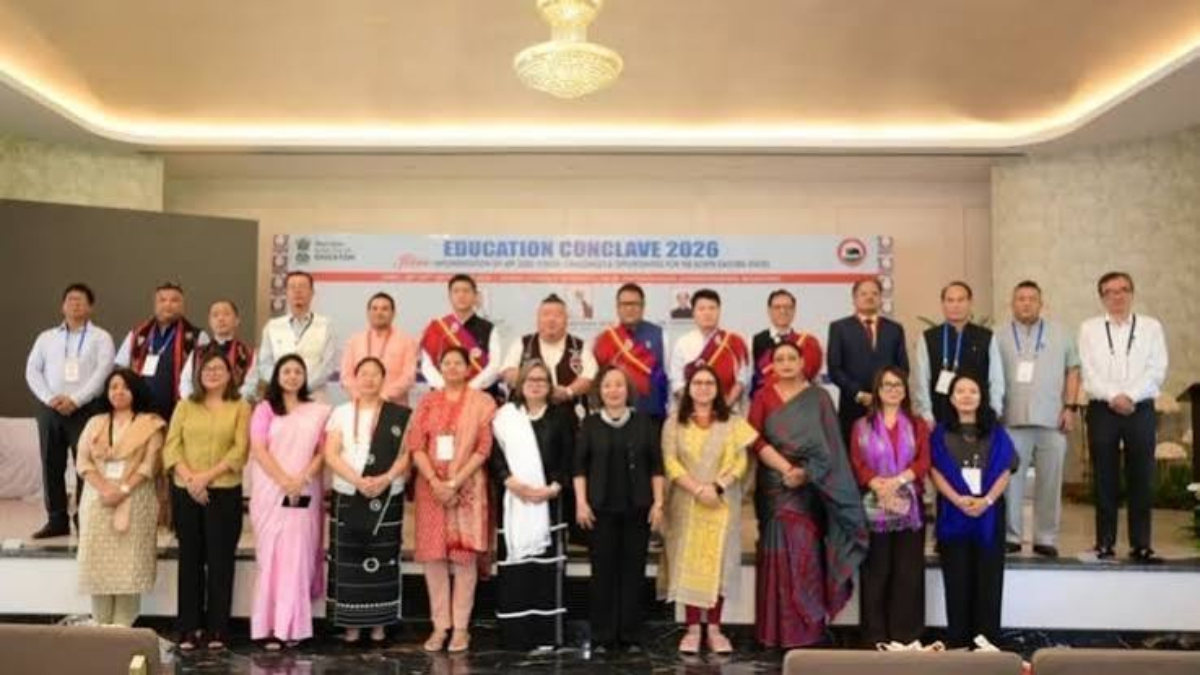
NEP 2020 in Northeast is set for a more region-specific implementation after education ministers, policymakers and academics called for a framework that accounts for the region’s geography, infrastructure, languages and local needs. The demand emerged at the two-day Northeast Education Conclave 2026 in Chümoukedima, Nagaland, which concluded on September 19 with proposals for stronger coordination among the northeastern states.
Why NEP 2020 in Northeast needs a regional approach
The conclave highlighted the challenges of applying common education norms across a region marked by difficult terrain, scattered settlements and diverse communities. Mizoram Education Minister Vanlalthlana called for a separate index and system for hilly areas, along with construction norms suited to the Northeast.
The issue is particularly visible in Nagaland’s school network. According to figures cited at the conclave, government schools account for about 80% of the state’s schools but serve roughly 33% of total enrolment. The figures underline the difficulties involved in maintaining infrastructure and ensuring access across remote and hilly locations.
The proposals do not seek a separate education policy for the region. Instead, the discussions focused on adapting the implementation of the national policy to local conditions while retaining its broader objectives.
Eight states seek stronger education coordination
A key proposal emerging from the conclave was closer coordination among the eight northeastern states. Vanlalthlana suggested that education ministers meet twice a year under the North Eastern Council and consider joint proposals after assessing common regional requirements.
The proposed approach could allow states to share best practices, institutional resources, faculty networks and capacity-building initiatives. Tripura Higher Education Minister Kishor Barman also called for greater student mobility, shared research infrastructure and joint research projects.
The Education Conclave 2026 brought together representatives from the region’s education departments, along with policymakers, academics and administrators. The final discussions identified access, quality, skills, research and innovation, and entrepreneurship as five major priorities.
Skills and employment take centre stage
The discussions on NEP 2020 in Northeast also placed strong emphasis on moving beyond degree-focused education. Barman said students need greater exposure to internships, apprenticeships, incubation programmes, entrepreneurship and skill-based learning.
Ministry of Education Additional Secretary Anandrao V. Patel similarly stressed the importance of combining academic education with industry exposure and multidisciplinary learning. He highlighted the National Apprenticeship Training Scheme and industry-academia partnerships as tools to prepare students for changing workplace requirements.
The conclave also linked education with sectors that have strong regional relevance, including agriculture, bamboo, tourism, biodiversity and traditional knowledge. The discussions emphasised connecting these areas with technology, research and entrepreneurship to create employment opportunities.
Local languages and indigenous knowledge
Another major element of NEP 2020 in Northeast is the effort to combine modern education with local languages, culture and indigenous knowledge. Participants discussed multilingual education and the need for learning resources that reflect the region’s circumstances.
The final proposals for school education included structured multilingual transition strategies, stronger foundational literacy and numeracy, learning-recovery measures and continuous professional development for teachers. The recommendations also called for documenting and sharing contextualised learning resources.
For higher education, participants proposed establishing institutions focused on the North-East Knowledge System and indigenous knowledge. Skill Hubs in existing institutions, State Public Universities and greater opportunities for academic progression also featured among the recommendations.
What happens next
The conclave’s recommendations are now expected to move towards the Centre. The School Education, Higher Education and Technical Education departments of the participating northeastern states will jointly submit the resolutions and recommendations to the Ministry of Education.
The Centre has also stressed the importance of infrastructure, teacher training and coordinated action to expand higher education access. Patel noted that reaching the national NEP target of a 50% Gross Enrolment Ratio in higher education by 2035 would require additional infrastructure and trained teachers. Online learning, virtual laboratories, multilingual education and platforms such as SWAYAM and SWAYAM Plus were also identified as ways to widen access.
The latest discussions indicate that NEP 2020 in Northeast is moving towards a more coordinated implementation model that combines national education goals with regional realities. For the states, the next challenge will be turning the conclave’s recommendations on infrastructure, skills, language, research and cooperation into practical measures that improve educational access and outcomes across both urban centres and remote communities.
Guns N’ Roses India Tour 2026 adds powerful Indian rock acts