


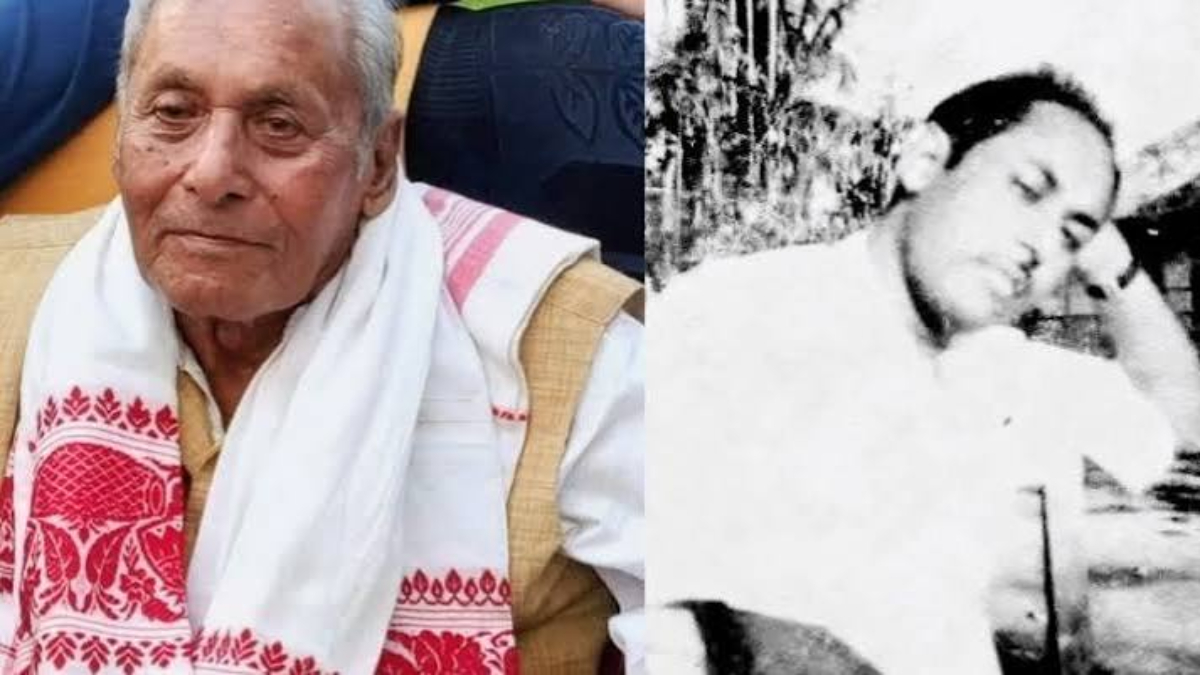
Bhola Kotoky remains one of the most important yet under-recognised figures in Assamese theatre and cinema. Actor, playwright, director and cultural activist, he devoted decades to the stage and helped shape Assam’s pioneering mobile theatre movement. His remarkable journey, including his unforgettable role as Rajani Master in Anirban, continues to hold a special place in the history of Assamese performing arts.
Bhola Kotoky’s Early Life and Theatre Roots
Born on January 20, 1932, at Sangia Majarchuk village in Jamugurihat, Kotoky developed an interest in performance during childhood. He participated in Bhaona performances at his village Namghar before becoming closely associated with Bapuji Bhawan Natya Samaj.
His artistic development was shaped by interactions with cultural icons including Jyotiprasad Agarwala, Bishnu Prasad Rabha, Phani Sarma and Gajen Baruah. While studying at Darrang College in Tezpur, his one-act play Bibhrat won major recognition at the 1956 Inter-University Youth Festival in Delhi. The production won Best Play, while Kotoky was honoured as Best Playwright and Best Director.
A Pioneer of Assam’s Mobile Theatre
Kotoky became closely associated with the early growth of Assam’s mobile theatre, or Bhramyaman theatre. In 1963, during the first season of Natraj Theatre, he became widely known for his lead performances.
Over the course of his career, he performed in around 150 plays and remained connected with several major theatre groups, including Suradevi, Manchakonwar, Biswarupa, Joy Jamuna, Purbajyoti, Apsara and Rang-Ghar. In 1968-69, he also produced and directed Biswarupa Theatre with Babul Medhi. The troupe introduced a circular stage format and had Bishnu Prasad Rabha as its chief theatrical adviser.
His stage career also included performances with legendary artists such as Phani Sarma and Bishnu Prasad Rabha. Eleven consecutive productions featuring the trio included Bhogjora, Emuthi Saul, Sati Beula, Miri Jiyori, Siraj, Maniram Dewan, Jerengar Sati, Keyo, Kabuliwala, Chhatrapati Shivaji and Rupalim.
The Breakthrough Role in Anirban
For many cinema audiences, Kotoky’s defining achievement was his portrayal of Rajani Master in Dr. Bhabendra Nath Saikia’s acclaimed film Anirban. Saikia had specifically imagined Kotoky for the role, but the actor was tied to a nine-month mobile theatre contract.
Rather than recast the character, Saikia reportedly waited for Kotoky to become available. The decision proved significant. As Rajani Master, Kotoky delivered a restrained and deeply realistic performance portraying a poor rural tutor facing personal tragedy and financial insecurity. His understated acting gave the character emotional depth without relying on exaggerated gestures.
The success of the performance helped demonstrate how the discipline of Assamese theatre could translate into powerful cinematic realism.
Beyond Anirban
Kotoky later appeared in several Assamese films, including Pulak Gogoi’s Sadari, Samarendra Narayan Dev’s Raja, Dara Ahmed’s Urvashi and Upen Baruah’s Jalanjali. He also worked in television, appearing in Brikodar Baruar Biya and Biju Phukan’s Deuta.
His contribution was not limited to acting. He wrote numerous one-act plays, including Swadeshi Gola, Bibhrat, Dwitiya Shahjahan, Duhsapno, Sanghat, Master Babu, Pratibaad, Pratikriya, Enajori and Sampriti. His full-length works included Saraighat, Swapna Bhagna, Dasyurani Putulibai, Dasyu Ratnakar, Merpaak and Agni Kanya.
A Wider Cultural Mission
In 1955, Kotoky joined the Indian People’s Theatre Association and worked alongside prominent cultural personalities, including Bhupen Hazarika, Bishnu Prasad Rabha and Gajen Baruah. He also performed in English, Hindi and Bengali productions in different parts of India.
His cultural work extended beyond theatre and cinema. He participated in the “Parbat-Pahar-Bhoiyam Sampriti” initiative, helping carry the teachings and cultural traditions associated with Srimanta Sankardev to indigenous communities across the Northeast. He also wrote essays and poems on theatre, culture and spirituality for several Assamese publications.
Awards and Lasting Influence
The Government of Assam honoured Kotoky with the Natasurya Phani Sarma Award in 2017. He also received the Jyotirupa Media Award, Moonlight Media Award, Natasurya Award from Zubeen Garg’s Kalaguru Artist Foundation and a Lifetime Achievement Award from the Assam State Film (Finance and Development) Corporation.
Kotoky died on November 4, 2022, following a brief age-related illness. His death marked the loss of a major figure from Assam’s pioneering mobile theatre generation. Yet his performances, writings and theatrical contributions continue to offer a valuable record of the state’s evolving cultural landscape.
Remembering Bhola Kotoky is therefore more than an exercise in nostalgia. It is a reminder of the artists who built Assamese theatre through dedication, discipline and creative courage, often without the national visibility they deserved. His legacy survives in the stages, films and cultural traditions that continue to shape Assam’s artistic identity.
MZP Pushes Strong Action on Engineering Seats and Drug Awareness