


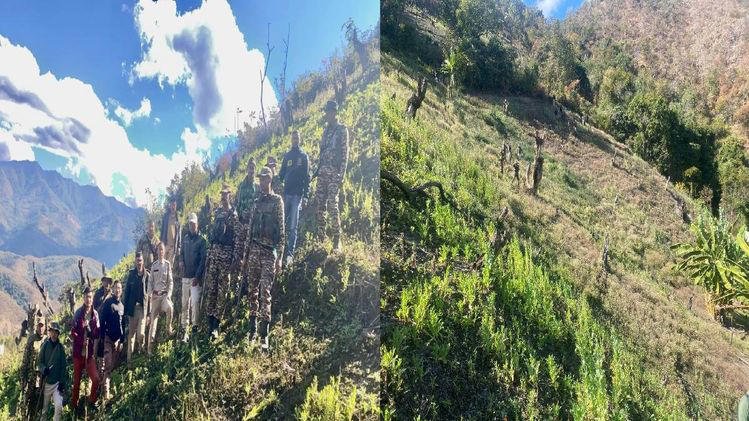
In a major blow to the narcotics trade in Northeast India, security forces have executed a massive crackdown in the hills of Manipur. On Tuesday, January 6, 2026, a high-stakes joint operation resulted in over 12.9 hectares of illegal poppy fields destroyed in the Senapati district. This mission marks the first large-scale eradication drive of the new year. It underscores the state’s unwavering commitment to its “War on Drugs” campaign despite ongoing regional challenges.
Read More: NIA Probes Serial Explosions in Manipur’s Bishnupur District
A Coordinated Strike in the Khabung Hill Ranges
The operation was not a solitary effort but a sophisticated collaboration between multiple agencies. The combined team included personnel from the Senapati Forest Division, the Manipur Police, and the Central Reserve Police Force (CRPF). Additionally, experts from the Narcotics Control Bureau (NCB) and dedicated village volunteers from Khabung participated in the drive.
The teams targeted the rugged terrain of the Upper and Lower Khabung Hill Ranges. Because these areas are remote, traffickers often believe they can operate without fear of detection. However, the successful mission where 12.9 hectares of illegal poppy fields destroyed proves that surveillance has reached even the most isolated ridges. During the sweep, authorities also discovered and dismantled a temporary hut used by cultivators, setting it ablaze to prevent future use.
Why the Senapati Poppy Destruction is Critical
Poppy cultivation is the primary source of opium, which fuels a dangerous transnational narcotics economy. For Manipur, this is not just a legal issue but a social and environmental crisis. The ongoing 12.9 hectares of illegal poppy fields destroyed help mitigate the spread of “crazy medicine” and heroin in the region.
Furthermore, the state government has frequently linked illicit farming to massive deforestation. Former officials and environmentalists have warned that clearing forests for poppy leads to soil erosion and recurrent floods. Therefore, by destroying these plantations, the security forces are also protecting the local ecology. The Khabung hill ranges, which share a border with Nagaland, are now under increased scrutiny to ensure that replanting does not occur during the next season.
Key Highlights of the Operation:
- Total Area Cleared: Approximately 12.9 hectares of illegal poppy fields destroyed in a single day.
- Infrastructure Dismantled: One temporary shelter was burnt and destroyed to disrupt the local supply chain.
- Legal Framework: The drive was conducted under the Narcotic Drugs and Psychotropic Substances (NDPS) Act, 1985.
- Community Involvement: Local volunteers from Khabung village played a vital role in identifying hidden plantation sites.
The Role of Technology and Intelligence
Modern technology has become a game-changer for the Manipur Police. In recent months, drones and aerial surveys have allowed the Forest Department to map out illegal clearings that are invisible from the ground. While the specific 12.9 hectares of illegal poppy fields destroyed this week were found through ground intelligence, drone surveillance continues to monitor the wider Senapati district.
The state administration remains under President’s Rule, and security is a top priority for the central government. Consequently, the coordination between state police and central forces like the CRPF and NCB has become more seamless. This unified front is essential for dismantling the financial networks that support poppy farmers and their hidden financiers.
Public Appeal and Future Crackdowns
Following the operation, district officials issued a strong appeal to the residents of Senapati. They emphasized that poppy cultivation is a punishable offense that carries severe legal consequences. Authorities urged citizens to remain vigilant and report any suspicious activity to the nearest police station.
The success of having 12.9 hectares of illegal poppy fields destroyed is only one part of a larger strategy. The government is also looking into alternative livelihood programs for hill farmers. By encouraging the cultivation of legal crops like ginger, pineapple, or coffee, the state hopes to provide a sustainable path away from the drug trade. However, until the transition is complete, the “War on Drugs” will continue with full force.
Conclusion: A Drug-Free Vision for Manipur
The destruction of the Khabung hill plantations sends a clear message to drug syndicates: there is no safe haven in the hills of Manipur. As the state navigates a complex political and social landscape, the fight against narcotics remains a unifying mission for law enforcement. The 12.9 hectares of illegal poppy fields destroyed this week represent a victory for public health, safety, and the environment.
As the 2026 season progresses, the “Amazon of the East” will likely see many more such drives. Security forces have already intensified their surveillance in other vulnerable districts like Kangpokpi and Ukhrul. Through persistent action and community cooperation, Manipur aims to reclaim its forests and its future from the shadow of the poppy trade.
Read More: Chabimura Eco-Tourism Makeover: Tripura’s Hidden Gem Goes Global