


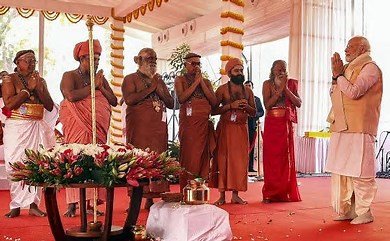
In a recent turn of events, Swami Prasad Maurya, a prominent leader of the Samajwadi Party, has stirred controversy by criticizing the Narendra Modi-led government for allegedly inviting only “fundamentalist Brahmin gurus” for the installation of the sengol, a ceremonial sceptre, during the inauguration of the new parliament building. Maurya expressed his disappointment, asserting that if the government truly believed in India’s secularism and sovereign character, it should have invited religious leaders from all faiths.
Prime Minister Narendra Modi inaugurated the grand Parliament building, a momentous occasion for the nation, and performed a traditional ritual called the “Ganapati Homam” accompanied by Vedic chants. However, Maurya’s remarks cast a shadow over the event, as he questioned the exclusion of leaders from diverse religious backgrounds. He argued that representatives from Buddhist, Jain, Sikh, Muslim, and Christian communities should have been invited, emphasizing the need for inclusivity and respect for all faiths.
By accusing the government of displaying a “vile mentality” and promoting “Brahminism,” Maurya’s statements reflect his concern about the BJP’s alleged favoritism towards a specific religious group. He contended that the government’s decision to exclusively invite Brahmin gurus from the southern states further reinforced this perception.
The controversy surrounding the selection of Brahmin gurus raises important questions about the principles of secularism and equality in a diverse nation like India. Critics argue that the government’s actions may inadvertently contribute to the marginalization of other religious communities and undermine the secular fabric of the country.
It is worth noting that Maurya’s criticisms stem from his political affiliation with the Samajwadi Party, as he switched sides from the Yogi Adityanath-led government to join the opposition party. This political backdrop adds another layer to the controversy, as the statement can be seen as an attempt to undermine the ruling party’s credibility.
As the public discourse continues, it is imperative for the government to address these concerns and emphasize its commitment to secularism and inclusivity. Engaging in a constructive dialogue with leaders from diverse religious backgrounds could help bridge the gap and promote a sense of unity among all sections of society.
The controversy surrounding the selection of Brahmin gurus for the installation of the sengol during the parliament building’s inauguration has sparked a debate on the government’s commitment to secularism and inclusivity. Swami Prasad Maurya’s remarks have brought attention to the need for equal representation of religious leaders from various faiths. As India moves forward, it is crucial for the government to foster an environment that embraces diversity and respects the pluralistic nature of the nation.