


Maharashtra Deputy Chief Minister Eknath Shinde has announced an ambitious plan to construct 30 lakh affordable homes across Mumbai and the Mumbai Metropolitan Region, or MMR, over the next two decades.
The state government aims to complete the massive housing target by 2047. The plan includes 10 lakh homes within Mumbai and another 20 lakh homes across key cities in the wider metropolitan region.
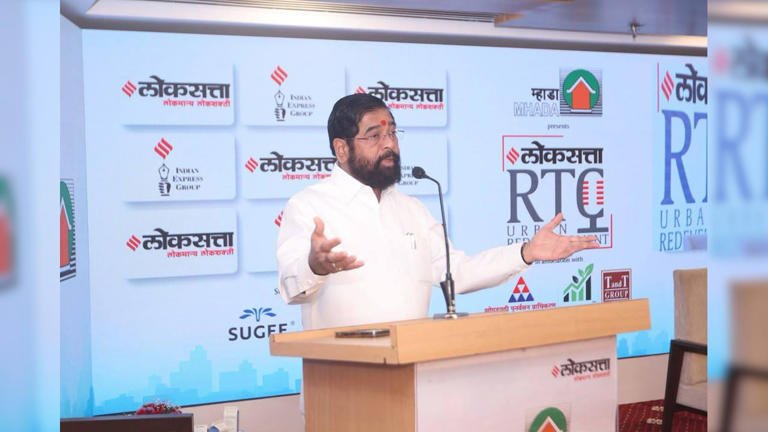
Shinde outlined the government’s housing vision while speaking at a housing and infrastructure conclave in Mumbai. He said the administration wants to accelerate redevelopment, improve urban infrastructure and create more housing opportunities for ordinary citizens.
The proposed housing programme forms part of a wider vision for Mumbai’s future. The government also plans to promote redevelopment, strengthen infrastructure and develop new urban centres around the Navi Mumbai International Airport.
Maharashtra sets target of 30 lakh affordable homes
The Maharashtra government has set a target of constructing 30 lakh affordable homes across Mumbai-MMR.
According to Shinde, the government plans to complete the target by 2047. The initiative will address the growing demand for housing in one of India’s largest urban regions.
Mumbai continues to face a major shortage of affordable housing. High property prices make home ownership difficult for many middle-income and lower-income families.
The government’s new plan seeks to expand the supply of homes across the metropolitan region. Authorities expect redevelopment and housing schemes to play a major role in achieving the target.
Shinde said the government wants to push development at a faster pace. He described the administration’s approach as one focused on removing obstacles and speeding up key projects.
The plan could become one of the largest housing initiatives announced for the Mumbai metropolitan region.
Mumbai to get 10 lakh new homes
Mumbai itself will account for around 10 lakh of the proposed 30 lakh affordable homes.
The Slum Rehabilitation Authority, or SRA, will play a major role in the programme. The government plans to construct around six lakh homes through SRA projects.
Another four lakh homes will come through the Maharashtra Housing and Area Development Authority, or MHADA, and other housing schemes.
The plan places redevelopment at the centre of Mumbai’s housing strategy.
Many parts of the city contain ageing and dilapidated buildings. Redevelopment projects could create new housing while improving safety and infrastructure.
Shinde highlighted the importance of the Unified Development Control and Promotion Regulations, or UDCPR. He said the framework has helped create a path for redevelopment projects involving old and unsafe buildings.
The government also plans to use cluster redevelopment to transform larger areas. This approach can allow authorities to redevelop groups of buildings and improve public infrastructure simultaneously.
Remaining 20 lakh homes planned across MMR
The wider Mumbai Metropolitan Region will receive the remaining 20 lakh homes under the government’s proposed plan.
These homes are expected to come up in Thane, Mira-Bhayander, Kalyan-Dombivli, Navi Mumbai, Ulhasnagar and Bhiwandi.
The distribution of housing across several cities could reduce pressure on Mumbai.
Greater availability of homes in neighbouring urban centres may also encourage more balanced development across the region.
The MMR has expanded rapidly over the years. Improved road, rail and metro connectivity has strengthened links between Mumbai and surrounding cities.
The government’s housing strategy appears to combine large-scale construction with infrastructure development.
New residential areas will require reliable transport, water supply, healthcare facilities and other essential services.
Shinde’s announcement places housing within a broader urban development framework.
Cluster redevelopment to reshape older areas
Cluster redevelopment will form another important part of the government’s urban development strategy.
The model allows authorities to redevelop larger groups of old or unauthorised structures instead of dealing with individual buildings separately.
According to Shinde, cluster development projects could also provide several civic facilities for residents.
These amenities may include digital libraries, community halls, primary health centres and centres focused on women’s empowerment.
The government believes that this approach can improve living conditions in densely populated neighbourhoods.
Redevelopment can also create opportunities to upgrade roads, drainage systems and public spaces.
However, large redevelopment projects require coordination between residents, developers and government agencies.
The success of the housing plan will therefore depend on effective implementation and timely approvals.
UDCPR expected to support redevelopment drive
Shinde highlighted the Unified Development Control and Promotion Regulations as an important tool for Mumbai’s redevelopment efforts.
The regulations provide a common planning framework for development and construction in Maharashtra’s urban areas.
According to the deputy chief minister, the approval of the UDCPR has helped remove barriers that previously slowed redevelopment.
The framework could support projects involving old and dilapidated buildings.
Many Mumbai residents live in ageing structures that require urgent redevelopment.
The government’s housing strategy seeks to address this challenge while adding new homes to the city’s overall housing stock.
Faster redevelopment could also help unlock land for planned development.
Authorities will need to balance the need for speed with planning requirements and infrastructure capacity.
Third Mumbai vision linked to wider development plans
Shinde also discussed the government’s broader vision for a proposed “Third Mumbai.”
The plan focuses on development around the Navi Mumbai International Airport, the Atal Setu, Jawaharlal Nehru Port Authority and the Samruddhi Mahamarg.
The government sees this area as a major growth zone for the coming decades.
The proposed development could include an Aerocity, Medicity, Sports City, Edu City and an IT-fintech hub.
Shinde described the project as a long-term vision that could shape the region’s growth over the next 50 years.
The wider development strategy could also influence future housing demand.
As new business and infrastructure projects emerge, authorities expect more people to move towards developing urban centres.
Affordable housing will remain essential to support this growth.
The government therefore appears to view the 30 lakh homes target as part of a much larger transformation of Mumbai-MMR.
Infrastructure development remains a key priority
Housing alone cannot address the challenges of rapid urban growth.
The Maharashtra government is also focusing on transport and infrastructure projects.
Shinde highlighted the proposed Thane Internal Ring Metro project, which Mahametro will execute.
The project aims to reduce traffic congestion and improve travel within Thane.
Improved transport links could make neighbouring cities more attractive for people who work in Mumbai.
This may support the government’s plan to distribute new housing across the wider metropolitan region.
Infrastructure will play a critical role in determining the success of the housing programme.
Residents will need access to workplaces, schools, hospitals and other services.
Planning authorities must therefore coordinate housing construction with infrastructure expansion.
Government targets completion by 2047
The Maharashtra government has set 2047 as the deadline for completing all 30 lakh affordable homes.
Shinde said the administration intends to achieve the target by that year.
The plan represents a long-term commitment rather than a short-term construction programme.
Over the next two decades, the government will need to identify land, secure approvals and coordinate several agencies.
SRA and MHADA will have important roles in the programme.
Private developers and other stakeholders may also contribute through redevelopment and housing schemes.
The scale of the plan will require sustained policy support.
Any delays in land acquisition, approvals or infrastructure development could affect progress.
A major housing vision for Mumbai-MMR
Eknath Shinde’s announcement outlines an ambitious roadmap for affordable housing across Mumbai and the wider MMR.
The plan aims to construct 30 lakh homes by 2047.
Mumbai will account for 10 lakh homes. The remaining 20 lakh units will spread across major cities in the metropolitan region.
The strategy combines affordable housing with redevelopment, infrastructure and long-term urban planning.
Cluster redevelopment and UDCPR will support efforts to transform ageing neighbourhoods.
Meanwhile, the proposed Third Mumbai could create a new growth centre around major transport and infrastructure projects.
The success of the plan will depend on implementation over the coming years.
If the government meets its target, the programme could significantly expand housing opportunities across one of India’s fastest-growing metropolitan regions.
For now, the announcement signals Maharashtra’s intention to place affordable housing at the centre of its long-term vision for Mumbai and the MMR.