


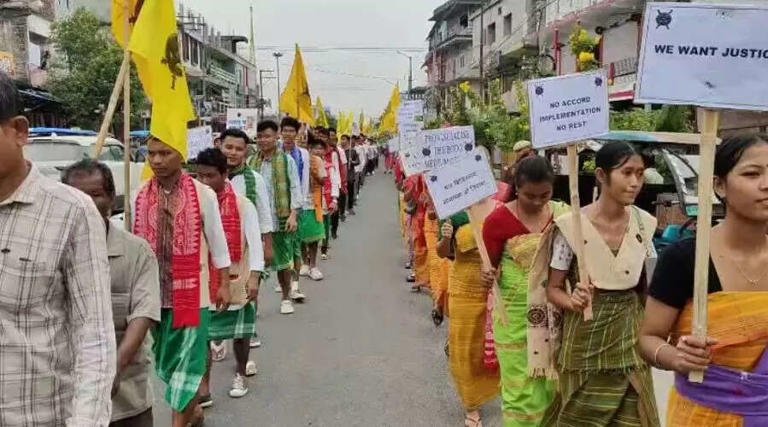
Thousands of people gathered across Assam’s Bodo-dominated areas this week as the All Bodo Students Union (ABSU) led massive protests demanding the full implementation of the Bodo Accord. Demonstrators marched through the streets, waving flags and chanting slogans that called on the state and central governments to fulfill their commitments made under the 2020 peace agreement.
The rallies, organized in Kokrajhar, Chirang, and Baksa districts, witnessed large participation from students, community leaders, and civil society organizations. Protesters carried banners urging the authorities to expedite measures promised in the Bodo Accord, including economic development, political safeguards, and administrative empowerment for the Bodoland Territorial Region (BTR).
Read More: Assam to Donate GST from Zubeen Garg’s Last Film to His Foundation
Addressing the gathering in Kokrajhar, ABSU president Dipen Boro said that while the Bodo Accord was signed to bring lasting peace to the region, many of its key provisions remain unfulfilled. “We supported the Accord with the hope that it would ensure peace, dignity, and progress for our people. But after nearly five years, several clauses are still pending. The delay shows the government’s lack of seriousness,” Boro stated.
He emphasized that the Bodo Accord implementation must not remain symbolic. According to him, issues such as land rights, job reservations, and financial packages for socio-economic development are yet to be addressed. He also criticized the slow progress in forming new administrative councils and transferring departments to the BTR government.
Background of the Bodo Accord
The third Bodo Accord was signed on January 27, 2020, between the Government of India, the Government of Assam, the All Bodo Students Union, and several factions of the National Democratic Front of Bodoland (NDFB). The agreement aimed to end decades of insurgency and establish a framework for peace and development in the Bodoland region.
The accord promised enhanced autonomy through the Bodoland Territorial Region, increased central funding, and protection of Bodo cultural and linguistic identity. It also pledged the rehabilitation of former militants and special economic packages for infrastructure and education.
However, the ABSU and other stakeholders allege that many promises have not been kept. The transfer of powers to the BTR administration remains incomplete, and several projects under the development package have not started. The Bodo Accord implementation thus remains a pressing issue for the region’s people.
Protesters’ Key Demands
During the rallies, the ABSU outlined several key demands. The first is the immediate release of all pending funds promised under the Bodo Accord’s development plan. The second concerns the implementation of land and forest rights for indigenous communities. The union also demanded the quick formation of a commission to resolve boundary disputes between the BTR and adjoining districts.
Protesters further called for the inclusion of Bodo language in the Eighth Schedule of the Constitution. Many placards at the protest read, “Implement Bodo Accord in letter and spirit” and “Justice delayed is peace denied.” The movement reflected growing frustration among locals who feel neglected by both state and central authorities.
Student groups from neighboring districts also joined the demonstrations, showing solidarity with the Bodo people’s cause. They argued that full implementation of the Accord would benefit not only the Bodos but also other communities living in the region by ensuring stability and inclusive development.
Government’s Response
In response to the protests, Assam government officials said that several steps have already been taken toward the Accord’s implementation. They pointed out that the Bodoland Territorial Council (BTC) has been strengthened, new administrative infrastructure is being developed, and projects worth hundreds of crores have been initiated.
A senior official from the Home Department said that the government remains committed to completing the Bodo Accord implementation. “Many promises are in progress. Development projects take time, and we are working in coordination with the central government to ensure that each commitment is fulfilled,” the official said.
Chief Minister Himanta Biswa Sarma also expressed his government’s willingness to engage in dialogue with ABSU and other stakeholders to address unresolved issues. He reiterated that peace and progress in the Bodoland region remain among the government’s top priorities.
Public Sentiment and Regional Impact
Despite assurances from the government, public sentiment in the BTR remains tense. Many locals feel that the benefits of the Accord have not reached the grassroots level. Several speakers at the protests claimed that unemployment and poor infrastructure continue to affect the region’s youth.
Community leaders urged both governments to take immediate steps before the frustration leads to renewed unrest. “The Bodo Accord was a symbol of peace and unity. If the promises are not met, people will lose faith in the system,” warned an ABSU activist in Udalguri.
Political observers say the protests signal a growing impatience among the people who had placed their hopes on the 2020 agreement. They added that fulfilling the Accord’s terms is essential not just for the Bodos but for overall peace in Assam.
The Road Ahead
ABSU announced that it would continue its campaign until the government gives a concrete timeline for completing the Bodo Accord implementation. The organization plans to hold awareness drives and peaceful sit-ins in all four BTR districts over the coming months.
The central government, too, has expressed interest in reviewing the Accord’s progress. Reports suggest that a joint committee may soon be formed to monitor implementation and ensure timely execution of pending promises.
For now, the protests stand as a reminder of the challenges in translating peace agreements into practical outcomes. The Bodo Accord remains one of the most important milestones in Assam’s history, but its success depends on consistent efforts and honest dialogue.
The ABSU’s movement has once again drawn national attention to the region’s aspirations. As one protester in Kokrajhar put it, “We fought for peace and dignity. We only ask the government to keep its word.” The coming months will determine whether the government’s response can turn that demand into reality and restore faith in the accord that once promised a new dawn for Bodoland.