


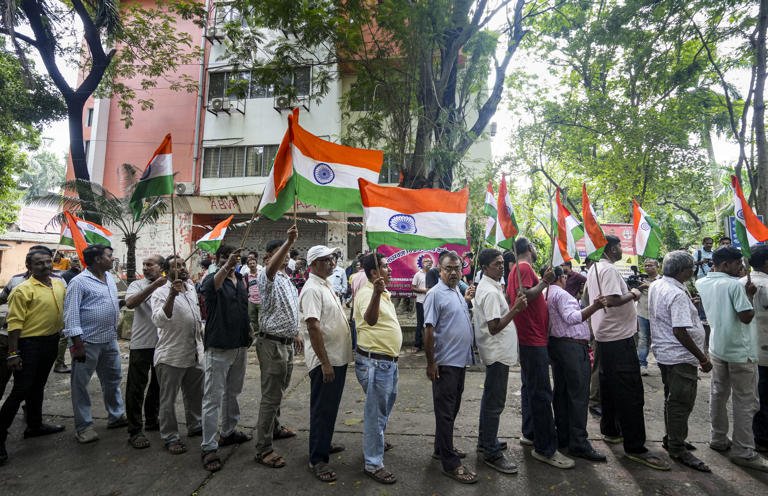
Jadavpur University witnessed rival political mobilisations as the Akhil Bharatiya Vidyarthi Parishad, or ABVP, and the Students’ Federation of India, or SFI, held separate marches in and around the campus amid an escalating row over nationalism and campus politics.
The ABVP organised a Vande Mataram march inside the university premises, while the SFI held a counter-march outside the campus along Raja Subodh Mullick Road. Police erected barricades to prevent the two groups from coming face-to-face.
The rival programmes reflected the growing ideological confrontation at one of West Bengal’s most politically active universities. Students, teachers and non-teaching employees participated in the events, turning the campus and its surroundings into competing spaces for opposing political narratives.
The latest mobilisation came after weeks of tension, clashes and controversy surrounding political graffiti and slogans on the Jadavpur University campus. The issue has now expanded into a wider debate over nationalism, freedom of expression and the role of political organisations within educational institutions.
ABVP Takes Out Vande Mataram March Inside Campus
The ABVP organised its march inside Jadavpur University ahead of a nationalist conference held at the Triguna Sen Auditorium.
The procession began near Aurobindo Bhavan, the university’s administrative headquarters. Participants carried the national flag and raised slogans including Vande Mataram and Bharat Mata Ki Jai.
The ABVP said the programme aimed to promote nationalism on the campus. The organisation also said it opposed what it described as anti-national slogans and activities at the university.
Students, teachers and non-teaching staff took part in the programme, according to reports.
The march moved through different parts of the campus before the nationalist conference began.
The ABVP’s mobilisation represented a strong visual and political response to the controversy surrounding wall graffiti and slogans at the university in recent days.
Portraits and Constitutional Illustrations Displayed
ABVP members also used the campus space to present what they described as an alternative political and cultural message.
The organisation displayed portraits of prominent personalities, including Rabindranath Tagore, at the university gate.
ABVP activists also displayed illustrations by renowned artist Nandalal Bose. These illustrations form part of the visual heritage associated with the Constitution of India.
The displays appeared to respond directly to controversial graffiti and political messages that had recently appeared on campus walls.
Political graffiti has become a major point of confrontation at Jadavpur University.
Left-affiliated student groups had earlier repainted political graffiti after authorities or unidentified individuals whitewashed some of the wall art. The SFI described its campaign as an effort to reclaim political expression on campus.
The ABVP’s latest displays added another layer to the contest over who controls the university’s political and visual spaces.
The campus has now become a site for competing expressions of nationalism, political identity and student activism.
SFI Organises Counter-March Outside Jadavpur University
While the ABVP marched inside the university, the SFI and other Left student organisations organised a counter-march outside the campus.
The SFI procession moved along Raja Subodh Mullick Road.
The Left student organisation opposed what it described as an attempt to impose a particular political interpretation of nationalism on the university.
SFI leaders and supporters argued that Jadavpur University has a long history of student activism and political debate.
They maintained that nationalism should not become a tool for limiting political expression on campus.
The SFI also criticised the involvement of organisations linked to the RSS and BJP in the wider controversy.
The rival processions therefore represented two sharply different positions.
The ABVP presented its programme as a defence of nationalism and opposition to alleged anti-national activities.
The SFI, meanwhile, framed its protest as resistance against political polarisation and the imposition of a particular ideological narrative.
The two organisations effectively occupied separate political spaces inside and outside the university.
Police Barricades Prevent Face-Off Between Rival Groups
Police maintained a strong presence around Jadavpur University during the rival programmes.
Authorities erected barricades outside the campus to prevent SFI activists from moving closer to the ABVP programme.
The security measures aimed to avoid a direct confrontation between the two groups.
The precaution was significant because Jadavpur University has witnessed clashes between ABVP members and Left student organisations in recent weeks.
Earlier confrontations led to allegations of violence from both sides and prompted heavy police deployment around the university.
Police had also faced confrontations with protesters during previous demonstrations by the rival student groups.
Thursday’s programmes remained physically separated, allowing the rival organisations to hold their marches without a direct face-off.
However, the competing demonstrations demonstrated that political tensions at the university remain high.
Nationalist Conference Adds to Political Significance
The ABVP’s Vande Mataram march took place before a nationalist conference organised at the Triguna Sen Auditorium.
The event was organised by the Haripada Bharati Smriti Raksha Committee.
Haripada Bharati was associated with the early organisational history of the BJP in West Bengal and served as the founding president of the party’s state unit in 1980.
The conference added further political significance to the day’s events.
The gathering brought the broader debate surrounding Jadavpur University into the context of West Bengal’s larger ideological contest.
The campus has traditionally remained a strong centre of Left student politics.
The increasing activity of ABVP and other groups linked to the BJP has therefore created a new political contest within and around the university.
The nationalist conference, combined with the ABVP march and the SFI counter-protest, transformed the day into another major episode in the ongoing political confrontation.
Graffiti Row Remains at the Centre of Tensions
The latest rival marches did not emerge in isolation.
Jadavpur University has witnessed growing tensions over wall graffiti, political slogans and competing claims about nationalism.
The controversy intensified after some political graffiti on campus walls was whitewashed.
Left-affiliated student groups responded by repainting the walls and launching a campaign described as “Reclaim the Wall.”
The students argued that the removal of political graffiti represented an attack on freedom of expression and the university’s long tradition of political engagement.
The controversy soon expanded beyond wall art.
Questions about anti-national slogans, Vande Mataram, student politics and political influence on campus became part of the wider debate.
The ABVP has used the issue to argue for a stronger assertion of nationalism within the university.
The SFI and other Left organisations have opposed what they see as attempts to reshape the university’s political culture through ideological pressure.
Recent Clashes Deepen Campus Polarisation
The latest marches also followed clashes between ABVP and Left student groups at Jadavpur University over the past two weeks.
An earlier confrontation during a student union-related meeting triggered further protests and counter-protests.
Both sides accused each other of violence.
The situation escalated as rival groups organised marches towards the university.
Police deployed additional personnel and erected barricades to control the demonstrations.
The confrontations placed Jadavpur University at the centre of political attention in West Bengal.
The recent unrest has also increased concerns about the impact of ideological confrontations on the academic environment.
Student organisations continue to maintain sharply opposing positions.
As a result, even cultural programmes, wall art and patriotic songs have become part of a larger political battle.
Battle Over Nationalism and Campus Politics Intensifies
At the heart of the latest confrontation lies a deeper disagreement over nationalism and political expression.
The ABVP argues that universities should not provide space for activities or slogans that it considers anti-national.
Its Vande Mataram march was intended to reinforce its position that national identity and patriotic values should receive greater prominence on campus.
The SFI has taken a different view.
The Left student organisation argues that universities must remain spaces for debate, dissent and political expression.
It has opposed what it sees as efforts to impose a single definition of nationalism.
These competing positions have created an increasingly polarised atmosphere.
The disagreement now extends beyond student elections or routine campus issues.
It has become part of a larger ideological conflict between Left politics and Hindutva-oriented student politics in West Bengal.
Jadavpur University has consequently emerged as one of the most prominent sites for this wider political contest.
Jadavpur University Remains a Major Political Flashpoint
The ABVP SFI rival marches at Jadavpur University have demonstrated that the nationalism row shows little sign of easing.
The two organisations held competing programmes on the same day, presenting sharply different visions of the university and its political culture.
The ABVP marched inside the campus with national flags and slogans of Vande Mataram and Bharat Mata Ki Jai.
The SFI responded with a counter-march outside the university, opposing what it described as ideological imposition and political polarisation.
Police barricades prevented the rival groups from coming face-to-face.
However, the demonstrations made clear that the ideological confrontation continues.
The dispute over graffiti, slogans and nationalism has now become a larger debate about freedom of expression and political activity in educational institutions.
With recent clashes still fresh and rival student organisations continuing their mobilisation, Jadavpur University remains a major flashpoint in West Bengal’s broader political battle.
The coming days will determine whether the competing groups can continue their political activities peacefully or whether the escalating ideological divide leads to further confrontation around one of the state’s most politically active campuses.