


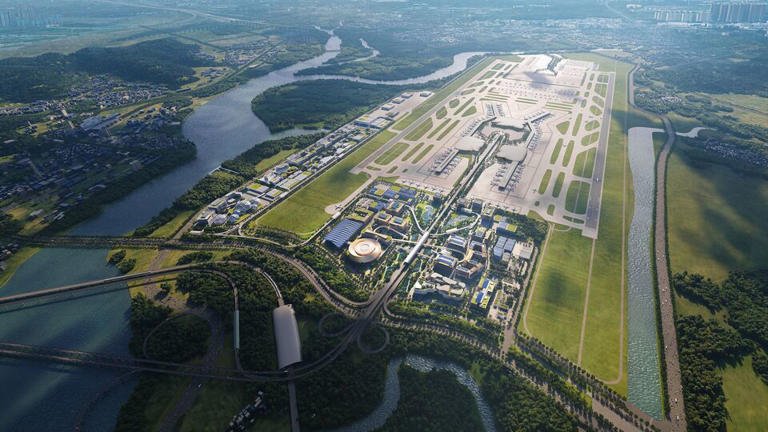
The Adani Group has unveiled plans to develop Changi-inspired airport cities across five Indian states with an initial investment of ₹20,000 crore, marking one of the country’s most ambitious airport infrastructure and urban development initiatives. The proposed airport cities are envisioned as integrated economic hubs combining aviation, commercial, hospitality, retail, logistics, business, and entertainment infrastructure around major airports managed by the group.
Inspired by Singapore’s globally acclaimed Changi Airport model, the project seeks to transform airports into multi-functional urban centres that extend far beyond traditional passenger terminals. The development is expected to create new opportunities for investment, employment, tourism, trade, and regional economic growth while strengthening India’s aviation infrastructure.
According to company officials, the airport city concept aligns with India’s rapidly expanding aviation sector and the increasing demand for world-class infrastructure capable of supporting long-term economic development.
Vision for Integrated Airport Cities
The proposed airport cities are designed to become integrated urban ecosystems where aviation infrastructure serves as the foundation for broader commercial and economic development.
Rather than functioning solely as transportation hubs, these airport cities will incorporate business districts, hotels, shopping centres, convention facilities, logistics parks, office complexes, entertainment zones, healthcare institutions, and residential developments.
Officials believe that such integrated planning creates vibrant economic centres capable of attracting investment while improving passenger experiences and supporting regional development.
The airport city model has gained global recognition for maximizing the economic potential of airport infrastructure beyond aviation operations.
Inspired by Singapore’s Changi Airport
The proposed developments draw inspiration from Singapore’s Changi Airport, widely regarded as one of the world’s leading aviation and airport management models.
Changi combines efficient passenger services with extensive retail facilities, hotels, business centres, entertainment attractions, green spaces, and tourism infrastructure, creating a destination that serves both travellers and local residents.
The Adani Group aims to adopt similar concepts by integrating commercial, hospitality, and recreational facilities with airport operations in India.
Officials noted that adapting successful international models to Indian conditions can significantly enhance the country’s airport infrastructure and passenger experience.
Initial Investment of ₹20,000 Crore
The company plans to invest approximately ₹20,000 crore during the initial phase of the airport city programme.
The investment will support the development of commercial infrastructure, transportation connectivity, public utilities, logistics facilities, hospitality projects, and supporting urban infrastructure surrounding selected airports.
Large-scale infrastructure investments of this nature are expected to stimulate economic activity while encouraging additional private investment over time.
Officials indicated that the airport city projects will be developed in phases based on regional demand, passenger traffic, commercial opportunities, and long-term planning objectives.
The initiative represents a significant addition to India’s infrastructure development landscape.
Development Across Five States
The airport city programme will initially focus on airports located across five states where the Adani Group manages aviation infrastructure.
Although each project will be tailored to local conditions, the overall objective is to create integrated urban centres capable of supporting business growth, tourism, logistics, and regional development.
Officials believe that airport-led development can transform surrounding areas into major economic corridors while strengthening connectivity between cities, industries, and global markets.
The projects are expected to complement broader national initiatives promoting infrastructure modernization and urban development.
Boosting Economic Growth
Airport cities are increasingly viewed as important drivers of regional economic development.
By integrating aviation with commercial activities, logistics, hospitality, retail, and business services, these developments create opportunities for sustained investment and employment generation.
Officials believe the proposed projects will stimulate local economies by attracting domestic and international businesses seeking proximity to world-class transportation infrastructure.
Improved connectivity also enhances trade, tourism, exports, and industrial development, creating multiplier effects across various sectors of the economy.
The investment is expected to contribute significantly to long-term economic growth in the participating states.
Creating Employment Opportunities
Large infrastructure projects generate employment throughout both construction and operational phases.
The airport city developments are expected to create jobs across engineering, construction, architecture, hospitality, retail, aviation services, logistics, information technology, facility management, and commercial operations.
Small and medium enterprises are also likely to benefit through increased demand for goods and services associated with the projects.
Officials expect the developments to support entrepreneurship while creating long-term employment opportunities for local communities.
The airport ecosystem will require a diverse workforce spanning multiple industries and professional sectors.
Enhancing Passenger Experience
Beyond commercial development, the airport cities aim to significantly improve passenger convenience and travel experiences.
Integrated facilities such as hotels, shopping centres, restaurants, convention halls, entertainment venues, and digital services will provide travellers with greater comfort and accessibility.
Officials noted that modern airports increasingly function as lifestyle destinations where passengers spend more time before and after their journeys.
Improved amenities also enhance the competitiveness of Indian airports within the global aviation industry.
The proposed developments seek to position Indian airports among the world’s leading aviation hubs.
Strengthening Logistics and Connectivity
Airport cities also serve as important logistics centres by integrating air cargo, warehousing, distribution, and transportation infrastructure.
Improved logistics capabilities facilitate faster movement of goods while supporting manufacturing, exports, e-commerce, and supply chain efficiency.
Officials believe that enhanced connectivity between airports, highways, rail networks, and industrial corridors will strengthen India’s position as a global logistics destination.
Efficient multimodal transportation systems also improve regional competitiveness while supporting industrial expansion.
The projects align with national efforts to modernize logistics infrastructure and reduce transportation costs.
Supporting Sustainable Urban Development
The proposed airport cities are expected to incorporate sustainable urban planning principles wherever feasible.
Modern infrastructure projects increasingly emphasize energy-efficient buildings, green spaces, water conservation, waste management, renewable energy integration, and environmentally responsible construction practices.
Officials stated that sustainability remains an important consideration in long-term infrastructure planning.
Balanced urban development ensures that economic growth is accompanied by environmental responsibility and improved quality of life for surrounding communities.
Smart infrastructure technologies are also expected to support efficient resource management.
Looking Ahead
The airport city initiative represents a long-term infrastructure strategy that extends beyond conventional airport development.
Future phases are expected to expand commercial facilities, strengthen transportation networks, attract global businesses, and create integrated urban ecosystems around aviation infrastructure.
Officials believe that continued investment in airport-led development will contribute significantly to India’s aspirations of becoming a global aviation and logistics hub.
The projects are also expected to support tourism growth, international business, and regional economic transformation over the coming decades.
Conclusion
The Adani Group’s proposal to develop Changi-inspired airport cities across five states with an initial investment of ₹20,000 crore reflects a significant step in India’s evolving infrastructure and aviation landscape. By transforming airports into integrated commercial and urban centres, the initiative seeks to create new opportunities for investment, employment, tourism, logistics, and regional development.
If implemented successfully, the airport city model has the potential to redefine the role of airports in India’s economy by combining world-class aviation infrastructure with business, hospitality, retail, and logistics ecosystems. The projects also underscore the growing importance of airport-led urban development as a catalyst for sustainable economic growth and enhanced global connectivity.