


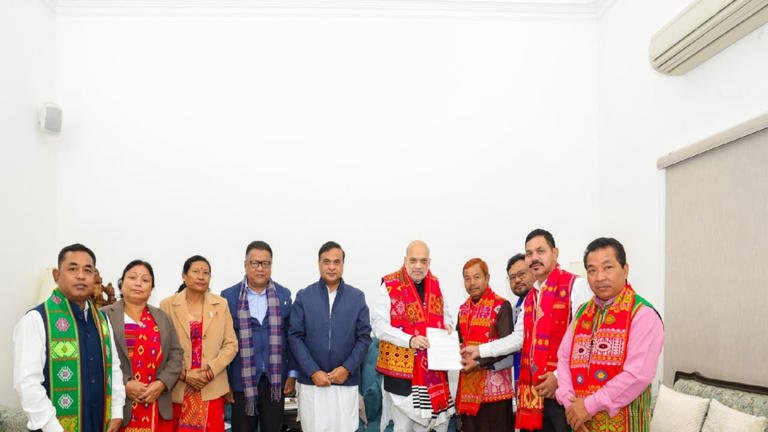
Amit Shah Assam tribal groups engagement took centre stage as the Union Home Minister met representatives of several tribal communities in Assam and assured them of continued dialogue on their long-pending demand for council status. The meeting, held during Shah’s visit to the state, was seen as a significant outreach effort by the Centre to address concerns related to political representation, administrative autonomy, and development.
According to officials, Shah listened to the grievances raised by tribal leaders and emphasised that the Union government remains committed to resolving issues through constitutional and democratic means. As a result, the meeting has raised expectations among tribal groups seeking greater administrative empowerment.
Read More: Tripura Assembly Speaker Biswabandhu Sen Dies in Bengaluru
Amit Shah Assam Tribal Groups Meeting Highlights
The Amit Shah Assam tribal groups meeting brought together representatives from multiple indigenous communities who have been demanding either autonomous council status or enhanced powers for existing councils. During the interaction, leaders highlighted issues related to governance, land rights, and development gaps in tribal-dominated areas.
Moreover, they stressed that the absence of adequate administrative autonomy has affected grassroots decision-making. Consequently, tribal representatives urged the Centre to expedite discussions on their demands.
In response, Shah assured them that their concerns would be examined carefully. He reiterated that dialogue remains the preferred path to resolving sensitive issues, especially those linked to identity and self-governance.
Demand for Council Status and Autonomy
The demand for council status has been a long-standing issue in Assam. Several tribal groups have sought autonomous councils under constitutional provisions to ensure better control over local governance and development planning. According to tribal leaders, such councils would help preserve cultural identity while improving administrative efficiency.
Amit Shah Assam tribal groups discussions also touched upon the need for clarity on the structure and powers of proposed councils. Therefore, leaders sought assurance that any future arrangement would provide meaningful authority rather than symbolic representation.
Officials said the Home Minister acknowledged the complexity of the issue. As a result, he stressed the need for consensus-building among stakeholders before any final decision.
Assurance of Continued Dialogue
Union Home Minister Amit Shah assured tribal leaders that the Centre would continue consultations with the state government and community representatives. According to him, inclusive dialogue is essential to ensure that solutions are sustainable and acceptable to all parties.
Furthermore, Shah emphasised that the government does not want to impose decisions without adequate discussion. Therefore, he encouraged tribal groups to engage constructively in future talks.
He also highlighted that several peace accords and council arrangements in the Northeast were achieved through dialogue. Consequently, he expressed confidence that similar engagement could address Assam’s tribal aspirations.
Role of Assam Government in the Process
The Assam government is expected to play a crucial role in facilitating discussions on council status. Officials said coordination between the Centre and the state would be essential to move forward.
Amit Shah Assam tribal groups meeting reportedly included discussions on aligning state policies with constitutional provisions. Therefore, the state government may initiate follow-up consultations at the district and community levels.
State leaders present at the meeting assured tribal representatives that their demands would be conveyed accurately. Additionally, they stressed that development and peace remain key priorities for the administration.
Development and Welfare Concerns Raised
Beyond council status, tribal leaders raised concerns about development deficits in their areas. Issues related to infrastructure, education, healthcare, and employment were discussed in detail.
According to participants, tribal regions often lag behind due to geographical challenges and limited administrative reach. Therefore, they urged the Centre to strengthen targeted welfare schemes.
Shah responded by highlighting ongoing central initiatives aimed at tribal welfare. Moreover, he said improved governance structures could enhance the delivery of such schemes.
Political and Social Significance of the Meeting
The Amit Shah Assam tribal groups interaction holds political significance, especially in the context of Assam’s diverse social fabric. Addressing tribal aspirations through dialogue is seen as crucial for long-term stability.
Political observers noted that the meeting could help reduce mistrust and create a platform for negotiation. At the same time, they cautioned that managing expectations would be important, given the sensitivity of the issue.
Nevertheless, the assurance of dialogue has been welcomed by several tribal organisations as a positive step.
Way Forward on Council Status Discussions
Looking ahead, officials said the process would involve further consultations, legal examination, and stakeholder engagement. Therefore, no immediate decision on council status is expected.
However, the Amit Shah Assam tribal groups meeting has reopened channels of communication that had remained dormant for some time. As a result, tribal leaders expressed cautious optimism about progress.
Ultimately, the issue of council status remains intertwined with questions of identity, governance, and development. By reaffirming dialogue as the way forward, the Centre has signalled its intent to address these concerns through democratic engagement rather than confrontation.
Read More: Assam Govt to Seek Early HC Ruling on Grazing Land Eviction