


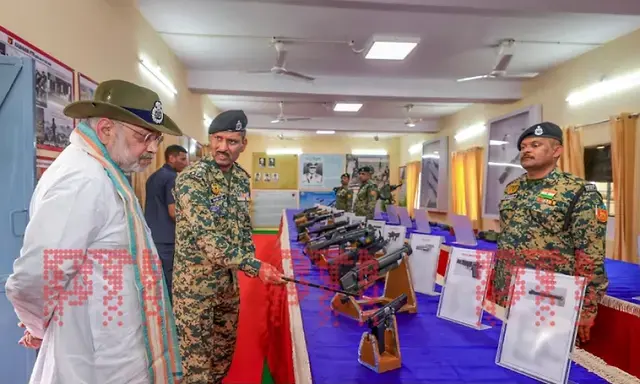
Union Home Minister Amit Shah called for the creation of a “quadrangular security grid” to strengthen protection along India’s international borders and improve coordination among agencies responsible for national security and border management.
The proposal reflects the Centre’s continued emphasis on adopting a broader and more integrated approach to border security. Officials stated that the objective is to combine surveillance, administration, intelligence, and institutional coordination to improve preparedness and strengthen response mechanisms in sensitive regions.
The Home Minister’s remarks came during discussions related to border governance and security planning and highlighted the government’s focus on creating a more comprehensive security framework.
Amit Shah Proposes Quadrangular Security Grid
During discussions on border management, Amit Shah stressed the need to move beyond traditional security approaches and adopt what he described as a quadrangular security grid.
According to officials, the proposed model aims to create stronger coordination among multiple institutions involved in protecting border regions.
The approach seeks to improve communication, reduce operational gaps, and strengthen monitoring systems.
Authorities indicated that modern border security increasingly depends on integration across departments rather than isolated operations.
The Home Minister stated that coordinated structures can improve efficiency and strengthen the country’s overall security architecture.
Officials also highlighted that stronger institutional links may support quicker decision-making and better implementation.
The proposal therefore reflects an effort to modernise border governance mechanisms.
Integrated Security Approach Gains Importance
Officials explained that changing security challenges require more comprehensive systems capable of addressing different forms of risk.
Border management today extends beyond physical deployment and includes intelligence gathering, administrative oversight, digital monitoring, and infrastructure planning.
Authorities stated that integrated approaches allow agencies to respond more effectively and improve coordination across regions.
The proposed security grid aligns with broader efforts to create stronger links between operational and administrative systems.
Officials believe coordinated structures help improve surveillance and reduce vulnerabilities.
The government has increasingly emphasised integrated planning in sensitive border areas.
The latest proposal reflects this larger strategic direction.
Border Protection Expands Beyond Physical Infrastructure
According to officials, protecting international borders now requires a combination of physical infrastructure and institutional preparedness.
Authorities stated that border management includes monitoring settlements, improving communication systems, strengthening administrative coordination, and integrating technology.
The proposed quadrangular framework seeks to support these objectives.
Officials noted that security systems become more effective when multiple agencies operate with shared priorities and information.
The Centre continues to encourage stronger coordination among departments involved in security planning.
Authorities also stressed the importance of creating long-term systems rather than relying only on reactive measures.
The proposal highlights a shift toward broader governance-based security planning.
Technology And Coordination Seen As Key Components
Officials stated that technology remains an increasingly important element of modern border security.
Digital monitoring systems, information-sharing platforms, and coordinated operational planning have become central to security management.
Authorities believe such tools can improve response capability and strengthen institutional preparedness.
The proposed security grid is expected to place significant emphasis on integration and communication.
Officials noted that technological support can help identify vulnerabilities and improve monitoring.
The government has continued to invest in systems aimed at strengthening border oversight.
The latest proposal reflects this growing focus on technology-driven security.
Centre Continues Focus On National Security
Border management remains an important component of the government’s national security strategy.
Officials stated that improving coordination and strengthening oversight continue to remain central priorities.
Authorities believe that evolving challenges require flexible and modern approaches.
The quadrangular security grid proposal reflects efforts to strengthen preparedness and improve administrative efficiency.
Officials also emphasised that stronger institutional coordination supports both security and governance objectives.
The government continues to focus on systems that improve long-term resilience and reduce vulnerabilities.
The latest remarks underline continuing emphasis on strategic planning.
Focus Turns To Implementation And Coordination
Following Amit Shah’s remarks, attention is expected to move toward how agencies interpret and implement the broader concept of the quadrangular security grid.
Officials may continue discussions regarding institutional roles and operational mechanisms.
Authorities are expected to assess how coordination frameworks can support stronger border management outcomes.
Observers noted that modern security planning increasingly depends on integrated approaches and efficient communication.
The proposal has therefore generated interest among those tracking governance and national security developments.
As discussions continue, the government’s emphasis remains on creating stronger institutional coordination, improving preparedness, and safeguarding India’s borders through a broader and more connected security framework.