


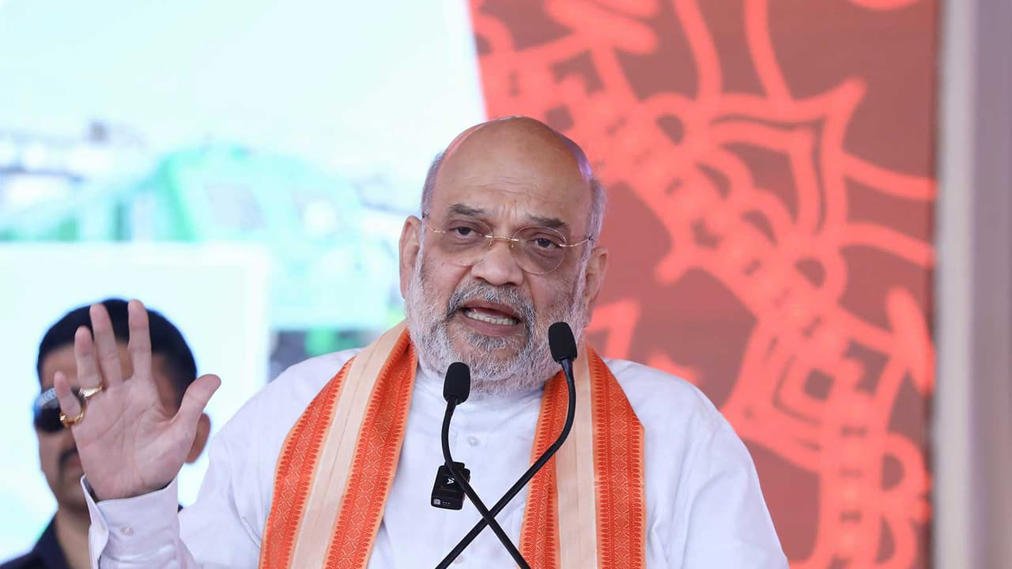
Union Home and Cooperation Minister Amit Shah on Sunday inaugurated, launched and laid foundation stones for several railway projects worth more than Rs 1,542 crore at Sabarmati in Ahmedabad, Gujarat.
The programme also saw the flagging off of India’s first LNG-powered train, marking a move towards alternative-fuel technology in railway operations. The projects cover railway safety, signalling, freight operations, line capacity and fuel efficiency.
India’s First LNG-Powered Train Flagged Off
One of the major highlights of the event was the launch of India’s first LNG-powered train.
The train uses a diesel-LNG dual-fuel system. Two 1,400-horsepower Driving Power Cars at the Sabarmati Integrated Coaching Depot have been converted to operate using both diesel and LNG.
Under the system, LNG can replace around 40 per cent of diesel consumption. The initiative is expected to reduce fuel use and emissions of carbon dioxide, nitrogen oxides and particulate matter.
The launch is part of Indian Railways’ wider efforts to introduce alternative fuels and improve energy efficiency in train operations.
Rs 700 Crore WAG-12 Maintenance Shed
Shah also inaugurated the WAG-12 locomotive maintenance shed at Sabarmati.
The facility has been developed at an estimated cost of Rs 700 crore and will provide maintenance support for up to 300 high-horsepower WAG-12 electric locomotives.
These locomotives have a capacity of around 12,000 horsepower and are designed to haul heavy and long freight trains. The maintenance facility is expected to support freight operations and improve locomotive availability.
Kavach Safety System to Cover 404 Km
Another major component of the railway package is the expansion of the indigenous Kavach automatic train protection system.
The foundation stone was laid for Kavach deployment across 404 km of railway network in the Ahmedabad division. The project covers the 157-km Ahmedabad-Palanpur section and the 247-km Ahmedabad-Samakhiyali section.
Kavach is designed to help prevent train collisions, control overspeeding and reduce risks associated with human error.
The technology is intended to provide an additional layer of safety for train operations.
Automatic Signalling System Introduced
The programme also included the introduction of an automatic block signalling system across 122.57 km of railway sections.
The system covers the Sabarmati-Kalol-Bhandu Motidau and Sabarmati-Sanand-Jakhwada sections. The project has an estimated cost of around Rs 118.83 crore.
Automatic signalling helps maintain safe distances between trains and can allow more efficient movement of trains on busy railway routes.
Sabarmati-Sarkhej Railway Line to Be Doubled
The event also marked the beginning of work to double the 21-km Sabarmati-Sarkhej railway line.
The project has been estimated at around Rs 313.27 crore. It includes work involving Sabarmati, Gandhigram, Vastrapur and Sarkhej stations, along with bridges and road underpasses.
The doubling project is expected to improve train movement and connectivity towards the Sarkhej-Dholera region. It is also intended to support increasing industrial and commercial activity in the area.
The project is targeted for completion by March 2028.
Shah Highlights Railway Modernisation
Addressing the gathering, Shah highlighted the transformation of railway infrastructure and technology in India.
He pointed to the development of high-horsepower WAG-12 locomotives, dedicated freight corridors and indigenous safety technologies such as Kavach.
Shah also highlighted the reduction in railway diesel consumption. According to figures cited during the event, annual diesel consumption declined from 293 crore litres in 2015-16 to 108 crore litres in 2024-25.
He said efforts were continuing to reduce diesel consumption further as railway electrification expands.
Focus on Alternative Energy
The LNG train forms an important part of the projects focused on alternative energy.
The dual-fuel technology allows LNG to substitute part of the diesel requirement while retaining diesel capability. The initiative is expected to help reduce fuel consumption and emissions.
The move comes as Indian Railways continues to explore technologies that can reduce dependence on conventional fuels and support cleaner railway operations.
Sabarmati Railway Station Undergoes Transformation
Shah also highlighted the transformation of Sabarmati railway station and its surrounding connectivity.
He said the station has developed links with the Metro Rail, bus station and bullet train station, improving connectivity for passengers.
Sabarmati is also closely associated with Mahatma Gandhi and the freedom movement. Shah referred to the historical importance of the area while discussing the station’s infrastructure development.
Railway Infrastructure Gets Major Push in Gujarat
The projects launched at Sabarmati bring together several aspects of railway development, including passenger connectivity, freight capacity, signalling, safety and alternative fuel technology.
The WAG-12 maintenance shed will support freight locomotives, while Kavach and automatic signalling will focus on operational safety and capacity.
At the same time, the LNG-powered train introduces dual-fuel technology into railway operations.
Together, the projects represent a significant infrastructure package for the Ahmedabad region and surrounding railway network.
Focus on Safety, Capacity and Cleaner Operations
The Sabarmati programme combines railway infrastructure expansion with technological upgrades.
The Kavach system is aimed at improving train safety, the signalling project can support smoother train movement, and the Sabarmati-Sarkhej doubling project is expected to increase line capacity.
Meanwhile, the LNG-powered train introduces an alternative-fuel option for railway operations.
With these projects, Indian Railways is continuing its focus on expanding infrastructure while introducing new technologies for safety, capacity and energy efficiency across its network.