


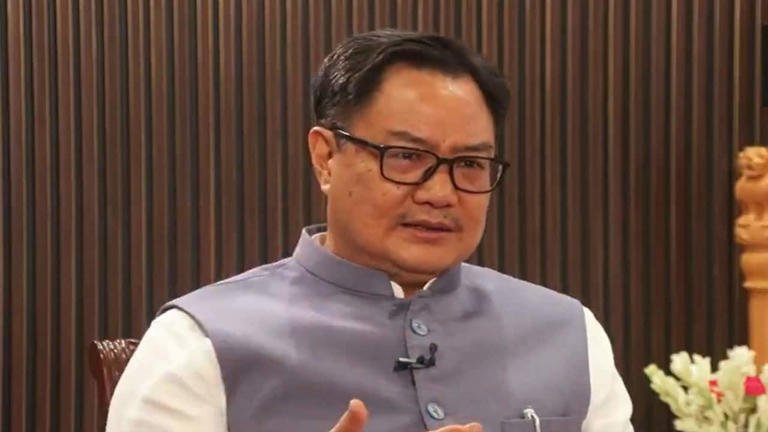
Parliamentary Affairs Minister Kiren Rijiju has left open the possibility of another sitting of Parliament, saying the Monsoon Session has not yet been formally prorogued and the government could summon the Houses again if required.
Rijiju’s remarks have triggered fresh speculation about whether the government may call Parliament for another sitting or use the existing session to take up pending legislative business.
When asked directly whether another sitting or a special session could be on the cards, the minister did not provide a clear answer. Instead, he explained the parliamentary procedure and pointed out that the government can summon Parliament again if the session has been adjourned but not prorogued.
When told that his remarks could be interpreted as leaving the possibility open, Rijiju responded, “You can read both ways.”
Kiren Rijiju leaves possibility of another sitting open
The Monsoon Session of Parliament was adjourned sine die on August 13. However, the session has not yet been formally prorogued.
This distinction has become central to the latest political discussion.
An adjournment sine die ends the current sitting without fixing a date for the next meeting. Prorogation, however, formally brings the parliamentary session to an end.
Rijiju said the government decides when Parliament should be called and requests the President to summon the Houses.
“If the House has not been prorogued, then the session can be called,” he said.
However, the minister stopped short of confirming whether the government was actually planning another sitting.
‘You can read both ways,’ says parliamentary affairs minister
The most significant moment of the interview came when Rijiju was asked whether his comments should be seen as a hint about another Parliament sitting.
Instead of confirming or denying the possibility, the minister replied, “You can read both ways.”
He added that, as Parliamentary Affairs Minister, he remains open to public scrutiny and observation.
However, he did not elaborate further on the government’s plans.
When asked directly whether a special session could be under consideration, Rijiju declined to answer.
“No, that I will not answer,” he said.
His carefully worded response has fuelled speculation without providing a definite indication of the government’s next move.
Why the Monsoon Session status matters
The fact that the Monsoon Session has not been prorogued has raised questions about the government’s options.
If Parliament has merely been adjourned sine die, it can be summoned again as part of the same session.
This means the government may not necessarily need to begin an entirely new parliamentary session.
Rijiju stressed that such a development would not be unprecedented.
He said there had been numerous occasions since 1952 when Parliament was adjourned sine die but not prorogued and was subsequently summoned again.
“It is nothing new which we are doing,” the minister said while referring to parliamentary precedents.
Opposition speculation over pending Bills
The delay in proroguing the Monsoon Session has also prompted questions from the Opposition about the government’s legislative plans.
Attention has focused on whether the government could use another sitting within the existing session to revisit key pending legislation.
According to reports, speculation has centred on the possibility of bringing back the Delimitation Bill and the Women’s Reservation Amendment Bill.
The Delimitation Bill was introduced alongside the Women’s Reservation Bill under the 131st Constitutional Amendment. However, it failed to secure the required two-thirds majority in the Lok Sabha during a three-day special session in April.
Rijiju, however, did not confirm whether either Bill was under consideration for another sitting.
Government retains authority to summon Parliament
Rijiju emphasised that the decision to call Parliament rests with the government.
Under the constitutional and parliamentary process, the government advises the President regarding the summoning of Parliament.
The minister’s explanation focused on the procedural possibility of recalling the Houses before the session is formally prorogued.
That possibility, however, does not amount to confirmation that another sitting will definitely take place.
Rijiju appeared to draw a distinction between what the government can legally and procedurally do and what it may ultimately decide to do.
This distinction explains his “you can read both ways” response.
The government has the option to summon Parliament again while the existing session remains open. Yet the minister has not disclosed whether it intends to exercise that option.
Another sitting would not be unprecedented
Rijiju sought to downplay suggestions that another sitting within the same parliamentary session would represent an unusual development.
He pointed to past instances when Parliament reconvened after being adjourned sine die.
The minister said he could provide a list of such occasions dating back to 1952.
Parliamentary procedure allows for this possibility because adjournment and prorogation have different legal and procedural consequences.
An adjournment sine die does not automatically terminate the session.
The President’s order of prorogation formally concludes it.
Until that happens, the government retains the ability to advise the President to summon the Houses again.
This procedural detail has become the basis of the current speculation surrounding another Parliament sitting.
What could another Parliament sitting mean?
If the government decides to summon Parliament again, it could potentially use the sitting to address pending legislative or other parliamentary business.
However, the agenda would depend entirely on the government’s decision.
Rijiju has not confirmed any specific Bill or issue that could be taken up.
The minister’s remarks therefore leave several possibilities open.
Another sitting could involve regular legislative business. It could also focus on specific government priorities.
Alternatively, the Monsoon Session could simply be prorogued without another sitting.
For now, no formal announcement has clarified the government’s next step.
The uncertainty has allowed political observers and Opposition parties to speculate about possible legislative developments.
Rijiju avoids direct confirmation
Throughout his remarks, Kiren Rijiju avoided making a definitive announcement.
He explained that the government had the authority to call Parliament again.
He also highlighted historical precedents.
Yet he refused to confirm whether another sitting or a special session was actually being planned.
His response appears designed to preserve the government’s options.
By saying that people could “read both ways,” Rijiju acknowledged that his comments could be interpreted as either a hint or simply an explanation of parliamentary procedure.
Until the government makes an official announcement, the question remains unresolved.
Political attention shifts to government’s next move
Rijiju’s comments have placed fresh focus on the government’s parliamentary strategy.
The Monsoon Session’s unusual status has become a subject of political interest because both Houses remain adjourned sine die without formal prorogation.
Any decision to reconvene Parliament could quickly trigger renewed political activity.
The Opposition is likely to closely watch the government’s next move.
A fresh sitting could also bring pending legislation back into focus.
For the government, however, the decision will depend on its legislative and political priorities.
Kiren Rijiju’s remarks keep speculation alive
Kiren Rijiju has not confirmed another Parliament sitting. Yet his remarks have clearly kept the possibility alive.
The Parliamentary Affairs Minister has pointed out that the government can summon Parliament again because the Monsoon Session has not been formally prorogued.
He has also cited several historical precedents to show that such a move would not be unusual.
Still, when pressed for a clear answer, Rijiju chose not to reveal the government’s plans.
His response — “You can read both ways” — has ensured that speculation over another Parliament sitting will continue.
For now, the government’s next move remains uncertain. Whether Parliament meets again before the Monsoon Session is prorogued will depend on a formal decision by the government and an official announcement in the days ahead.