


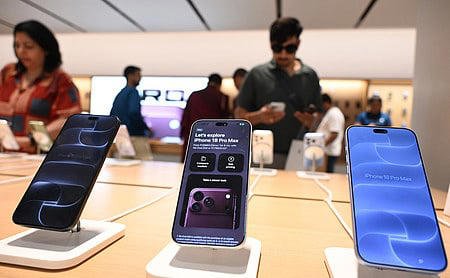
Apple’s decision to limit customers to two iPhones per purchase has drawn attention in India ahead of the launch of its first foldable smartphone, the iPhone Duo. However, industry sources say the restriction is a long-standing practice rather than an entirely new policy.
The company’s Indian online store currently allows customers to purchase a maximum of two iPhones per customer. The limit applies across models, meaning buyers can order two units of the same device or combine two different iPhone models. However, adding a third iPhone to the shopping cart triggers a warning asking customers to reduce the quantity.
The restriction comes just ahead of the iPhone Duo’s scheduled retail launch on October 23, 2026. Pre-orders for the device opened on October 16, amid reports of strong demand and extended delivery timelines.
Although the timing has raised questions about possible supply constraints, Apple has not publicly explained the reason for the current purchase cap. Industry observers say similar restrictions have been used previously to manage demand and discourage bulk buying.
Apple Has Used Purchase Limits Since 2007
Apple’s history of restricting iPhone purchases goes back to the launch of its original smartphone in 2007.
At the time, the company limited customers to two iPhones to discourage bulk purchases and unauthorised resale. The restriction was introduced when demand for the first-generation device was high and supplies were limited.
Apple again introduced purchase restrictions in March 2020, when the COVID-19 pandemic disrupted global supply chains and forced the company to close many of its retail stores outside China. Customers in several markets faced limits on the number of devices they could purchase online.
These earlier instances show that purchase caps are not unprecedented in Apple’s retail operations. The company has used such measures in different circumstances, including product launches and periods of supply uncertainty.
However, the existence of earlier restrictions does not establish that the current policy has the same purpose. Apple has not confirmed whether the latest limit is primarily intended to prevent reselling, manage inventory or address another commercial concern.
Two-Device Cap Applies Across iPhone Models in India
The current restriction on Apple’s Indian online store extends beyond the new iPhone Duo.
Reports indicate that the cap also applies to the iPhone 18 Pro, iPhone 18 Pro Max and earlier models, including the iPhone 17. Customers can purchase two devices in total, regardless of whether they select identical or different models.
For example, a customer may order two iPhone Duo devices or combine one iPhone Duo with one iPhone 18 Pro. However, the website blocks an order containing three iPhones.
This could affect customers planning to buy devices for several family members, purchase gifts or acquire multiple phones in one transaction.
The restriction has also been reported in other markets, including the United States, China, Singapore and Hong Kong. However, purchase rules and availability arrangements can vary between countries.
It also remains unclear how long the current restriction will stay in place or whether it will apply consistently across Apple’s physical stores and authorised retailers.
iPhone Duo Launch Raises Questions About Supply
The timing of the purchase cap has attracted attention because of reports of strong demand for the iPhone Duo.
The foldable smartphone is scheduled to reach retail stores on October 23, following the opening of pre-orders a week earlier. Reports have indicated that delivery estimates for some configurations moved significantly after initial orders were placed, with some customers facing waits extending into January 2027.
Such delays have fuelled speculation about the availability of the new device. A purchase limit could help distribute available stock among more customers if supplies are tight, although Apple has not confirmed that this is the reason for the restriction.
The reported limit may also make bulk buying for resale more difficult. When demand exceeds readily available supply, resellers can purchase devices in large quantities and offer them at higher prices.
Nevertheless, the purchase cap alone does not prove that Apple is facing a specific production shortfall or that resale prevention is its stated objective.
Apple’s Retail Policy Allows Quantity Restrictions
Apple’s published retail policies state that the company may restrict the quantity of products available for purchase because of popularity or supply constraints. It also reserves the right to change purchase quantities.
This gives the company flexibility to adjust order limits as market conditions change.
For Apple, such restrictions can serve as a retail-management tool during periods of unusually high demand. They may also help the company control bulk orders while ensuring that individual customers have an opportunity to purchase new products.
The current limit is therefore consistent with the company’s established ability to impose quantity restrictions. However, Apple’s published policy does not confirm the specific reason behind the two-iPhone cap now appearing on its Indian online store.
What Buyers Should Know
Customers purchasing directly from Apple’s online store in India should check the quantity permitted at checkout before placing an order. Those planning to buy more than two iPhones in one transaction may need to explore alternative purchasing arrangements, subject to the rules followed by individual retailers.
Buyers should also check delivery estimates for their chosen model and storage configuration, particularly ahead of the iPhone Duo’s launch.
Ultimately, the two-iPhone limit is not without precedent in Apple’s history. Earlier restrictions show that the company has previously capped purchases during major launches and periods of disruption.
The latest move has renewed discussion because it coincides with the arrival of Apple’s first foldable smartphone. Yet, without an official explanation, the precise reason for the current restriction remains uncertain.