


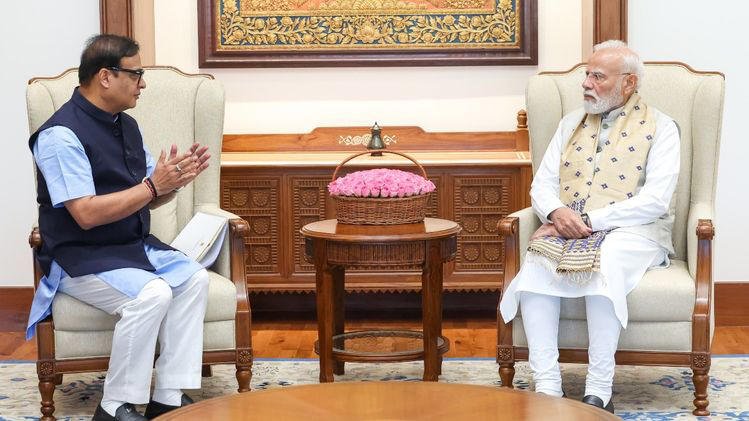
Assam Chief Minister Himanta Biswa Sarma met Prime Minister Narendra Modi in New Delhi to discuss the flood situation in the state, ongoing recovery efforts and the achievements and priorities of the Assam government during its first 100 days in office. The meeting focused on key issues affecting the state, particularly the impact of recurring floods and the measures being taken to provide relief, rehabilitation and long-term support to affected communities.
Floods remain one of Assam’s most serious and recurring challenges, affecting thousands of people and causing widespread damage to homes, agricultural land, roads and other infrastructure. The Chief Minister discussed the situation in flood-affected areas and highlighted the importance of continued support for relief and recovery measures.
The meeting also provided an opportunity for the Assam government to brief the Prime Minister on its work during the first 100 days. The discussion covered governance priorities, development initiatives and the government’s broader plans for the state.
Focus on Assam Flood Recovery and Rehabilitation
The flood situation in Assam continues to require sustained attention, particularly in areas where people have suffered losses to their homes, livelihoods and agricultural activities. During his meeting with the Prime Minister, Sarma discussed the ongoing recovery process and the need to strengthen rehabilitation efforts.
While immediate relief is essential during and after floods, long-term recovery is equally important. Families who lose their homes or sources of income often require continued assistance even after floodwaters recede. Restoring damaged infrastructure, supporting farmers and rebuilding affected communities are therefore major components of the recovery process.
The Chief Minister highlighted the importance of coordinated efforts between the state and the Centre to address these challenges. Central assistance plays a significant role in supporting states during major natural disasters, particularly when the scale of damage requires extensive reconstruction and rehabilitation.
Assam’s geographical location and the presence of the Brahmaputra and its tributaries make the state highly vulnerable to flooding. Heavy rainfall, rising water levels and erosion regularly affect several districts, making disaster preparedness and long-term flood management a continuing priority for the government.
Need for Long-Term Solutions to Flooding
The discussion with Prime Minister Modi also comes against the backdrop of Assam’s continued search for sustainable solutions to its flood problem. Every year, large sections of the state face the threat of flooding, disrupting normal life and affecting economic activity.
While relief camps, emergency services and disaster response teams are important during a crisis, long-term planning is necessary to reduce the overall impact of floods. Strengthening embankments, improving drainage systems, protecting vulnerable riverbanks and developing better early-warning mechanisms can help communities prepare for extreme weather events.
Climate-related changes have also made disaster management increasingly important. Unpredictable rainfall patterns and extreme weather conditions can increase the challenges faced by vulnerable regions.
The Assam government has repeatedly emphasised the need to combine immediate relief measures with long-term infrastructure and environmental planning. The meeting in Delhi underlined the importance of cooperation between the state and the Centre in addressing an issue that affects the lives of millions of people.
Assam Government Reviews First 100 Days
Apart from flood recovery, Sarma also discussed the Assam government’s performance and initiatives during its first 100 days. The initial months of a government are often seen as an important period for setting administrative priorities and beginning the implementation of key promises and policies.
The Chief Minister briefed Prime Minister Modi about the steps taken by the state government and its focus on development, welfare and governance. The first 100 days have been used to establish priorities and push forward initiatives aimed at improving public services and supporting different sections of society.
For any government, the first few months are important for translating political commitments into administrative action. Decisions taken during this period can influence the direction of policy implementation for the rest of the term.
The Assam government has focused on a range of sectors, including infrastructure, welfare, education, healthcare and economic development. The discussion with the Prime Minister allowed the state leadership to present its progress and seek continued support for future initiatives.
Centre-State Coordination Remains Important
The meeting between Sarma and Modi highlighted the importance of strong coordination between the Centre and state governments. Major challenges such as natural disasters, infrastructure development and economic growth often require cooperation across different levels of government.
For Assam, central support is particularly important in areas involving large-scale infrastructure, disaster recovery and regional development. The state has a strategic position in the Northeast and plays an important role in improving connectivity and economic integration across the region.
The Centre has placed significant emphasis on the development of the Northeast in recent years, with a focus on infrastructure, connectivity and investment. Assam, as one of the region’s largest states, has an important role in this broader development strategy.
The Chief Minister’s meeting with the Prime Minister therefore focused not only on immediate concerns but also on Assam’s future development priorities.
Development, Welfare and Governance on the Agenda
The first 100 days of the Assam government have been marked by efforts to advance its development and welfare agenda. Governments often use this period to demonstrate administrative momentum and establish confidence in their ability to deliver on promises.
Development in Assam involves addressing both urban and rural needs. Improving roads, healthcare facilities, educational institutions and employment opportunities remains essential for long-term growth. At the same time, welfare measures are important for supporting economically vulnerable sections of society.
The government also faces the challenge of ensuring that development reaches remote and geographically difficult areas. Several parts of Assam continue to face connectivity and infrastructure challenges, making targeted investment necessary.
Good governance and efficient implementation are equally important. Announcing policies is only the first step; ensuring that their benefits reach the intended people is critical to their success.
Flood Recovery and Development Must Go Together
One of the key messages emerging from the meeting is that disaster recovery and long-term development cannot be treated as separate issues. Rebuilding after floods provides an opportunity to create stronger and more resilient infrastructure.
Roads, bridges, homes and public facilities that are reconstructed with future disasters in mind can reduce vulnerability. Similarly, investments in early-warning systems and disaster preparedness can help protect lives and livelihoods.
For farmers and rural communities, flood recovery must also include support for restoring agricultural activity. Damage to crops and livestock can have long-term economic consequences, making timely assistance essential.
A comprehensive approach to recovery can therefore help affected communities return to normal life while also strengthening their ability to withstand future disasters.
Looking Ahead
The meeting between Assam Chief Minister Himanta Biswa Sarma and Prime Minister Narendra Modi in New Delhi reflected the state’s immediate concerns as well as its longer-term ambitions. Flood recovery remains a pressing issue, particularly for communities that continue to face the consequences of recurring natural disasters.
At the same time, the discussion on the government’s first 100 days highlighted its efforts to move forward with its development and governance agenda. The coming months will be important in determining how these initiatives are implemented and how effectively recovery efforts reach those affected by floods.
With continued cooperation between the Assam government and the Centre, the state aims to address immediate challenges while pursuing long-term development. As Assam works towards rebuilding flood-affected communities and strengthening its infrastructure, the focus will remain on creating a more resilient and prosperous future for its people.