


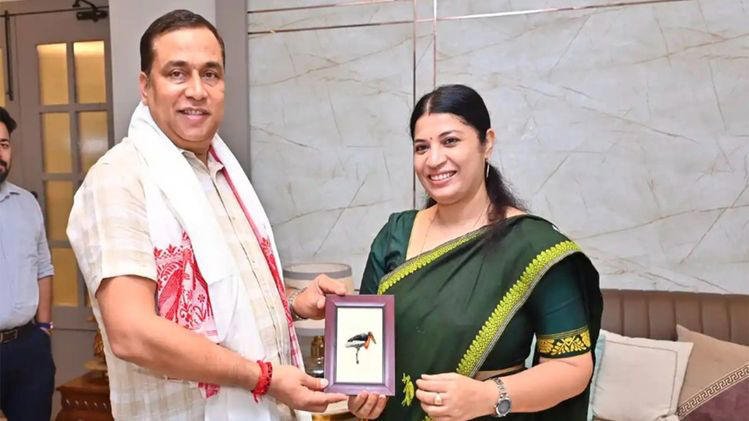
Assam Forest Minister Chandra Mohan Patowary met internationally acclaimed wildlife conservationist Purnima Devi Barman and reaffirmed the state government’s commitment to strengthening conservation efforts for the Hargila, also known as the Greater Adjutant Stork. The meeting focused on expanding collaborative initiatives aimed at protecting the endangered bird species while promoting community participation in conservation programmes across Assam.
During the interaction, the minister appreciated the remarkable contribution made by Purnima Devi Barman in transforming public perception of the Hargila and mobilising local communities to protect the bird and its nesting habitats. He assured that the Forest Department would continue to extend all possible support to ensure the long-term success of conservation initiatives.
The meeting reflects Assam’s growing emphasis on biodiversity conservation and community-led environmental protection as part of its broader ecological preservation strategy.
Recognition of Purnima Devi Barman’s Conservation Efforts
Purnima Devi Barman has earned international recognition for her pioneering work in conserving the Greater Adjutant Stork, one of the world’s rarest large wading birds. Through sustained community engagement and awareness campaigns, she has played a transformative role in changing attitudes toward the species, which was once considered undesirable in many rural communities.
Her innovative conservation model has encouraged local residents, particularly women, to actively participate in protecting nesting trees, rescuing injured birds, and promoting environmental awareness.
During the meeting, the Forest Minister commended her dedication and described her work as an inspiring example of how community participation can significantly contribute to wildlife conservation.
He noted that her efforts have not only helped increase awareness but have also enhanced Assam’s reputation as a leader in community-based conservation.
Government Pledges Enhanced Support
The Forest Minister assured that the Assam government would continue to strengthen its partnership with conservationists, local communities, and environmental organisations working towards the protection of the Hargila.
He emphasised that the Forest Department would explore additional measures to improve habitat conservation, support awareness campaigns, and facilitate scientific monitoring of the bird’s population.
According to the minister, conserving endangered species requires coordinated efforts involving government agencies, researchers, educational institutions, and local communities.
He reiterated that the state remains committed to providing policy support and necessary resources for initiatives that contribute to wildlife preservation and ecological sustainability.
Importance of the Hargila in Assam’s Biodiversity
The Greater Adjutant Stork occupies a unique place in Assam’s rich biodiversity. Despite facing threats from habitat loss, urbanisation, and changing environmental conditions, the bird has become a symbol of successful conservation through community participation.
The minister observed that protecting the Hargila also contributes to preserving wetland ecosystems, which play an essential role in maintaining ecological balance and supporting numerous other species.
He stressed that safeguarding biodiversity is critical not only for environmental sustainability but also for maintaining healthy ecosystems that benefit agriculture, water resources, and local livelihoods.
The meeting highlighted the need to continue protecting natural habitats while encouraging sustainable development practices that minimise ecological degradation.
Community Participation Remains Central
One of the key topics discussed during the meeting was the importance of community involvement in wildlife conservation. Purnima Devi Barman’s conservation model has demonstrated that local communities become the strongest protectors of biodiversity when they actively participate in conservation efforts.
The Forest Minister praised the role of village communities, women’s self-help groups, students, and volunteers in safeguarding Hargila nesting sites and spreading awareness about wildlife conservation.
He noted that government initiatives become significantly more effective when local residents develop a sense of ownership towards protecting their natural environment.
The state government intends to continue encouraging community-led conservation programmes while strengthening partnerships with grassroots organisations working in environmental protection.
Strengthening Wildlife Conservation Initiatives
The meeting also focused on expanding broader wildlife conservation programmes across Assam. The Forest Department continues to implement multiple initiatives aimed at protecting endangered species, restoring habitats, and improving biodiversity management.
Officials discussed the importance of scientific research, habitat monitoring, ecological restoration, and public awareness in ensuring the long-term survival of vulnerable wildlife populations.
The minister emphasised that conservation strategies should combine scientific expertise with traditional ecological knowledge possessed by local communities.
He added that integrated conservation planning would help strengthen Assam’s position as one of India’s leading states in biodiversity preservation.
Promoting Environmental Awareness
The Forest Minister highlighted environmental education as an essential component of successful conservation. Awareness campaigns conducted by Purnima Devi Barman and her team have helped transform public attitudes towards the Hargila by encouraging people to view the bird as a valuable part of Assam’s natural heritage.
The government plans to continue supporting educational programmes that promote wildlife conservation among students, youth organisations, and local communities.
Officials believe that creating environmental awareness from an early age will encourage greater public participation in protecting forests, wetlands, and endangered species.
The minister also encouraged collaboration between educational institutions and conservation organisations to further strengthen environmental education across the state.
Balancing Development and Conservation
The discussion underscored the importance of balancing infrastructure development with ecological conservation. The Forest Minister stated that Assam remains committed to pursuing sustainable development while protecting its forests, wetlands, and wildlife habitats.
He observed that environmental conservation should be integrated into development planning to ensure that economic growth does not compromise biodiversity.
Protecting habitats of endangered species such as the Hargila requires careful planning, effective land management, and continuous monitoring of ecological conditions.
The government, he said, will continue working towards achieving both developmental objectives and environmental sustainability through responsible policymaking.
Vision for Long-Term Conservation Success
Concluding the meeting, the Forest Minister reiterated the government’s determination to strengthen conservation efforts through collaboration, scientific research, and community participation. He expressed confidence that continued cooperation with dedicated conservationists like Purnima Devi Barman would further improve the protection of the Hargila and other endangered species.
Purnima Devi Barman appreciated the government’s continued support and emphasised the importance of sustained partnerships in achieving long-term conservation goals.
The meeting reinforced Assam’s commitment to preserving its rich biodiversity while recognising the crucial role played by individuals and communities in environmental stewardship. With stronger government backing, enhanced public awareness, and active community participation, Hargila conservation efforts are expected to continue serving as a successful model for wildlife protection not only in Assam but across India and beyond.