


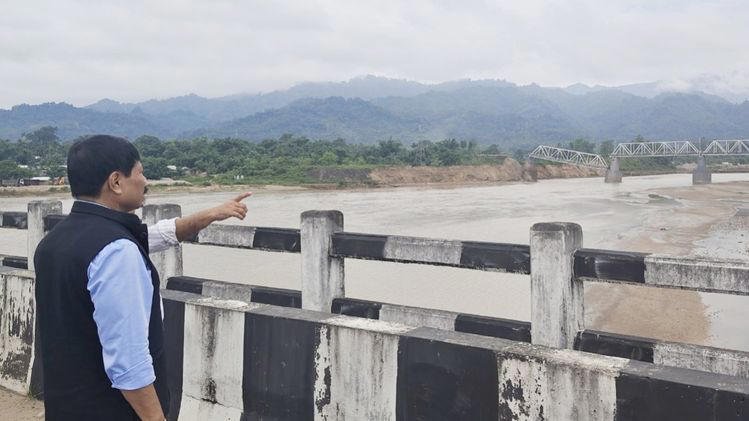
Assam Cabinet Minister Atul Bora visited the flood-affected Simen railway bridge in Dhemaji district to assess the damage caused by heavy rainfall originating in neighbouring Arunachal Pradesh, which has severely disrupted railway services in the region. The inspection comes as authorities continue efforts to restore rail connectivity after rising water levels and strong currents affected the bridge and surrounding railway infrastructure.
The minister reviewed the condition of the railway bridge, interacted with officials overseeing restoration work, and took stock of the measures being undertaken to resume train operations at the earliest. The disruption has impacted passenger movement as well as the transportation of goods, highlighting the importance of restoring normal rail services without delay.
Officials accompanying the minister briefed him on the current situation and the progress of repair and safety assessments being conducted by railway engineers.
Heavy rainfall in Arunachal triggers flooding in border districts
The disruption was caused by continuous heavy rainfall in Arunachal Pradesh, which led to a sharp rise in the water levels of rivers flowing into Assam. The increased discharge resulted in flooding in several parts of Dhemaji district, affecting transportation infrastructure, including the Simen railway bridge.
Officials stated that the sudden surge in river flow placed significant pressure on the railway infrastructure, prompting authorities to suspend train movement as a precautionary measure to ensure passenger safety.
Floodwaters and erosion have affected several low-lying areas in the district, while railway authorities continue to monitor water levels and track conditions before allowing the resumption of services.
The incident highlights the close interconnection between weather conditions in Arunachal Pradesh and flood situations in downstream districts of Assam.
Atul Bora reviews restoration measures
During his visit, Atul Bora closely examined the affected railway bridge and reviewed the ongoing restoration efforts being carried out by railway officials and engineering teams.
He directed concerned authorities to work in close coordination and expedite repair activities while ensuring that all safety protocols are followed before train operations are resumed.
The minister also stressed the importance of maintaining constant monitoring of the bridge’s structural condition and surrounding river flow to prevent any further risks during the ongoing monsoon season.
Officials informed him that technical assessments are being conducted to determine the extent of damage and identify the necessary repairs required to restore safe rail movement.
The government assured that every possible effort would be made to minimise inconvenience to passengers and restore connectivity at the earliest.
Railway services disrupted due to safety concerns
Railway authorities temporarily suspended train movement through the affected section after detecting risks associated with the flood-hit bridge.
Officials explained that the precautionary suspension was necessary to safeguard passengers, railway personnel, and infrastructure while engineers carried out detailed inspections.
Several train services have been affected due to the disruption, with passengers experiencing delays, cancellations, and route adjustments.
Railway officials are continuously evaluating the condition of the tracks, bridge foundations, and supporting infrastructure before deciding on the restoration of normal operations.
Authorities have urged passengers to remain updated through official railway announcements regarding changes in train schedules.
Engineers conduct structural assessment
Engineering teams have been deployed to inspect the Simen railway bridge and assess the impact of the flooding on its structural stability.
The inspection includes evaluating bridge foundations, supporting pillars, track alignment, embankments, and erosion around the structure.
Officials stated that restoration work will proceed based on technical recommendations to ensure that railway operations resume only after the infrastructure is declared completely safe.
Continuous monitoring of river behaviour is also being undertaken to assess any additional risks posed by further rainfall in the upstream areas.
The technical evaluation is expected to guide both immediate repair work and long-term strengthening measures for the bridge.
Government emphasises passenger safety
During the inspection, Atul Bora reiterated that passenger safety remains the government’s highest priority.
He stated that while restoring railway connectivity is important, train services would only resume after engineers certify that the bridge and tracks are structurally secure.
The minister appreciated the efforts of railway personnel, district administration officials, disaster response teams, and other agencies working under challenging weather conditions to restore essential infrastructure.
He also assured that the state government would extend full cooperation to the railway authorities in facilitating restoration work.
Officials emphasized that precautionary measures taken during emergencies play a vital role in preventing accidents and protecting lives.
Floods continue to affect Dhemaji district
Dhemaji remains among the districts affected by the current spell of monsoon flooding triggered by heavy rainfall in the upstream regions of Arunachal Pradesh.
Several rivers flowing through the district have witnessed rising water levels, leading to inundation of agricultural fields, damage to roads, and disruption of transportation networks.
Local administrations continue to monitor flood conditions while implementing relief measures for affected residents wherever necessary.
Authorities are also maintaining surveillance over embankments and vulnerable infrastructure to minimise the impact of further rainfall.
Disaster management teams remain on standby to respond to any emergency arising from worsening flood conditions.
Coordination between departments strengthened
Officials stated that multiple departments, including the railway authorities, district administration, disaster management agencies, and state government departments, are working together to address the situation effectively.
Regular coordination meetings are being held to assess progress, share technical updates, and prioritise restoration work based on ground conditions.
The government has emphasised the importance of inter-agency cooperation in responding to natural disasters that affect critical public infrastructure.
Authorities noted that such collaborative efforts are essential for restoring normalcy while ensuring public safety during the monsoon season.
Focus on restoring connectivity quickly and safely
The inspection by Atul Bora reflects the government’s commitment to restoring rail connectivity as quickly as possible while maintaining strict safety standards.
Officials stated that railway services play a crucial role in connecting remote districts with the rest of Assam and neighbouring states, making timely restoration a priority.
However, they reiterated that engineering assessments and safety certification would determine the timeline for resumption of train operations.
Continuous monitoring of weather conditions and river levels will remain an important factor in planning restoration activities over the coming days.
Government committed to restoring normal rail operations
The visit by Assam Minister Atul Bora to the flood-hit Simen railway bridge underscores the seriousness with which the state government is addressing the disruption caused by heavy rainfall in Arunachal Pradesh. As restoration work progresses, authorities remain focused on ensuring that damaged infrastructure is repaired efficiently while maintaining the highest standards of passenger safety.
With engineers conducting detailed structural assessments and multiple agencies working in coordination, efforts are underway to restore railway connectivity at the earliest possible opportunity. The incident also serves as a reminder of the recurring challenges posed by monsoon floods in Assam’s border districts and the importance of strengthening critical infrastructure to improve resilience against future natural disasters.