


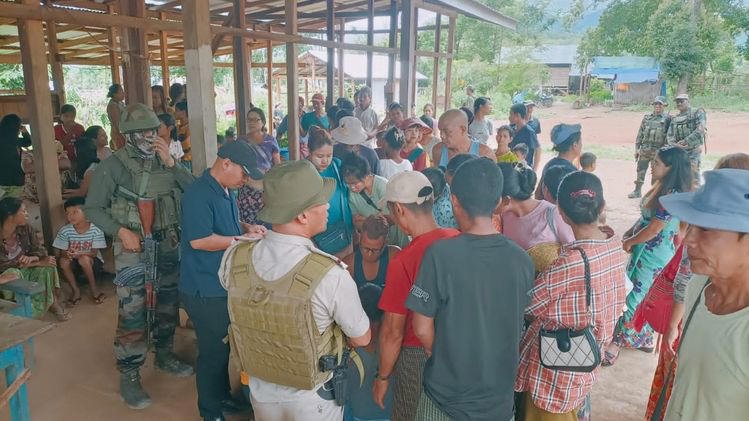
In a significant step towards strengthening border management and ensuring accurate identification of displaced persons, the Assam Rifles has launched a biometric registration drive for displaced Myanmar nationals residing in Manipur’s Kamjong district. The initiative aims to create a comprehensive and verified database of individuals who crossed into India after unrest in Myanmar while facilitating better coordination between security agencies and civil authorities.
Kamjong, which shares an international border with Myanmar, has witnessed the arrival of several displaced families over the past few years following the political instability and armed conflict in the neighbouring country. The biometric registration exercise is expected to streamline the identification process, improve administrative efficiency, and enhance security monitoring without disrupting humanitarian assistance being extended to those seeking temporary refuge.
Officials said the drive is being carried out in coordination with the district administration and other concerned agencies to ensure that the registration process remains systematic, transparent, and accurate.
Addressing challenges arising from cross-border displacement
The continuing instability in Myanmar has forced thousands of civilians to leave their homes and seek safety in neighbouring countries, including India. Border districts in Manipur have received a considerable number of displaced persons due to their geographical proximity and long-standing ethnic and cultural ties shared by communities living on both sides of the international boundary.
The influx has created administrative and humanitarian challenges for local authorities, who have had to balance security concerns with the need to provide basic assistance to displaced families.
Officials noted that maintaining accurate records of displaced individuals is essential for effective governance, policy planning, and ensuring that humanitarian support reaches the intended beneficiaries. The biometric registration drive is therefore viewed as an important administrative measure to strengthen documentation while maintaining order in border areas.
Biometric data to improve identification and record management
The registration exercise involves collecting biometric information along with personal identification details of displaced Myanmar nationals currently residing in Kamjong district. Officials stated that the process has been designed to establish a reliable database that can be used for identity verification and administrative purposes.
Biometric registration reduces the possibility of duplicate records, false identities, or inaccuracies that may arise in manual documentation systems. By creating a digital database, authorities will be able to maintain updated records while facilitating coordination among various government departments involved in relief, security, and border management.
The exercise is also expected to simplify future verification procedures and enable authorities to respond more efficiently to administrative requirements involving displaced populations.
Assam Rifles working closely with civil administration
The Assam Rifles has undertaken the registration drive in close coordination with the Kamjong district administration and other government agencies. Officials emphasized that the initiative is being implemented through a collaborative approach to ensure that both security considerations and humanitarian responsibilities are adequately addressed.
Registration teams have been deployed at designated locations where displaced individuals are being assisted through the documentation process. Authorities are ensuring that the exercise is conducted in an orderly manner while providing necessary guidance to participants regarding the information and documentation required.
Officials stated that cooperation between civil authorities and security agencies has been instrumental in ensuring the smooth conduct of the registration drive.
Strengthening border management and internal security
The biometric registration initiative forms part of broader efforts to strengthen border management in Manipur, particularly in districts adjoining Myanmar. Security agencies believe that maintaining accurate records of displaced individuals is essential for preventing misuse of identities, detecting illegal activities, and ensuring effective monitoring of cross-border movements.
Authorities have clarified that the registration exercise is intended to improve administrative oversight rather than restrict humanitarian assistance. Maintaining verified records helps distinguish genuine displaced persons from individuals who may attempt to exploit the prevailing situation for unlawful purposes.
Officials noted that robust documentation mechanisms contribute to national security while also supporting better policy decisions related to border governance.
Humanitarian assistance continues alongside registration
Authorities have reiterated that displaced Myanmar nationals residing in Kamjong continue to receive humanitarian assistance in accordance with prevailing government guidelines. The biometric registration exercise is being carried out alongside ongoing efforts to ensure access to essential services and basic support for those affected by the conflict in Myanmar.
Officials emphasized that the registration process is not intended to interfere with relief measures but rather to strengthen the administration of such assistance by maintaining accurate beneficiary records.
Proper identification enables authorities to assess the requirements of displaced communities more effectively and allocate available resources in a transparent and efficient manner.
The government continues to coordinate with local administrations to address humanitarian needs while maintaining law and order in sensitive border regions.
Importance of accurate data for future planning
Experts believe that creating a comprehensive biometric database will assist authorities in long-term planning related to border administration, humanitarian response, and public service delivery.
Reliable data enables governments to estimate the number of displaced persons accurately, monitor demographic trends, and formulate policies based on verified information rather than estimates.
The registration exercise may also facilitate coordination between various departments responsible for health services, education, relief distribution, and public welfare whenever necessary.
Officials stated that accurate documentation remains a fundamental requirement for effective governance, particularly in areas experiencing significant population movements due to external conflicts.
Kamjong’s strategic role along the India-Myanmar border
Kamjong district occupies a strategically important position along the India-Myanmar border and has remained one of the key entry points for displaced persons fleeing violence in Myanmar.
The district’s rugged terrain and extensive international boundary require continuous vigilance from security forces while also demanding close coordination with local communities and civil authorities.
Over the years, Assam Rifles has maintained a significant presence in the region, carrying out border security duties, assisting civil administration, and supporting humanitarian efforts whenever required.
The biometric registration drive reflects the force’s broader role in maintaining stability while facilitating orderly administrative processes in sensitive border areas.
Continued efforts to balance security and humanitarian responsibilities
The launch of the biometric registration drive for displaced Myanmar nationals in Manipur’s Kamjong district highlights the government’s effort to balance humanitarian considerations with effective border management. By creating a verified database through biometric identification, authorities aim to strengthen administrative efficiency, improve record management, and support informed policy decisions.
The initiative also underscores the importance of coordinated action between the Assam Rifles, district administration, and other government agencies in addressing the complex challenges arising from cross-border displacement.
As the registration exercise progresses, officials are expected to continue monitoring the situation closely while ensuring that displaced families receive necessary assistance in accordance with established guidelines. The effort represents a significant step towards improving governance in border areas while maintaining security, transparency, and humanitarian accountability amid the continuing crisis in neighbouring Myanmar.