


Artificial intelligence is rapidly becoming more than a technological issue. It is now linked to economic strength, national security and geopolitical influence. In a recent column, strategic affairs expert C Raja Mohan examined how the growing US-China AI competition could create new challenges for India.
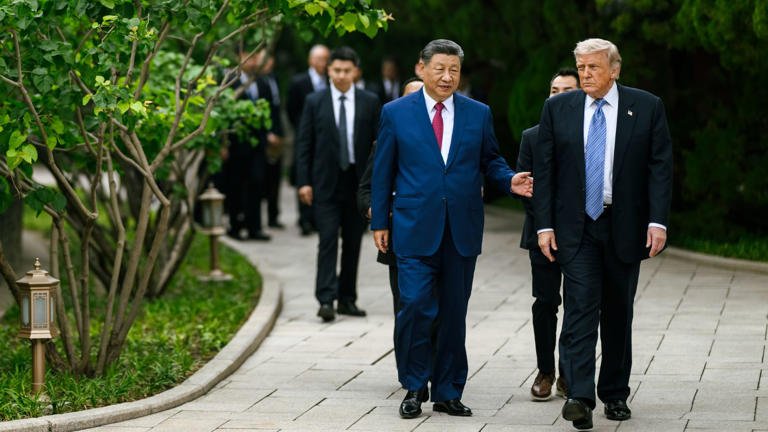
The discussion comes as Washington and Beijing prepare to begin a formal dialogue on artificial intelligence and its risks. The development follows China’s efforts to promote its own approach to international AI cooperation through the BRICS framework.
According to Raja Mohan, frontier AI capabilities remain concentrated largely in the United States and China. Their competition could therefore influence how the technology develops and how other countries gain access to advanced systems.
US and China Take Different Approaches
The emerging US-China AI dialogue reflects two different concerns. Washington has focused heavily on the risks created by increasingly powerful AI models, including their possible military applications.
China, meanwhile, has promoted wider access and international cooperation around AI. During the recent BRICS summit in Delhi, Chinese President Xi Jinping called for greater openness and invited BRICS members to join the World Artificial Intelligence Cooperation Organisation.
China has also proposed an open-source AI community within the BRICS framework. Its approach presents AI access and diffusion as important priorities for developing countries.
At the same time, the two powers continue to disagree over several issues. These include advanced computing chips, export controls, data governance, open-source models and the role of government regulation.
AI Security Becomes Part of Strategic Competition
The US-China conversation is also moving towards AI-related security risks. Raja Mohan noted that both countries have discussed mechanisms that could reduce the possibility of accidents, miscalculations and misuse involving powerful AI systems.
Earlier discussions produced a limited understanding that humans should remain responsible for decisions involving nuclear weapons. More recent talks have considered a continuing AI dialogue and possible notification mechanisms for incidents with national-security implications.
Such communication channels could become important during a crisis. However, reaching a broader agreement on the future of AI remains difficult because Washington and Beijing have competing strategic interests.
India Faces a Complex Strategic Challenge
For India, the growing competition presents a difficult balancing exercise. New Delhi has deep technological and commercial links with the United States. Raja Mohan noted that India is part of the US-led Pax Silica initiative focused on technology and supply chains.
At the same time, India remains a BRICS member. Therefore, it continues to participate in a grouping where China has promoted its own vision for international AI cooperation.
India has also stayed outside China’s World Artificial Intelligence Cooperation Organisation. Raja Mohan linked this position to continuing security concerns and distrust between India and China.
Consequently, India has to engage with both the technological ecosystem led by the US and the wider Global South discussions taking place through BRICS.
China Has a Larger AI Technology Base
Another challenge concerns the difference in technological capabilities. India has promoted the use of AI for developing societies and has sought to make the technology accessible.
However, China has developed substantial capabilities in computing infrastructure, hardware and advanced AI models. This gives Beijing a wider set of technological resources to offer developing countries.
That competition could become significant as countries across the Global South look for affordable access to AI tools, computing capacity and digital infrastructure. India will therefore need to strengthen its own capabilities while maintaining international partnerships.
Risk of AI Rules Being Set by Two Powers
Raja Mohan also raises concerns about how future AI rules could affect countries outside the US-China relationship.
If Washington and Beijing reach agreements on strategic stability, those arrangements could influence the broader international technology environment. Other countries could then face rules or restrictions developed without their direct participation.
The issue has similarities with earlier debates over global nuclear governance. India has historically been cautious about international arrangements that could create unequal access to strategic technologies.
At the same time, continuing US-China rivalry could limit the possibility of a complete agreement between the two powers. Competition for technology and global markets may also create opportunities for countries such as India.
India Needs Stronger Domestic AI Capabilities
The debate ultimately highlights the importance of India’s technological capacity. Raja Mohan argues that India’s position in the AI era will depend heavily on capabilities rather than declarations of technological sovereignty.
Those capabilities include computing power, semiconductor production, AI models, research, investment and skilled human resources.
India can also deepen cooperation with trusted international partners while developing stronger domestic capabilities. Such an approach could help New Delhi participate more effectively in discussions about the future of artificial intelligence.
AI Could Reshape India’s Global Position
The growing US-China competition shows that AI is becoming closely connected with global power. The technology now affects economic competitiveness, defence, diplomacy and strategic stability.
For India, this creates both challenges and opportunities. New Delhi must manage its relationships with major technology powers while building its own research, infrastructure and talent base.
Raja Mohan’s analysis therefore places India’s AI challenge within a much larger geopolitical transformation. As Washington and Beijing increasingly shape the rules and capabilities surrounding advanced AI, India’s ability to develop technological strength and maintain strategic flexibility will remain central to its role in the emerging global order.