


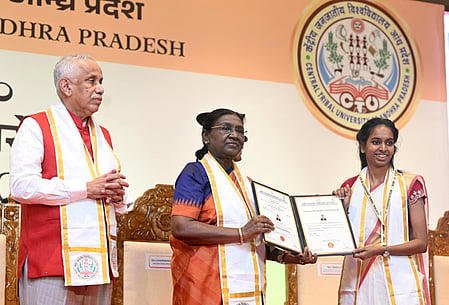
President Droupadi Murmu has called upon the Central Tribal University to evolve into a premier institution for tribal leadership, policy formulation, and research, emphasising that it should become a national centre dedicated to empowering tribal communities through education, innovation, and inclusive development. Addressing students, faculty members, researchers, and dignitaries, the President said the university has the potential to shape future tribal leaders, influence policymaking, and preserve India’s rich indigenous heritage while contributing meaningfully to national development.
Highlighting the crucial role of higher education in empowering marginalised communities, President Murmu observed that universities must go beyond conventional teaching by actively engaging in research, community outreach, and policy-oriented studies. She stressed that the Central Tribal University should emerge as a platform where academic excellence is integrated with practical solutions to address the social, economic, educational, and cultural challenges faced by tribal communities across the country.
The President noted that tribal societies possess invaluable knowledge systems, traditions, and cultural practices that deserve greater academic attention and recognition.
Higher education can empower tribal communities
President Murmu emphasised that education remains one of the most powerful tools for transforming lives and expanding opportunities for tribal communities. She stated that access to quality education enables young people to develop leadership skills, pursue professional careers, preserve their cultural identity, and actively contribute to nation-building.
The President observed that institutions dedicated to tribal education have a unique responsibility to provide not only academic knowledge but also confidence, innovation, and opportunities for holistic development.
She encouraged students to view education as a means of empowering both themselves and their communities, urging them to become agents of positive change capable of addressing local and national challenges.
According to the President, strengthening tribal education is essential for achieving inclusive growth and social justice.
University should become a centre for policy research
A major focus of the President’s address was the need for the Central Tribal University to become a leading institution for research and policy development related to tribal affairs.
She said the university should undertake evidence-based research that informs government policies on tribal welfare, education, healthcare, livelihoods, environmental conservation, and socio-economic development.
By producing high-quality research and policy recommendations, the institution can contribute significantly to addressing the evolving needs of tribal communities while supporting informed decision-making at both state and national levels.
President Murmu encouraged researchers to document indigenous knowledge systems, traditional governance models, and community practices that can contribute to sustainable development and public policy.
She noted that academic research should directly benefit society by offering practical solutions to real-world challenges.
Preserving tribal heritage and indigenous knowledge
The President highlighted the importance of preserving India’s diverse tribal cultures, languages, traditions, and indigenous knowledge systems.
She observed that tribal communities possess centuries of accumulated wisdom related to biodiversity conservation, sustainable agriculture, traditional medicine, natural resource management, and harmonious coexistence with nature.
The university, she said, should actively document, preserve, and promote this invaluable heritage through interdisciplinary research, academic programmes, museums, digital archives, and community partnerships.
President Murmu stressed that protecting tribal cultural identity is essential not only for preserving India’s diversity but also for enriching the country’s intellectual and cultural landscape.
She encouraged students and scholars to take pride in indigenous traditions while integrating them with modern scientific knowledge.
Developing future tribal leaders
President Murmu said the Central Tribal University should become a nurturing ground for developing future tribal leaders capable of contributing to governance, public administration, academia, entrepreneurship, science, and social development.
Leadership, she noted, is not confined to politics but extends to every field where individuals inspire change and serve society.
She urged students to cultivate qualities such as integrity, compassion, resilience, critical thinking, and public service while preparing for leadership roles.
The President also encouraged universities to provide opportunities for leadership development through academic activities, community engagement, internships, innovation programmes, and social initiatives.
According to her, empowering young tribal leaders will strengthen democratic participation and contribute to more inclusive governance.
Innovation and entrepreneurship should be encouraged
The President called upon the university to foster a strong culture of innovation, entrepreneurship, and research among tribal youth.
She observed that modern education should equip students with the knowledge and skills necessary to create employment opportunities rather than solely seeking jobs.
By encouraging startups, technological innovation, skill development, and entrepreneurship, educational institutions can help tribal communities achieve greater economic self-reliance.
President Murmu suggested that the university collaborate with industries, research institutions, government agencies, and entrepreneurs to create an ecosystem that supports innovation and practical learning.
She added that entrepreneurial initiatives rooted in local resources and traditional knowledge could generate sustainable livelihoods while preserving cultural identity.
Balancing tradition with modern education
President Murmu emphasised that modern education and traditional knowledge should complement each other rather than exist in opposition.
She observed that tribal communities have historically demonstrated sustainable ways of living that remain relevant in addressing contemporary environmental and developmental challenges.
Educational institutions, she said, should encourage students to appreciate both scientific advancements and indigenous wisdom while promoting interdisciplinary learning.
The President stressed that integrating traditional knowledge with modern research can lead to innovative solutions in agriculture, healthcare, biodiversity conservation, and climate resilience.
Such an approach would enable students to remain connected to their cultural roots while participating confidently in an increasingly globalised world.
Universities should contribute to national development
The President stated that higher educational institutions have a broader responsibility beyond awarding degrees.
Universities should actively contribute to national development through quality research, technological innovation, social outreach, and policy engagement.
She encouraged the Central Tribal University to collaborate with government departments, research organisations, civil society institutions, and international academic bodies to expand its academic impact.
The institution should also undertake extension activities that directly improve the lives of tribal communities through education, healthcare awareness, skill development, environmental conservation, and livelihood support.
According to President Murmu, universities become truly successful when their knowledge benefits society as a whole.
Students urged to pursue excellence and social responsibility
Addressing students, President Murmu encouraged them to pursue academic excellence while remaining committed to serving society.
She said knowledge should always be accompanied by humility, compassion, ethical conduct, and a strong sense of responsibility towards one’s community and the nation.
The President urged students to remain curious, embrace lifelong learning, and continuously seek opportunities to contribute positively to society.
She reminded young learners that education is both a privilege and a responsibility that should be used to uplift not only individual lives but also the communities from which they come.
Her message encouraged students to combine personal ambition with a commitment to inclusive and sustainable development.
A vision for inclusive and knowledge-driven tribal development
President Droupadi Murmu’s vision for the Central Tribal University extends far beyond its role as an academic institution. By calling for the university to become a national hub for tribal leadership, policy research, innovation, and cultural preservation, she outlined an ambitious roadmap for empowering tribal communities through education and knowledge. Her emphasis on integrating indigenous wisdom with modern research, nurturing future leaders, promoting entrepreneurship, and influencing public policy reflects a holistic approach to tribal development.
As India continues to strengthen its higher education ecosystem, institutions such as the Central Tribal University have an opportunity to become catalysts for inclusive growth and social transformation. By fostering academic excellence, preserving tribal heritage, encouraging research-driven policymaking, and preparing socially responsible leaders, the university can play a pivotal role in advancing the aspirations of tribal communities while contributing significantly to the nation’s progress. President Murmu’s address serves as a powerful reminder that education, when rooted in inclusivity and purpose, has the potential to transform societies and build a more equitable future for all.