


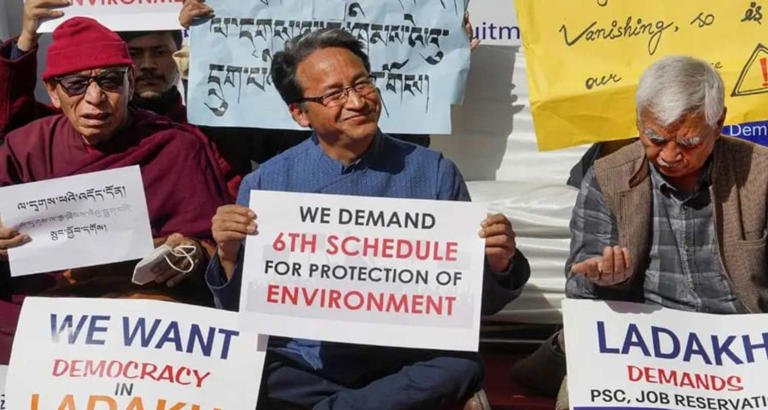
The Ministry of Home Affairs (MHA) has proposed extending the Article 371 guarantee for Ladakh to safeguard the interests of its people amid a prolonged deadlock over the 6th Schedule demand. The proposal aims to provide constitutional protection for Ladakh’s land, culture, and employment rights while ensuring administrative flexibility within the Union Territory framework.
This offer marks a potential breakthrough in the ongoing dialogue between the Centre and Ladakh-based groups, who have been demanding inclusion under the 6th Schedule of the Constitution since the region’s bifurcation from Jammu and Kashmir in 2019.
Read More: Assam Withdraws Two-Child Policy for Tribal and Tea Communities
Background: The Demand for the 6th Schedule
Following the abrogation of Article 370 and the creation of the Union Territory of Ladakh, local groups began pushing for constitutional safeguards under the 6th Schedule. They argued that it would protect the region’s fragile ecology, traditional land ownership systems, and distinct cultural heritage.
However, the Centre hesitated to extend the 6th Schedule—which is currently applicable only to certain tribal regions in the Northeast—to Ladakh, citing administrative and structural challenges. The ongoing negotiations between the MHA and the Leh Apex Body (LAB) and Kargil Democratic Alliance (KDA) have faced repeated delays, leading to frustration among local leaders.
The latest move by the Centre to consider an Article 371 guarantee for Ladakh appears to be a middle path aimed at resolving this impasse.
What Article 371 Could Mean for Ladakh
Article 371 of the Indian Constitution provides special provisions for several states, including Maharashtra, Gujarat, Nagaland, and Mizoram, among others. These provisions allow flexibility in administrative control, land ownership rights, and protection of cultural identity.
Under the new proposal, Ladakh may receive similar protections, ensuring that only local residents can own land or secure government jobs. It would also allow the administration to prioritize local customs and resource management.
Officials stated that the model would be specifically designed for Ladakh’s unique demographic and geographic context. The Article 371 guarantee for Ladakh could thus provide constitutional backing to local governance and safeguard indigenous rights without altering the Union Territory status.
Mixed Reactions from Local Bodies
The proposal has sparked mixed reactions across Ladakh. The Leh Apex Body (LAB) welcomed the Centre’s willingness to explore constitutional safeguards but maintained that only 6th Schedule status could fully address the region’s aspirations.
Kargil Democratic Alliance (KDA), on the other hand, expressed concern that the Article 371 route may offer limited autonomy compared to the 6th Schedule. They emphasized that Ladakh’s people deserve a robust mechanism that ensures both political representation and control over local resources.
Despite differing opinions, both groups agreed that the Centre’s proposal marks progress after years of stalemate. Many residents view the move as a sign that New Delhi is finally acknowledging Ladakh’s long-standing demands for protection and self-governance.
Centre’s Balancing Act
For the central government, extending the Article 371 guarantee for Ladakh represents a delicate balancing act. On one hand, it aims to address public sentiment in Ladakh, where concerns over loss of land and identity have intensified. On the other, it seeks to maintain national administrative consistency without expanding the 6th Schedule beyond the Northeast.
According to officials, Article 371 provides enough constitutional scope to tailor safeguards without fundamentally changing Ladakh’s status as a Union Territory. The move is seen as a pragmatic solution to preserve cultural integrity while retaining administrative control with the Centre.
Protecting Land, Jobs, and Culture
A key concern among Ladakhis is the protection of their land and employment opportunities. After the abrogation of Article 370, several constitutional safeguards that earlier existed under the Jammu and Kashmir framework were removed. Residents fear that unrestricted land sales and migration could threaten local demography.
The proposed Article 371 guarantee for Ladakh would reintroduce restrictions on land ownership and employment similar to those enjoyed by other regions under Article 371. It would also empower local bodies to make decisions on resource management and development projects, ensuring sustainable growth aligned with ecological needs.
Ecological and Cultural Sensitivity
Ladakh’s unique environment and cultural fabric make the demand for autonomy even more critical. Environmentalists have warned that unregulated industrial and tourism activities could harm the region’s fragile ecosystem.
The Article 371 model, by enabling region-specific governance, could ensure that development policies respect local traditions and ecological limits. It would also protect the rights of indigenous communities such as the Brokpas, Balti, and Changpa, whose livelihoods depend on traditional practices like pastoralism and handicrafts.
Political Implications
The Centre’s decision to consider the Article 371 guarantee for Ladakh carries significant political weight. It comes amid growing public unrest and a series of peaceful protests demanding constitutional protection. Analysts believe the move could calm tensions and restore trust between the Centre and Ladakh’s leadership.
However, political observers also caution that offering Article 371 without adequate legislative power may not satisfy all stakeholders. They emphasize that the final framework must include strong safeguards and local decision-making authority to ensure long-term stability.
Way Forward
Talks between the MHA and representatives from the LAB and KDA are expected to continue over the next few weeks. Both sides are reportedly working on finalizing the contours of the Article 371 framework. The government has assured that no decision will be taken without full consultation with local bodies.
While the 6th Schedule demand remains on the table, the proposed Article 371 guarantee for Ladakh may serve as a bridge toward broader autonomy and self-reliance. If implemented effectively, it could provide Ladakh with the protection it seeks while maintaining constitutional coherence across India.
For the people of Ladakh, this development revives hope that their voice will finally find constitutional recognition—preserving their heritage, land, and way of life for generations to come.
Read More: Manipur Celebrates Ningol Chakkouba Amid Pain of Displacement