


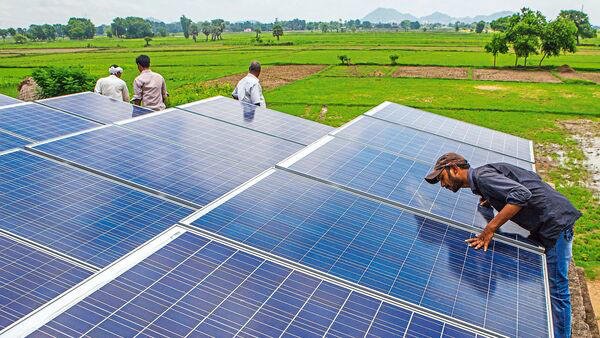
The Centre plans to introduce financial support for agrivoltaics under the next phase of the Pradhan Mantri Kisan Urja Suraksha evam Utthaan Mahabhiyaan (PM KUSUM), Ministry of New and Renewable Energy (MNRE) Secretary Santosh Kumar Sarangi has said.
The initiative aims to help farmers generate solar electricity while continuing agricultural activities on the same land. The government intends to make this dual-use model more commercially viable by addressing the additional cost of installing elevated solar panels above farmland.
Speaking during the AgriVoltaics World Conference 2026 in New Delhi, Sarangi said the proposed programme could support the development of around 5 gigawatts (GW) of agrivoltaic capacity over three to four years.
The government is considering replacing the existing Component A of PM KUSUM with an agrivoltaics-focused component. However, the programme’s final structure and financial arrangements will depend on the completion of the proposal and the necessary approvals.
The announcement marks a potential expansion of India’s agricultural solarisation programme, with a greater emphasis on generating renewable energy without taking productive agricultural land out of cultivation. <Cite refs={[“turn404651search2″,”turn404651search3″,”turn404651search5”]} />
What Is Agrivoltaics and How Does It Work?
Agrivoltaics, also known as agrisolar or agricultural photovoltaics, involves installing solar panels above farmland at a height that allows crops to grow and routine farming activities to continue underneath.
Unlike conventional ground-mounted solar installations, the technology enables farmers to use the same plot of land for food production and electricity generation.
Elevated structures can provide sufficient space for agricultural machinery, irrigation and other farming operations. Depending on the crop and panel design, the arrangement may also offer partial shade and help manage water loss.
The model could be particularly useful in India, where agricultural landholdings are often small and farmers cannot easily spare land exclusively for solar projects.
Union Minister for New and Renewable Energy Pralhad Joshi has described agrivoltaics as an opportunity for farmers to become both annadatas and urjadatas—food producers and energy producers.
The government has emphasised that the technology should supplement farming rather than replace it. Its success will depend on selecting suitable crops, designing appropriate panel structures and ensuring that farmers retain control over their land. <Cite refs={[“turn404651search5″,”turn404651search6”]} />
Government Aims to Bridge 25–30% Additional Cost
One of the biggest challenges facing agrivoltaics is its higher installation cost.
According to Sarangi, elevated solar structures make agrivoltaic projects around 25–30% more expensive than conventional ground-mounted solar installations. The additional expense largely comes from the civil infrastructure required to raise and support the panels.
The proposed scheme aims to address this cost difference through financial assistance and incentives. The objective is to help projects become competitive with conventional solar plants and encourage more states to adopt the model.
The MNRE is working with the Ministry of Finance to develop the funding mechanism. The government has indicated that support could be incorporated into PM KUSUM 2.0 rather than introduced through an entirely separate scheme.
Reducing the cost gap will be important for attracting farmers, cooperatives, farmer-producer organisations (FPOs) and private developers. Without suitable financial support, the additional investment could discourage participation, particularly among small and marginal farmers.
The government also hopes that wider adoption, improved designs and greater experience in project development will help reduce costs over time. <Cite refs={[“turn404651search2″,”turn404651search4”]} />
PM KUSUM 2.0 Could Replace Existing Component A
The proposed agrivoltaics initiative is expected to form part of the next phase of PM KUSUM, a government programme designed to promote solar energy in agriculture.
Under the existing scheme, Component A supports decentralised solar power plants, generally with capacities of up to 2 megawatts. These plants allow farmers and other eligible participants to generate electricity for sale to distribution companies.
The proposed restructuring could shift this component towards solar installations that allow agricultural production and power generation to coexist.
PM KUSUM has also supported standalone solar pumps and the solarisation of existing grid-connected agricultural pumps. These measures aim to reduce dependence on diesel, improve energy access and strengthen farmers’ incomes.
The next phase is expected to build on this foundation while expanding opportunities for renewable electricity generation on agricultural land.
However, the final design of PM KUSUM 2.0, including its funding arrangements and implementation details, remains subject to government decisions. <Cite refs={[“turn404651search3″,”turn404651search5″,”turn404651search7”]} />
Crop Selection and Research Will Be Crucial
The effectiveness of agrivoltaics depends heavily on the crops grown beneath solar panels and the design of the installations.
Initial assessments by the Indian Agricultural Research Institute (IARI) suggest that leafy vegetables, fruits, horticultural crops and floriculture may be suitable for certain agrivoltaic systems. Some crops may benefit from partial shade, while others require greater exposure to direct sunlight.
Rice, wheat and sugarcane may be less suitable in some configurations, although outcomes will vary depending on local conditions and the specific system used.
Researchers are examining crop requirements, panel height, spacing and other technical factors across different agro-climatic zones. The goal is to develop recommendations that help farmers maintain productivity while generating electricity.
Agricultural experts have also highlighted the importance of adequate drainage, access for tractors and harvesters, and protection against extreme weather.
Further research and field trials will be necessary before the technology can be expanded across India’s diverse agricultural regions. A single design is unlikely to work equally well for every crop or climate.
States to Play a Key Role in Expanding Agrivoltaics
State governments will be important to the success of the proposed programme. Sarangi has stressed that states must encourage suitable projects and establish clear arrangements for purchasing electricity generated through agrivoltaics.
Feed-in tariffs and power-purchase arrangements can provide greater certainty for farmers and developers considering investment.
States such as Maharashtra, Rajasthan, Andhra Pradesh, Madhya Pradesh, Karnataka and Uttar Pradesh have been identified as having significant agrivoltaic potential.
The government is also exploring ways to encourage states to develop different project models, including initiatives led by individual farmers, FPOs, cooperatives and private developers leasing agricultural land under long-term arrangements.
The Centre’s proposed financial support is intended to encourage early adoption and help states build experience with the technology.
A New Opportunity for Farmers and Clean Energy
Agrivoltaics could provide farmers with an additional source of income while supporting India’s renewable energy ambitions. By combining crop production with electricity generation, the technology offers a potential solution to competition between food production and solar infrastructure.
However, its long-term success will depend on affordability, suitable crop selection, reliable electricity-purchase arrangements and protection of farmers’ interests.
The proposed 5 GW target over three to four years represents an important ambition, but actual capacity addition will depend on state participation, project economics and the final design of the scheme.
If the government can bridge the cost gap and develop practical models for small and marginal farmers, agrivoltaics could become a more significant part of India’s agricultural energy strategy.
The next phase of PM KUSUM is therefore expected to play a key role in determining whether solar farming can expand beyond pilot projects and become a commercially viable option for farmers across the country.