


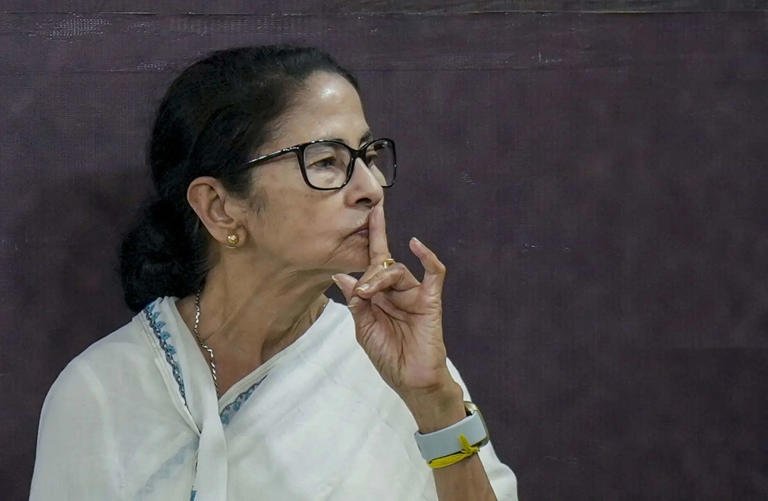
The Congress has extended an invitation to West Bengal Chief Minister and Trinamool Congress (TMC) chief Mamata Banerjee to attend its July 21 programme in Kolkata, while simultaneously urging her to acknowledge that leaving the Congress to form the Trinamool Congress was a “mistake.” The remarks have added a fresh political dimension to the relationship between the two parties, which often cooperate at the national level while remaining fierce rivals in West Bengal.
The invitation, coupled with the political message, comes amid continuing debates over opposition unity and the evolving dynamics between regional parties and the Congress ahead of future electoral contests. While the Congress sought to highlight its historical association with Banerjee, the TMC has yet to formally respond to the latest remarks.
Political observers believe the development reflects the complex relationship between the Congress and the TMC, where cooperation on national issues often contrasts with intense political competition in the state.
Congress Extends Invitation to July 21 Programme
Congress leaders said Mamata Banerjee is welcome to attend the party’s July 21 event in Kolkata, describing the invitation as a political gesture.
However, they added that her participation should be accompanied by an acknowledgment that leaving the Congress to establish the Trinamool Congress was an incorrect political decision.
The statement quickly drew attention because Banerjee spent several years in the Congress before breaking away in 1998 to launch the Trinamool Congress, which has since become the dominant political force in West Bengal.
The invitation has sparked fresh discussions about the changing political relationship between the two parties.
Congress Highlights Historical Association
While extending the invitation, Congress leaders referred to Banerjee’s long political journey within the party before she formed the TMC.
They argued that the Congress played an important role in shaping her early political career and suggested that political differences eventually led to the split.
According to Congress leaders, acknowledging the decision to leave the party as a mistake would represent a symbolic recognition of that shared political history.
The remarks also reflected the Congress’s attempt to reassert its historical presence in West Bengal politics.
TMC and Congress Remain Political Rivals in Bengal
Although both parties are part of broader opposition discussions at the national level, they continue to compete directly in West Bengal.
The Congress and the Trinamool Congress frequently criticise each other over governance, organisational strength, and electoral strategies within the state.
Political analysts note that while the two parties occasionally cooperate on issues concerning national politics, their rivalry in Bengal remains strong.
The latest comments are expected to further intensify political exchanges between the two organisations.
Mamata Banerjee’s Political Journey
Mamata Banerjee began her political career with the Congress and emerged as one of the party’s prominent leaders in West Bengal.
In 1998, she founded the All India Trinamool Congress after differences with the Congress leadership. Since then, the TMC has grown into the state’s dominant political party under her leadership.
Banerjee has served multiple terms as Chief Minister and has positioned the TMC as one of the country’s major regional political parties.
Her political evolution continues to shape the relationship between the Congress and the TMC.
Opposition Unity Faces Complex Challenges
The latest development comes at a time when opposition parties continue discussing strategies to counter the Bharatiya Janata Party (BJP) at the national level.
However, regional political realities often complicate these efforts, particularly in states where opposition parties compete directly against one another.
West Bengal remains one such example, where the Congress and the TMC seek support from many of the same voter groups despite occasional cooperation on broader national issues.
Political observers say this dual relationship makes coordination among opposition parties particularly challenging.
Congress Seeks to Strengthen Its Position
The Congress has been working to rebuild its organisational presence in West Bengal, where it has faced declining electoral influence over the past two decades.
Party leaders believe strengthening the Congress at the grassroots level remains essential for future electoral success.
The invitation to Banerjee and the accompanying remarks also reflect the Congress’s effort to remind voters of its historical role in Bengal politics.
At the same time, the party continues to position itself as an independent political force within the state.
Political Reactions Expected
The Congress’s remarks have triggered fresh political debate, with leaders from different parties expected to respond in the coming days.
While Congress leaders defended their statement as a political observation, supporters of the TMC are likely to view the comments as an attempt to score political points.
Observers believe the exchange may lead to further statements from both parties as they continue to define their respective political positions.
The development has once again highlighted the competitive nature of West Bengal’s political landscape.
National and State Politics Diverge
The relationship between the Congress and the TMC often differs at the national and state levels.
At the national level, both parties have participated in discussions on several opposition issues. In West Bengal, however, they remain direct competitors seeking to expand their political influence.
Analysts say this contrast illustrates the complexity of coalition politics in India, where parties frequently cooperate in one context while contesting fiercely in another.
The latest remarks underscore these continuing political contradictions.
Focus Shifts to Political Messaging
Political observers believe the Congress’s invitation carries symbolic significance beyond the event itself.
By linking the invitation to Banerjee’s departure from the Congress, the party has attempted to revisit a key moment in West Bengal’s political history while reinforcing its own identity.
Whether the statement influences future political engagement between the two parties remains uncertain, but it has already generated considerable discussion within political circles.
The episode also demonstrates how historical political decisions continue to shape present-day narratives.
Congress-TMC Relations Remain Under Spotlight
The Congress’s invitation to Mamata Banerjee for its July 21 programme, accompanied by the suggestion that she acknowledge leaving the party as a “mistake,” has added another chapter to the evolving relationship between the two political parties.
While the Congress highlighted its historical association with the West Bengal Chief Minister, the Trinamool Congress continues to chart its own political course as the state’s ruling party. As both organisations prepare for future electoral contests, their interactions are expected to remain closely watched, reflecting the complex balance between political rivalry in West Bengal and broader opposition dynamics at the national level.