


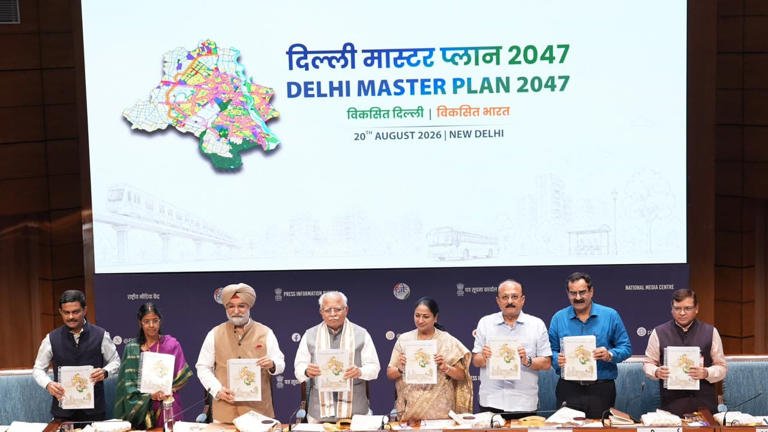
Delhi is preparing for a major transformation over the next two decades with the unveiling of the Delhi Master Plan 2047, a long-term roadmap that aims to address the capital’s growing population, housing needs, transport challenges and environmental concerns. The proposed plan envisions the creation of around 30 to 40 lakh new homes while also focusing on better public transport, improved infrastructure and more sustainable urban development.
The plan comes as Delhi continues to face pressure from rapid population growth and urban expansion. Housing shortages, traffic congestion, pollution and limited public spaces have created serious challenges for the city. The new master plan seeks to provide a structured approach to managing this growth and improving the quality of life for residents.
The Delhi Master Plan 2047 aims to prepare the national capital for future needs by combining housing development with transport planning, environmental protection and better public infrastructure.
The success of the plan will depend on how effectively authorities implement its proposals and coordinate with different agencies responsible for Delhi’s development.
A Long-Term Vision for Delhi’s Growing Population
Delhi has witnessed rapid urbanisation over several decades, and its population is expected to continue growing in the coming years.
This growth will increase the demand for housing, transport, water, electricity, healthcare and other essential services.
The Delhi Master Plan 2047 aims to prepare the city for these future demands.
Instead of responding to problems only after they emerge, the plan seeks to guide development through long-term planning.
Urban planners need to consider where people will live, how they will travel and where new jobs and commercial centres will develop.
The proposed roadmap also recognises that Delhi cannot continue expanding without proper infrastructure.
New residential areas will require schools, hospitals, roads and public transport.
Planning these facilities together can help create more organised and liveable neighbourhoods.
Plan Proposes 30–40 Lakh New Homes
One of the most significant proposals under the Delhi Master Plan 2047 is the creation of around 30 to 40 lakh new homes.
The proposal aims to address the growing demand for housing as Delhi’s population expands.
Housing remains a major challenge for the national capital. Property prices remain high in many areas, while a large number of people struggle to find affordable accommodation.
The new homes could help increase the housing supply and create more options for different sections of society.
However, simply building more houses will not solve the problem.
Authorities will need to ensure that new housing projects include basic services and proper infrastructure.
Residents will require access to water, electricity, sanitation, schools, healthcare and transport.
The plan will therefore need to focus on creating complete neighbourhoods rather than isolated housing projects.
Focus on Affordable and Planned Housing
Affordable housing is expected to remain an important part of Delhi’s future development strategy.
A large number of people move to the capital in search of employment and educational opportunities.
Many workers and their families need reasonably priced housing near their workplaces.
The master plan can help identify areas suitable for new residential development.
It can also encourage more efficient use of available land.
Vertical development and redevelopment may become increasingly important because Delhi has limited land available for expansion.
Older areas may require redevelopment to improve infrastructure and provide safer housing.
However, redevelopment projects will need to consider the needs of existing residents.
Authorities must ensure that development does not displace vulnerable communities without proper rehabilitation.
Better Public Transport and Improved Connectivity
Transport forms another major pillar of the Delhi Master Plan 2047.
Delhi’s residents face long travel times and heavy traffic congestion on many roads.
The city’s expanding Metro network has improved connectivity, but the growing population will create further pressure on the transport system.
The new plan focuses on improving public transport and strengthening connectivity across the city.
Better integration between the Metro, buses and other forms of public transport could make travel more convenient.
Authorities may also focus on improving last-mile connectivity.
Many commuters face difficulties travelling between Metro stations and their homes or workplaces.
Improved bus services, walking routes and other transport options can help address this problem.
A strong public transport system can also reduce dependence on private vehicles.
Making Delhi More Friendly for Pedestrians and Cyclists
The Delhi Master Plan 2047 also provides an opportunity to rethink how people move within the city.
Many areas lack safe and accessible footpaths.
Cyclists also face difficulties because of limited dedicated infrastructure.
Future development could place greater emphasis on pedestrian-friendly streets and cycling facilities.
Better footpaths can improve safety and encourage people to walk for short distances.
This can reduce traffic pressure and support a healthier lifestyle.
Public spaces should also remain accessible to elderly people, children and persons with disabilities.
Urban planning that focuses only on cars can create congestion and reduce the quality of public spaces.
A more balanced transport system can make Delhi easier to navigate.
Green Spaces and Environmental Protection
Environmental sustainability will be a major challenge for Delhi as the city expands.
The capital already faces serious concerns related to air pollution, rising temperatures and pressure on natural resources.
The master plan can provide an opportunity to protect green spaces and increase environmental resilience.
Parks, urban forests and open spaces can improve the quality of life for residents.
Trees can also help reduce the urban heat effect and improve local air quality.
Protecting water bodies will remain equally important.
Rapid construction and urban expansion can damage natural drainage systems and increase the risk of waterlogging.
The future development strategy must therefore balance construction with environmental protection.
Improving Water and Waste Management
Delhi’s growing population will also increase the demand for water and sanitation.
The city will need stronger systems to manage water supply and wastewater.
Rainwater harvesting and water conservation could become increasingly important.
Authorities may also need to improve waste collection and processing systems.
A growing city produces more solid waste, and poor management can create serious environmental and health concerns.
The master plan can support a more organised approach to waste management by identifying suitable locations for treatment facilities and improving local infrastructure.
Long-term planning can help authorities prepare for future demands rather than responding only when existing systems become overwhelmed.
Redevelopment of Older Areas
Delhi has several densely populated neighbourhoods with ageing infrastructure.
Redevelopment could play an important role in improving these areas.
Older buildings may require structural upgrades, while narrow roads can create problems for emergency services.
The Delhi Master Plan 2047 could encourage redevelopment that improves housing and infrastructure.
However, authorities will need to manage redevelopment carefully.
Many older neighbourhoods have strong social and commercial networks.
Development should therefore improve living conditions without unnecessarily disrupting communities.
The participation of local residents can play an important role in planning such projects.
Creating New Economic and Employment Centres
Future urban planning must also consider where people will work.
If employment remains concentrated in a few parts of Delhi, large numbers of people will continue travelling long distances every day.
The master plan can encourage the development of new commercial and employment centres across the city.
A more distributed economy could reduce travel times and pressure on major business districts.
New employment hubs could also support the development of surrounding residential areas.
Technology, services, manufacturing and small businesses can all contribute to Delhi’s economic growth.
Infrastructure and transport planning will remain important for supporting these activities.
Challenges in Implementing the Master Plan
The Delhi Master Plan 2047 presents an ambitious vision, but implementation will be its biggest challenge.
Delhi’s governance structure involves several agencies and different levels of government.
Effective coordination will be necessary to ensure that development projects move forward.
Funding will also remain a major issue.
Building homes, expanding transport networks and improving infrastructure will require significant investment.
Authorities will need to prioritise projects and ensure that public resources are used effectively.
Environmental concerns could also create difficult decisions.
The city needs new housing and infrastructure, but development must not destroy the green spaces and natural systems that protect Delhi’s environment.
A Vision for a More Liveable Capital
The Delhi Master Plan 2047 represents a long-term attempt to prepare the capital for a larger population and changing urban needs.
The proposed creation of 30 to 40 lakh new homes could significantly expand Delhi’s housing capacity.
At the same time, better public transport can make the city more accessible and reduce pressure on roads.
The focus on green spaces, redevelopment and improved infrastructure could also support a better quality of life.
However, the real impact of the plan will depend on implementation.
Authorities will need to ensure that housing remains affordable, transport systems remain accessible and environmental protection receives adequate attention.
Looking Ahead
The Delhi Master Plan 2047 sets out an ambitious vision for the future of India’s capital.
With proposals for 30 to 40 lakh new homes, improved public transport, better connectivity and stronger environmental planning, the roadmap aims to address some of Delhi’s most pressing urban challenges.
The plan recognises that Delhi’s future growth must be carefully managed.
Housing, jobs, transport and environmental protection cannot be planned separately.
They must work together to create a city that remains liveable as its population grows.
The coming years will determine how successfully authorities translate this vision into reality.
If implemented effectively, the Delhi Master Plan 2047 could reshape the capital by creating more homes, improving mobility and building a more sustainable urban environment for future generations.