


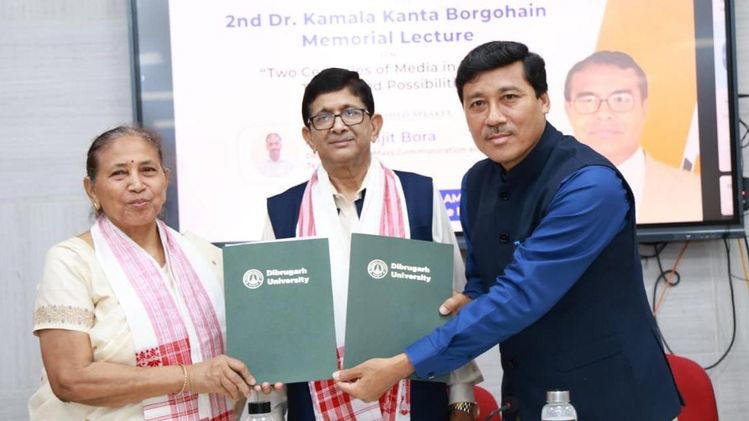
Dibrugarh University organised the Dr Kamala Kanta Borgohain Memorial Lecture on May 7 at the Indira Miri Conference Hall, bringing together academicians, media experts, journalists, and scholars to discuss the evolution, growth, and digital transformation of Assamese media.
The programme focused on the changing landscape of journalism and communication in Assam, especially in the era of digital media and rapidly evolving technology. Experts participating in the event highlighted both the opportunities and challenges facing Assamese media organisations in the modern information age.
The memorial lecture was organised by the Centre for Studies in Journalism and Mass Communication (CSJMC). The event began with the ceremonial lighting of the lamp followed by the university anthem.
Officials said the lecture aimed to encourage deeper discussions regarding media ethics, digital transformation, language journalism, and the future of regional media platforms in Assam.
Read More: Manipur Deputy CM Stresses Honesty In Healthcare
Experts discuss changing landscape of Assamese media
Media experts and academicians attending the programme discussed how Assamese media has transformed over the years from traditional print journalism to digital and multimedia platforms.
Speakers highlighted the historical journey of Assamese newspapers, radio broadcasting, television journalism, and digital media development in the state.
Experts noted that regional language journalism continues playing an important role in preserving cultural identity and informing local communities despite rapid technological changes.
According to participants, Assamese media has adapted significantly to changing audience behaviour and the increasing influence of digital platforms and social media.
Scholars also discussed how online news consumption patterns have transformed journalism practices in Assam over the past decade.
Several speakers stressed that digital transformation has expanded the reach of Assamese media beyond geographical boundaries, allowing regional content to connect with global audiences.
Digital transformation creates new opportunities
Experts at the memorial lecture said digital transformation has opened new opportunities for Assamese media organisations, journalists, and content creators.
The growth of online news portals, social media platforms, video content, and mobile journalism has changed how audiences consume information.
Speakers observed that younger audiences increasingly prefer digital platforms over traditional print media for accessing news and updates.
Media professionals also highlighted the role of digital technology in improving news accessibility, audience interaction, and content distribution.
However, experts warned that rapid digital growth also creates challenges related to misinformation, declining print revenue, and increased competition for audience attention.
Several participants stressed the need for Assamese media organisations to invest in digital innovation while maintaining journalistic credibility and ethical standards.
They also discussed the importance of adapting newsroom practices to meet the demands of fast-paced digital journalism.
Importance of regional language journalism highlighted
One of the major themes discussed during the event was the importance of regional language journalism in protecting linguistic and cultural identity.
Speakers said Assamese media has historically played an important role in shaping public opinion, promoting literature, and preserving cultural heritage in the region.
Experts emphasised that regional journalism remains essential because local communities often rely on Assamese-language media for information connected to culture, politics, education, and social issues.
Scholars also discussed how digital platforms can help Assamese media reach younger audiences who increasingly consume content online.
At the same time, participants warned that regional language media organisations face financial and technological challenges while competing with larger national and international media platforms.
Experts encouraged media institutions to strengthen digital strategies without compromising language quality and journalistic ethics.
Media ethics and responsible journalism discussed
The memorial lecture also focused on the importance of ethical journalism in the digital era.
Experts said the rapid spread of information through social media has increased the risk of misinformation, fake news, and sensationalism.
Speakers stressed that journalists and media organisations must remain committed to accuracy, accountability, and responsible reporting despite pressure from digital competition.
Several participants discussed how the rise of social media influencers and user-generated content has changed public trust in journalism.
Media scholars noted that professional journalism remains essential for fact-checking, balanced reporting, and democratic accountability.
Participants also highlighted the need for journalism education institutions to train students in ethical reporting practices and digital verification techniques.
The role of media literacy among audiences also emerged as an important topic during the discussions.
Journalism education gains importance
The programme organised by CSJMC also highlighted the growing importance of journalism and mass communication education in Assam.
Academicians said educational institutions must prepare students for rapidly changing media environments shaped by digital technology, multimedia storytelling, and online communication platforms.
Experts encouraged journalism students to develop skills related to video production, digital editing, data journalism, and multimedia reporting.
They also stressed the importance of critical thinking and ethical awareness in journalism education.
Several speakers noted that the future of Assamese media will depend significantly on the ability of young journalists to adapt to technological changes while preserving professional standards.
The memorial lecture reportedly encouraged students to actively engage with discussions regarding media innovation and communication trends.
Dr Kamala Kanta Borgohain remembered
The event also paid tribute to Dr Kamala Kanta Borgohain for his contributions to literature, education, and intellectual discussions in Assam.
Speakers remembered his role in promoting knowledge, cultural awareness, and academic engagement in the region.
Participants said organising the memorial lecture in his honour reflected the importance of intellectual discourse and educational development in Assam.
The programme witnessed participation from students, researchers, faculty members, journalists, and media professionals from different institutions.
Organisers said the event successfully created a platform for meaningful discussions regarding the future of Assamese media and journalism.
Assamese media faces evolving future
Experts concluded that Assamese media currently stands at an important transition point because of rapid digitalisation and changing audience expectations.
While digital platforms provide opportunities for growth and wider reach, media organisations must also address challenges related to sustainability, credibility, and technological adaptation.
Participants agreed that Assamese media can continue remaining influential if it successfully balances innovation with responsible journalism and cultural preservation.
Observers noted that regional media organisations across India face similar transitions as digital technology reshapes communication systems and public engagement.
The discussions at Dibrugarh University highlighted both optimism and concern regarding the future of regional journalism in the digital age.
As Assamese media continues evolving, experts believe institutions, journalists, and educators must work together to strengthen ethical standards, digital skills, and language journalism in the years ahead.
Read More: Tripura CM Manik Saha Reviews Public Services And Law And Order