


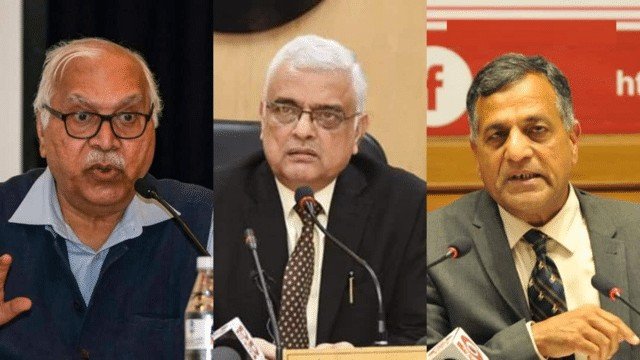
The ongoing controversy over the Special Intensive Revision (SIR) of electoral rolls has drawn criticism from several former Election Commissioners. Former Chief Election Commissioners SY Qureshi and OP Rawat have questioned aspects of the process. Former Election Commissioner Ashok Lavasa has also asked the Election Commission of India (ECI) to disclose the full facts behind reported differences within the poll panel.
The controversy follows reports that Election Commissioners Sukhbir Singh Sandhu and Vivek Joshi raised objections on several occasions over decisions and procedures connected with the SIR exercise. The reported objections covered issues including changes to Form 6, voter registration and deletion procedures, and the centralisation of electoral-roll data.
The ECI, however, has maintained that differences in views and written comments are part of normal institutional deliberations. It has also said that its final decisions, including those concerning SIR, were taken through established procedures and have full legal validity.
OP Rawat Calls Reported Differences Serious
Former Chief Election Commissioner OP Rawat described the reported differences within the Commission as serious and unfortunate. Rawat served as Chief Election Commissioner from January to December 2018.
He said that during his tenure, decisions in the Commission were generally taken unanimously. He added that the reported objections by two serving commissioners raised important questions about the decision-making process.
Rawat particularly questioned the reported changes to Form 6. The form is used for registering new voters. According to reports, the two serving commissioners objected to changes introduced during the SIR process.
Rawat said that altering a statutory form without following the required legal procedure would be a serious matter. He described the reported change to Form 6 as “absolutely wrong and illegal”.
He also raised concerns about the reported centralisation of electoral-roll data. According to Rawat, technology should not prevent an Electoral Registration Officer from exercising powers assigned under election law.
Rawat Raises Concerns Over the SIR Process
Rawat also criticised what he described as problems emerging during the SIR exercise. He said that issues had been raised from the beginning of the process and that some had reached the courts.
He argued that the Election Commission should act quickly if serious procedural problems are established. Rawat also questioned the impact of the controversy on public confidence in the electoral process.
At the same time, Rawat questioned why the two serving commissioners had reportedly raised their objections internally for several months without publicly addressing the matter.
According to reports, Sandhu and Joshi recorded objections on multiple occasions over a period of about 10 months. The reported concerns included Form 6, voter-list changes and electoral database systems.
What Did SY Qureshi Say?
Former Chief Election Commissioner SY Qureshi also questioned the manner in which decisions were reportedly taken within the Commission.
Qureshi said the Election Commission is a multi-member constitutional body. He argued that where members disagree, the statutory decision-making mechanism must be followed.
Qureshi has called for greater transparency over decisions taken by the Commission during the period under scrutiny. He suggested that the ECI should publish a complete list of decisions taken over the past year and a half, showing which decisions were unanimous and which involved differences.
He also suggested that the three serving Election Commissioners should jointly explain what happened. According to Qureshi, such a public explanation would help clarify the nature of the reported objections and the subsequent decisions.
Qureshi has further raised the possibility of returning to the electoral-roll position that existed before the latest SIR if the process is ultimately found to have serious legal problems. He said the legal implications would need to be examined before elections are conducted using a disputed electoral roll.
Ashok Lavasa Seeks Full Clarification
Former Election Commissioner Ashok Lavasa has taken a different but related approach. Rather than drawing a final conclusion from the reported objections, Lavasa has asked the Election Commission to disclose the complete record.
Lavasa questioned whether the objections raised by Sandhu and Joshi were considered before final decisions were taken. He also asked whether the reported changes to Form 6 and the ERO-Net system followed the required legal procedure.
According to Lavasa, the central question is not simply whether commissioners expressed different opinions. It is also whether the decisions ultimately implemented complied with the law.
He said a centralised electoral database is not necessarily problematic. However, he stressed that Electoral Registration Officers must continue to exercise the statutory powers assigned to them.
Lavasa also said the ECI should provide the public with the relevant records and explain whether the objections were accepted, rejected or otherwise considered.
Lavasa’s Earlier Disagreement With the Commission
Lavasa’s comments have also drawn attention because of his experience during the 2019 Lok Sabha elections.
During that period, Lavasa had reportedly disagreed with decisions giving clean chits to Prime Minister Narendra Modi and then BJP president Amit Shah in alleged Model Code of Conduct cases. He later resigned from the Election Commission.
His latest comments therefore come against the background of his earlier experience with internal differences within the poll panel. However, his present argument centres on transparency, legal procedure and the need for the Commission to explain the reported objections.
What Has the Election Commission Said?
The Election Commission has rejected the suggestion that internal comments automatically represent institutional dissent.
The poll panel said that written observations, technical suggestions and questions raised during the preparation of decisions are part of normal institutional deliberations. It has maintained that individual communications should not be viewed separately from the final decisions of the Commission.
The ECI has also stated that its decisions, including those related to SIR, were taken unanimously and according to established statutory procedures. It said that highlighting selected internal notes without considering the wider decision-making process provides only part of the picture.
The Commission has therefore rejected the characterisation of the reported exchanges as evidence of an institutional breakdown.
Legal Questions Remain Central
The dispute has now moved beyond political criticism and into questions about election law and institutional procedure.
One major issue concerns Form 6 and whether changes made during the SIR process required amendments to existing rules. Another concerns the role of Electoral Registration Officers within increasingly centralised digital systems.
Former commissioners have also raised questions about how disagreements between members of a multi-member constitutional body should be recorded and resolved.
Under Section 18 of the Chief Election Commissioner and Other Election Commissioners Act, 2023, the Commission’s business is to be conducted unanimously as far as possible. If the members differ, the law provides for a majority decision.
SIR Dispute Puts Focus on Transparency
The statements by Qureshi, Rawat and Lavasa have added another layer to the ongoing SIR controversy.
Their comments differ in emphasis. Qureshi has called for greater disclosure of the Commission’s decisions. Rawat has questioned reported changes to electoral procedures and described some issues as serious. Lavasa has asked the ECI to provide the complete facts and clarify how the reported objections were handled.
The Election Commission, meanwhile, maintains that its final decisions remain legally valid and that internal differences are a normal part of institutional deliberation.
As the SIR dispute continues, the central questions remain focused on electoral-roll procedures, the legal basis of changes to voter-registration systems, and the transparency of decision-making within the Election Commission.