


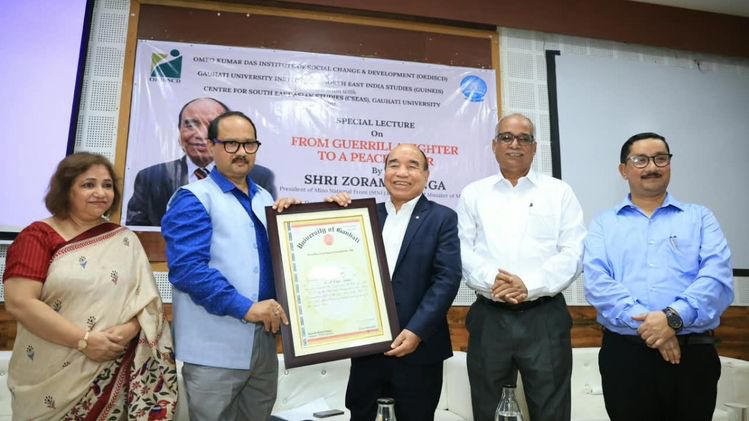
Former Mizoram Chief Minister Zoramthanga delivered a special lecture at Gauhati University, reflecting on Mizoram’s remarkable journey from decades of conflict and political uncertainty to peace and stability. Drawing from his personal experiences and long political career, Zoramthanga highlighted the complex process that transformed the state from a region affected by insurgency into one of the most peaceful parts of the Northeast.
The lecture focused on the importance of dialogue, patience, political understanding and mutual trust in resolving long-standing conflicts. Zoramthanga, who played an important role in the Mizo peace process and later served as the Chief Minister of Mizoram, shared insights into the circumstances that led to the signing of the historic Mizoram Peace Accord and the developments that followed.
His address offered students, teachers and members of the academic community an opportunity to understand the peace process not merely as a political event but as a long and difficult journey involving negotiations, sacrifices and the willingness of different sides to move beyond conflict.
Understanding Mizoram’s Years of Conflict
Mizoram’s journey towards peace cannot be understood without looking at the political developments that led to the rise of the Mizo movement. The region witnessed growing dissatisfaction and political unrest during the decades following India’s independence.
A major turning point came after the devastating Mautam famine of the late 1950s. The famine, which was associated with the flowering of bamboo and a subsequent increase in the rat population, created severe hardship for local communities. The response to the crisis contributed to growing public dissatisfaction and eventually led to the formation of political movements demanding greater attention to the concerns of the Mizo people.
Over time, the political movement developed into an armed insurgency. The Mizo National Front emerged as the central organisation leading the movement, and the region experienced years of violence and instability.
The conflict affected ordinary people, disrupted normal life and created deep political divisions. For years, a peaceful settlement appeared difficult as the positions of the Indian government and the insurgent leadership remained far apart.
From Armed Struggle to Political Dialogue
One of the central themes of Zoramthanga’s lecture was the transformation of the Mizo movement from armed conflict to political dialogue. This shift required sustained engagement and a willingness to explore a negotiated settlement.
Zoramthanga was closely associated with the Mizo National Front and worked alongside its leader, Laldenga, during important stages of the peace process. The journey towards a settlement involved several rounds of communication and negotiations.
Moving from conflict to dialogue was not an easy process. Years of violence had created mistrust, and both sides had to overcome political differences and uncertainties. However, the gradual recognition that a negotiated solution could provide a more lasting answer created space for progress.
The peace process demonstrated that dialogue can become possible even after prolonged conflict. Political disagreements may remain intense, but communication can help create opportunities for compromise and reconciliation.
The Historic Mizoram Peace Accord
The signing of the Mizoram Peace Accord in 1986 marked a historic turning point for the state. The agreement between the Government of India and the Mizo National Front brought an end to two decades of insurgency and established a framework for political reconciliation.
The accord is often regarded as one of India’s most successful peace agreements because it was followed by the integration of former insurgents into the democratic political process. The Mizo National Front transformed into a recognised political party and began participating in elections.
The peace agreement also helped strengthen democratic institutions and create conditions for long-term stability. Rather than allowing the conflict to continue, the settlement opened the way for political participation and development.
Zoramthanga’s reflections at Gauhati University highlighted the importance of this transition. The peace accord was not simply a document signed by political leaders; it represented a decision to replace armed confrontation with democratic engagement.
Peace Requires Trust and Political Courage
During his lecture, Zoramthanga emphasised lessons that can be drawn from Mizoram’s experience. One of the most important lessons is the need for trust between parties involved in a conflict.
Peace negotiations can succeed only when different sides believe that their concerns will be heard and that commitments made during discussions will be respected. Building such trust often takes years, particularly after prolonged violence.
Political courage is equally important. Leaders involved in negotiations may face criticism from their own supporters and may have to make difficult decisions. A settlement often requires compromise, which can be politically challenging.
The Mizoram experience shows that peace cannot be achieved simply by ending violence. A durable settlement requires a political arrangement that allows people to participate in democratic processes and express their concerns through constitutional means.
Mizoram as an Example of Lasting Peace
Today, Mizoram is frequently cited as an example of successful conflict resolution and long-term peace. The state has maintained stability for decades following the 1986 accord, despite the challenges that have affected other parts of the Northeast.
The success of the peace process is linked to several factors. The agreement addressed important political concerns, while the transition of the MNF into democratic politics created a peaceful avenue for political competition.
Former insurgents were given the opportunity to participate in the political system, helping reduce the possibility of a return to armed conflict. The peace process also allowed Mizoram to focus increasingly on governance, development and social progress.
However, the Mizoram model cannot necessarily be copied directly in every conflict. Each region has its own history, political circumstances and social realities. Nevertheless, the experience provides important lessons about the value of dialogue, patience and inclusive political solutions.
Importance of Peace Studies and Academic Discussion
The special lecture at Gauhati University also underlined the importance of academic institutions in studying conflict and peace-building. Universities can provide a platform where students and researchers examine historical experiences and draw lessons for contemporary society.
For students in the Northeast, the story of Mizoram’s peace process offers an important example from the region’s own history. Rather than studying conflict resolution only through international examples, they can analyse a successful peace process that took place within India’s democratic framework.
Academic discussions can also help preserve the memories and experiences of people who were directly involved in important historical events. Leaders such as Zoramthanga offer firsthand perspectives that may not always be fully captured in official documents or textbooks.
The interaction therefore gave students an opportunity to connect political history with lived experience.
Lessons for the Northeast and Beyond
Mizoram’s journey from conflict to peace continues to offer important lessons for other regions dealing with political tensions and social divisions. The most significant lesson is that dialogue must remain open, even during periods of serious disagreement.
A conflict that appears impossible to resolve at one stage may eventually move towards a settlement when political circumstances change and leaders are willing to engage. Negotiation does not always produce immediate results, but sustained communication can gradually build the foundation for peace.
The Mizoram Peace Accord also demonstrates the importance of honouring commitments. A peace agreement can succeed only when its provisions are implemented and the people involved believe that the political process is genuine.
At the same time, peace must be supported by opportunities for democratic participation, economic development and social reconciliation. Ending armed conflict is an important first step, but lasting peace depends on creating conditions in which communities can build a stable future.
Zoramthanga’s Personal Perspective on a Historic Journey
Zoramthanga’s special lecture carried particular significance because of his direct association with the political developments that shaped Mizoram’s modern history. His journey from the period of insurgency to becoming a senior political leader and Chief Minister reflects the broader transformation experienced by the state.
His experiences provide a personal perspective on the challenges of moving from confrontation to negotiation. The transition required individuals and organisations to reconsider their strategies and place long-term peace above continued conflict.
By sharing these experiences with students at Gauhati University, Zoramthanga brought attention to the human and political dimensions of peace-building. Historical events are shaped not only by institutions and agreements but also by individuals who make difficult decisions during critical moments.
Looking Ahead
The former Mizoram Chief Minister’s lecture at Gauhati University served as a reminder that peace is often the result of a long and challenging process rather than a single event. Mizoram’s transformation from conflict to stability was made possible through years of political engagement, negotiation and reconciliation.
The 1986 Mizoram Peace Accord remains a major milestone in India’s history of conflict resolution, demonstrating how dialogue and political accommodation can help bring an end to prolonged violence.
For students and researchers, Zoramthanga’s reflections offered valuable lessons on leadership, negotiation and the importance of building trust. For the wider Northeast, Mizoram’s experience continues to stand as a powerful example of how even deeply rooted conflicts can eventually give way to peace.
As discussions on conflict resolution and peace-building continue, the story of Mizoram remains a reminder that lasting stability requires patience, courage and a willingness to choose dialogue over violence.