


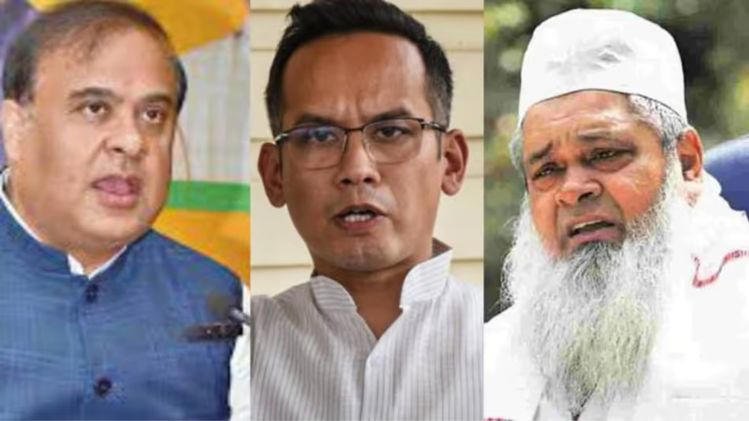
Congress leader Gaurav Gogoi has stirred political debate in Assam by calling Chief Minister Himanta Biswa Sarma and AIUDF chief Badruddin Ajmal “two sides of the same coin.” The remark has added fresh intensity to the political discourse ahead of the Assam Assembly Elections 2026, with parties sharpening their narratives and targeting rivals more aggressively.
The statement by Gaurav Gogoi reflects the Congress party’s attempt to position itself as a distinct alternative in a competitive political landscape. By linking the BJP and AIUDF leadership, Gogoi has aimed to question their political approaches and influence voter perception.
Read More: AIUDF Faces Toughest Contest in Assam Polls
Gogoi’s Sharp Attack on Political Rivals
Gaurav Gogoi made the statement during a political interaction, where he criticised both Himanta Biswa Sarma and Badruddin Ajmal. According to him, despite ideological differences, both leaders contribute to a style of politics that he claims divides society.
He argued that such politics distracts from real issues such as development, employment, and governance. Therefore, he called for a shift in focus toward policies that benefit the people of Assam.
Moreover, Gogoi emphasized that voters should look beyond rhetoric and evaluate the actual impact of political leadership. His remarks suggest a broader strategy to challenge dominant narratives in the state.
As a result, the comment has triggered strong reactions from both the BJP and AIUDF, further intensifying political exchanges.
Political Context Behind the Statement
The timing of Gogoi’s statement is significant, as Assam gears up for the Assembly Elections 2026. Political parties have started mobilizing support and framing their campaign narratives.
By calling Himanta Biswa Sarma and Badruddin Ajmal “two sides of the same coin,” Gogoi appears to be attempting to draw a contrast between Congress and its rivals. This approach aims to consolidate support among voters who seek an alternative political direction.
Furthermore, the statement reflects ongoing rivalries and shifting alliances in Assam politics. The BJP and AIUDF have often been portrayed as opposing forces, making Gogoi’s comparison particularly noteworthy.
Therefore, the remark has sparked debate about political positioning and strategy in the state.
BJP Responds to the Allegation
Leaders from the BJP have strongly rejected Gogoi’s claim, calling it baseless and politically motivated. They have defended the government’s record, highlighting achievements in infrastructure, security, and economic development.
According to BJP leaders, equating Himanta Biswa Sarma with Badruddin Ajmal is an attempt to mislead voters. They argue that the party has consistently worked for the progress of Assam and has delivered tangible results.
Moreover, BJP representatives have accused the Congress of resorting to rhetoric instead of presenting a clear vision. They have challenged Gogoi to focus on policy-based discussions rather than personal attacks.
As a result, the exchange has added to the intensity of the political contest.
AIUDF Reacts to Gogoi’s Remarks
The AIUDF has also responded to Gogoi’s statement, rejecting the comparison and defending its political stance. Party leaders have stated that their focus remains on representing the interests of their constituents.
They have argued that equating their leadership with that of the BJP oversimplifies the political landscape. According to them, each party has its own ideology and approach to governance.
Furthermore, AIUDF leaders have suggested that Gogoi’s remarks reflect political frustration. They have emphasized their commitment to addressing community concerns and participating in democratic processes.
Therefore, the statement has drawn criticism from multiple sides, highlighting the complexity of political dynamics in Assam.
Congress Strategy to Reframe Political Debate
Gaurav Gogoi’s comment appears to be part of a broader Congress strategy to reframe the political debate in Assam. By linking rival leaders, the party aims to shift focus toward issues such as governance, employment, and development.
The Congress has been trying to position itself as a party that prioritizes inclusive growth and balanced policies. Therefore, statements like these are intended to highlight perceived shortcomings in rival parties.
In addition, the party is working to strengthen its grassroots presence and reconnect with voters. Engaging in strong political messaging helps draw attention and create discussion.
As the elections approach, such strategies are likely to play a crucial role in shaping voter perception.
Impact on Voter Sentiment
Statements like Gogoi’s can influence voter sentiment by shaping narratives around political leaders. While some voters may view the remark as a valid critique, others may see it as political rhetoric.
The effectiveness of such statements depends on how they resonate with the electorate. Voters often consider multiple factors, including governance, development, and personal credibility, when making decisions.
Moreover, the reactions from BJP and AIUDF indicate that the statement has already sparked significant attention. This increased visibility could impact public discourse in the coming weeks.
Therefore, the comment may contribute to a more polarized yet engaging political environment.
Intensifying Political Competition in Assam
The exchange between Congress, BJP, and AIUDF reflects the growing intensity of political competition in Assam. As parties prepare for elections, they are actively shaping narratives and targeting opponents.
Gaurav Gogoi’s remark adds another layer to this competition, highlighting differences in political approaches. At the same time, it underscores the importance of communication in modern campaigns.
Furthermore, such statements often set the tone for future debates and discussions. Political parties may continue to use similar strategies to gain attention and influence voters.
As a result, the political landscape in Assam is becoming increasingly dynamic.
Conclusion: A Heated Political Narrative Emerges
Gaurav Gogoi’s statement describing Himanta Biswa Sarma and Badruddin Ajmal as “two sides of the same coin” has intensified political discourse in Assam. The remark reflects the Congress party’s strategy to challenge its rivals and present itself as an alternative.
While BJP and AIUDF have rejected the claim, the statement has succeeded in drawing attention and sparking debate. As the Assembly Elections 2026 approach, such exchanges are likely to become more frequent.
In conclusion, the evolving political narrative in Assam highlights the importance of messaging, strategy, and public perception. Gaurav Gogoi’s comment has added momentum to this narrative, setting the stage for a competitive and closely watched electoral contest.