


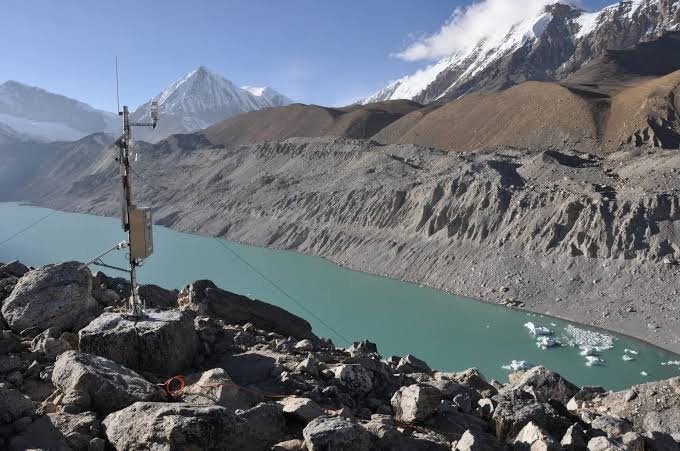
The Glacial Lake Monitoring (SK) effort at South Lhonak Lake is using scientific monitoring systems to track changes in water conditions at one of Sikkim’s high-priority glacial lakes. Remote sensing and ground-based instruments are helping authorities and researchers assess potential glacial lake outburst flood risks in the region.
Glacial Lake Monitoring (SK) Focuses on South Lhonak
The Glacial Lake Monitoring (SK) initiative focuses on South Lhonak Lake, a high-altitude glacial lake in North Sikkim that authorities have identified as a priority site for monitoring.
South Lhonak Lake gained particular attention after its major outburst in October 2023. ISRO’s National Remote Sensing Centre used satellite imagery to compare the lake before and after the event and reported that about 105 hectares of lake area drained between September 28 and October 4, 2023.
The event demonstrated the importance of monitoring changes in vulnerable glacial lakes. Moreover, information about lake area, water conditions, and surrounding terrain can help scientists and disaster-management agencies assess potential hazards.
Sikkim authorities have subsequently continued efforts to strengthen monitoring systems at South Lhonak and other vulnerable lakes. Therefore, the latest monitoring work forms part of a wider strategy to improve preparedness for glacial lake outburst floods, commonly known as GLOFs.
Glacial Lake Monitoring (SK) Uses Remote and Ground-Based Systems
The Glacial Lake Monitoring (SK) effort combines remote sensing with instruments installed near vulnerable glacial lakes. Satellite observations can provide repeated information about changes in lake area and surrounding terrain, while ground-based equipment can collect measurements directly at the site.
ISRO has previously used satellite data to monitor South Lhonak Lake. Its analysis compared satellite observations from different dates to identify changes in the lake’s area following the 2023 outburst.
Furthermore, Sikkim authorities and partner agencies have installed monitoring equipment at South Lhonak Lake. During a collaborative expedition in late 2024, officials re-installed a monitoring system equipped with pressure probes after the earlier system had been washed away during the 2023 flood.
The use of pressure probes can provide valuable information about changing water conditions. However, the information available does not establish that the latest monitoring system has recorded a specific new increase in lake volume.
Therefore, reports about water expansion should be interpreted alongside verified measurements and official technical assessments.
Glacial Lake Monitoring (SK) Strengthens GLOF Risk Assessment
The Glacial Lake Monitoring (SK) initiative has broader significance because South Lhonak remains an important site for assessing GLOF risks in Sikkim.
A glacial lake can develop as glaciers retreat and meltwater accumulates in areas constrained by natural barriers. Changes in lake size, water pressure, surrounding ice, and moraine structures can influence potential flood hazards.
Moreover, Sikkim authorities have identified South Lhonak and Shako Chho among the state’s high-priority glacial lakes for monitoring and risk-reduction measures. In 2023, monitoring stations were handed over to disaster-management authorities as part of efforts to develop early-warning systems for GLOFs.
Ground observations also complement satellite information. In 2025, a multidisciplinary scientific team conducted bathymetric studies at South Lhonak, fixed pressure probes, and collected post-flood sediment samples as part of continuing GLOF risk assessments.
Consequently, monitoring now involves several forms of scientific observation rather than relying on a single source of information.
Glacial Lake Monitoring (SK) Supports Early Warning Efforts
The Glacial Lake Monitoring (SK) system can contribute to early-warning efforts by providing authorities with information about changing conditions at vulnerable lakes.
Early warning becomes particularly important in mountainous regions because downstream communities can have limited time to respond if a sudden glacial flood occurs. Therefore, monitoring systems can form an important part of disaster preparedness.
Sikkim has also developed broader hydrological monitoring capabilities. The state’s National Hydrology Project includes plans for meteorological and hydrological stations, automatic water-level recorders, and systems for collecting and sharing water-resource information.
Additionally, ISRO has highlighted the value of satellite-based monitoring for glacial lakes and water bodies. Satellite observations can provide information across large and difficult-to-access Himalayan areas, although cloud cover can sometimes limit the availability of suitable imagery.
However, monitoring alone cannot eliminate GLOF risks. Authorities also need effective warning systems, communication networks, evacuation planning, and continued scientific assessment.
Conclusion
The Glacial Lake Monitoring (SK) effort at South Lhonak Lake reflects Sikkim’s continuing focus on understanding and reducing glacial lake outburst flood risks. Satellite observations and ground-based instruments provide complementary information that can help scientists and disaster-management authorities track changes at the high-altitude lake.
Moreover, the monitoring work carries particular importance because South Lhonak experienced a major outburst in October 2023. ISRO’s satellite analysis documented substantial changes in the lake following that event, while Sikkim authorities have since strengthened ground-based monitoring and scientific investigations.
Overall, the Glacial Lake Monitoring (SK) initiative represents an important part of Sikkim’s wider GLOF preparedness strategy. Continued monitoring, scientific analysis, and early-warning planning can help authorities better understand changing conditions and improve preparedness for downstream communities.
FAQs
1. What is Glacial Lake Monitoring (SK)?
Glacial Lake Monitoring (SK) refers to the use of satellite observations, ground-based instruments, and scientific studies to monitor vulnerable glacial lakes in Sikkim, including South Lhonak Lake.
2. Why is South Lhonak Lake monitored closely?
South Lhonak is a high-priority glacial lake because it experienced a major outburst in October 2023. Authorities therefore continue to monitor the lake and assess potential GLOF risks.
3. What technology helps monitor South Lhonak Lake?
Scientists and authorities use satellite imagery as well as ground-based equipment such as pressure probes. These systems provide different types of information about lake and environmental conditions.
4. Has South Lhonak Lake previously experienced an outburst?
Yes. ISRO reported that South Lhonak Lake underwent an outburst in October 2023 and that approximately 105 hectares of lake area drained between September 28 and October 4, 2023.
5. Can monitoring prevent a glacial lake outburst flood?
Monitoring cannot prevent an outburst by itself. However, it can provide important information for risk assessment and early-warning systems, which can support disaster preparedness and response.