

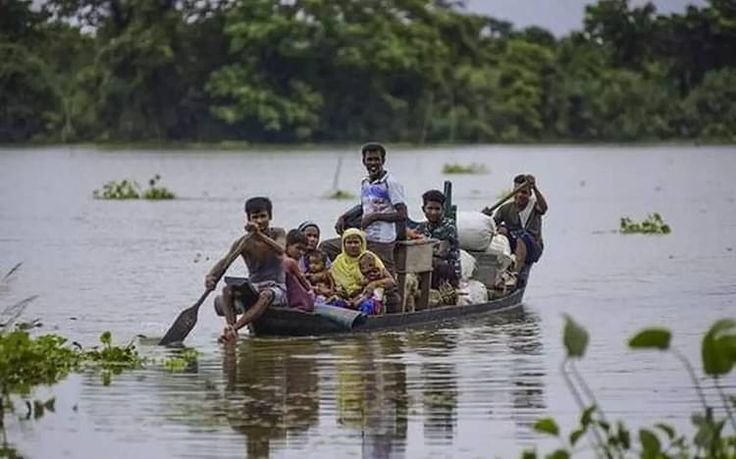
The Golaghat flood 2025 has caused massive disruption in Assam, affecting over 24,588 people across five revenue circles. Continuous rainfall, coupled with water release from a nearby hydroelectric project, has inundated over 120 villages, forcing mass evacuations and triggering a full-scale emergency response.
Local authorities, disaster relief agencies, and NGOs are now working around the clock to support the displaced residents and prevent further tragedy.
What Triggered the Golaghat Flood 2025?
Heavy Rainfall and Hydroelectric Water Release
Torrential rains in upstream Nagaland have caused the Dhansiri and Doyang rivers to overflow. In addition, the Doyang Hydroelectric Project released water to prevent dam overload, which further overwhelmed flood-prone regions in Golaghat. Consequently, dozens of villages submerged within hours, leaving families little time to evacuate.
This sudden inflow overwhelmed existing embankments, making it impossible for local drainage systems to manage the volume.
Affected Areas and Damage Overview
Villages Submerged, Homes Damaged
Floodwaters have submerged homes, schools, farmlands, and public infrastructure across five revenue circles:
- Golaghat
- Morongi
- Sarupathar
- Khumtai
- Bokakhat
Authorities report that more than 2,900 hectares of cropland are underwater, with thousands of families losing both shelter and livelihood. The agricultural damage is expected to impact the regional food supply chain for months to come.
“This is one of the worst floods we’ve faced in recent years,” said a local farmer in Khumtai. “My entire crop is gone.”
Emergency Response and Relief Measures
Government and Rescue Agencies Mobilize
The Assam State Disaster Management Authority (ASDMA), along with SDRF and NDRF teams, has successfully evacuated over 1,200 people and rescued 550 stranded livestock.
A network of 42 relief camps is currently operational across the district, offering shelter, food, and medical care to displaced families.
Essential Supplies Being Distributed
Each camp is equipped with:
- Dry food rations
- Clean drinking water
- Baby food and sanitary products
- Basic medical aid and animal fodder
The District Disaster Management Authority (DDMA) is coordinating round-the-clock supply distribution. Relief kits are also being air-dropped to areas that remain inaccessible by road.
Weather Alert: More Rain Ahead
The India Meteorological Department (IMD) has issued a warning for continued moderate to heavy rainfall across Assam and adjoining states. With soil already saturated and rivers above danger levels, any additional precipitation could worsen the flooding.
Authorities remain on high alert and have advised residents to avoid travel near rivers or low-lying areas.
Agricultural and Economic Impact
The Golaghat flood 2025 has severely impacted Assam’s tea belt and agricultural economy. Rice paddies, vegetable plots, and cash crops have all suffered damage, creating concerns about food security and market prices in the coming weeks.
Financial Aid and Compensation
Local officials have confirmed that families of the two deceased victims have received ₹4 lakh each in ex-gratia compensation. Additionally, preliminary steps are being taken to assess crop loss compensation and assistance under central disaster relief schemes.
Community and NGO Support Growing
Local NGOs, student bodies, and religious groups have stepped up by organizing community kitchens, distributing clean clothes and blankets, and offering emotional support to affected families.
These grassroots efforts are playing a crucial role in supplementing the state’s official relief machinery.
“Even if we lost our homes, we haven’t lost our hope,” said a resident sheltering in a relief camp in Bokakhat. “Our community is strong.”
Building Flood Resilience
The crisis has reignited discussions on:
- Strengthening embankment infrastructure
- Installing real-time flood warning systems
- Improving coordination for upstream water release
- Promoting climate-resilient agriculture
Experts argue that without proactive planning, such disasters will only become more frequent and damaging.
How You Can Help
To support the people of Golaghat, you can:
- Donate to verified local NGOs active in flood relief
- Volunteer with local aid organizations or logistics efforts
- Raise awareness on social media using #GolaghatFlood2025
- Stay informed and avoid sharing unverified updates
Small acts of solidarity today can bring long-term relief to those in crisis.
READ MORE: Meghalaya Cabinet Expansion: 8 New Ministers Join Office