

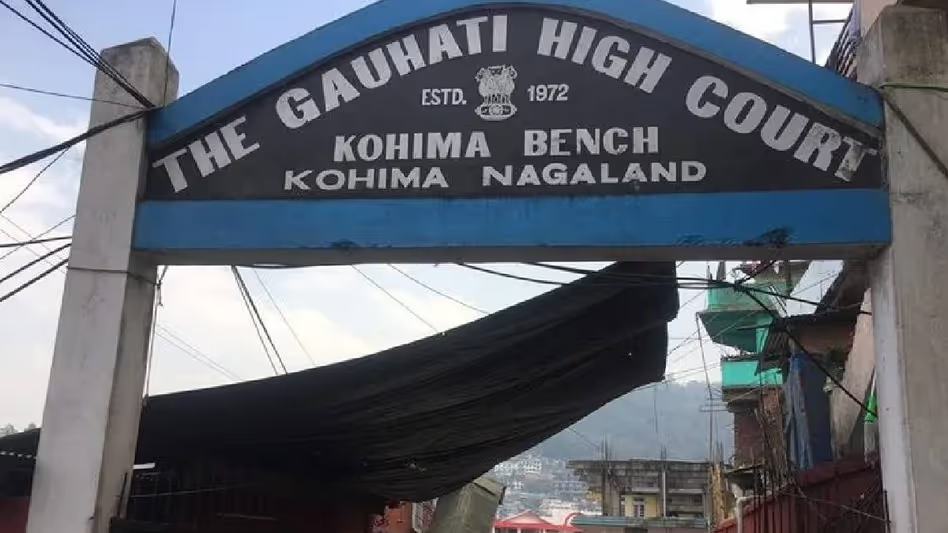
Nagaland HC nullifies recruitment in health dept over serious procedural violations, exposing irregularities in hiring and calling for transparent processes.
Nagaland HC Nullifies Recruitment in Health Dept Over Serious Procedural Violations
In a landmark judgment that sent shockwaves across the state, the Nagaland High Court nullifies recruitment in health dept after identifying serious procedural violations in the hiring process. The verdict has sparked intense discussions on governance, transparency, and accountability in Nagaland’s public administration.
The judgment has been hailed by many as a powerful move against corruption and irregularities, while others see it as a wake-up call for the state government to strengthen its recruitment frameworks.
The Case in Brief
The controversy began when several aspirants approached the High Court, alleging that the recruitment process in the health department was riddled with irregularities, favoritism, and lack of transparency.
After a detailed hearing, the Nagaland HC nullifies recruitment in health dept, stating that the process violated constitutional principles of equality, fairness, and merit-based selection.
The Court’s decision emphasizes that public employment cannot be treated as a privilege or private favor—it is a fundamental right under Article 14 and 16 of the Indian Constitution.
Key Findings of the Court
The order that Nagaland HC nullifies recruitment in health dept was based on several strong observations, including:
- Absence of proper advertisements inviting all eligible candidates.
- Unfair shortlisting procedures, with no clarity on evaluation methods.
- Serious allegations of nepotism and favoritism in the selection process.
- Violation of rules framed under service law applicable to government departments.
The Court concluded that the entire recruitment exercise was vitiated by illegality, and therefore could not stand.
Public Reactions: A Mixed Bag
The decision that Nagaland HC nullifies recruitment in health dept has drawn mixed reactions:
- Aspirants who challenged the process welcomed the verdict, calling it a victory for justice and meritocracy.
- Those already appointed expressed shock and disappointment, fearing the loss of jobs.
- Civil society organizations praised the court for upholding transparency and accountability.
This division shows the complex human impact of such judgments. While the verdict corrects wrongs, it also raises concerns about the fate of existing employees.
Impact on Governance
The ruling that Nagaland HC nullifies recruitment in health dept is more than just a legal case—it is a governance milestone. It highlights:
- The urgent need for standardized recruitment rules.
- The role of judiciary in monitoring executive lapses.
- The importance of merit-based hiring in critical sectors like healthcare.
Given that the health department plays a crucial role in public welfare, flawed recruitment could have long-term consequences on service delivery and efficiency.
Why Procedural Integrity Matters in Public Hiring
When the Nagaland HC nullifies recruitment in health dept, it is not just punishing procedural lapses—it is protecting the core values of public service.
Procedural integrity ensures:
- Equal opportunity for all aspirants.
- Competence and efficiency in public service.
- Trust in the system among citizens.
Without transparency, government jobs risk becoming political favors rather than positions of responsibility.
The Human Side of the Verdict
Behind the headlines that Nagaland HC nullifies recruitment in health dept, there are real human stories:
- A young graduate who prepared for years finally saw justice delivered.
- A selected candidate, now losing their job, faces uncertainty and frustration.
- Families dependent on government employment must now rethink their future plans.
The judgment is a reminder that governance failures affect lives, not just policies.
Comparisons with Similar Cases in India
The ruling that Nagaland HC nullifies recruitment in health dept is not an isolated incident. Across India, courts have stepped in to quash flawed recruitments:
- Rajasthan High Court canceled irregular teacher recruitments.
- Madhya Pradesh HC intervened in police recruitment scams.
- Supreme Court of India has repeatedly emphasized the need for fairness and transparency in public jobs.
This trend shows that judicial scrutiny is a powerful check against bureaucratic mismanagement.
Legal and Constitutional Significance
The Nagaland HC nullifies recruitment in health dept ruling reinforces constitutional principles:
- Article 14 (Equality before law): No candidate should be discriminated against.
- Article 16 (Equality of opportunity in public employment): Recruitment must be open, transparent, and merit-based.
- Rule of Law: Government must operate within a legal framework, not arbitrarily.
Thus, the judgment strengthens constitutional governance in the state.
Challenges Ahead
While the verdict is widely applauded, the order that Nagaland HC nullifies recruitment in health dept also creates challenges:
- Vacant posts in the health department could affect healthcare delivery.
- The government must re-initiate the recruitment process quickly to avoid service gaps.
- Displaced employees may file appeals or demand compensation.
The path forward requires careful balancing of justice and administrative efficiency.
What This Means for Job Aspirants
For thousands of job aspirants in Nagaland, the message is clear:
- Merit and fairness will prevail in the long run.
- Legal remedies exist when procedures are violated.
- Vigilance is required to hold authorities accountable.
Thus, while the process may be delayed, the ruling ensures that future opportunities will be fairer.
Steps the Government Must Take
After the Nagaland HC nullifies recruitment in health dept, the government has a responsibility to:
- Frame clear and transparent recruitment policies.
- Ensure widespread advertisements to invite applications.
- Use independent boards or commissions for selection.
- Set up grievance redressal mechanisms for candidates.
Only then can it restore public confidence in government hiring.
Civil Society’s Role
Civil society groups have welcomed the judgment, but they also stress that:
- Monitoring recruitment processes must become routine.
- Whistleblowers must be protected and encouraged.
- Transparency initiatives like RTI (Right to Information) should be promoted.
This ensures that cases don’t reach courts too late, saving years of litigation.
Read More: Powerful Mobile Connectivity in Arunachal’s Border Districts to Get Push as Army, Airtel Ink Pact