


India-Japan bilateral trade has the potential to reach USD 50 billion by 2030, rising sharply from USD 27.47 billion in 2025-26, according to a report by industry body Assocham.
The report said stronger economic complementarities, greater export diversification and deeper business engagement could drive the expansion. An upgraded India-Japan trade agreement could also play an important role in achieving the target.
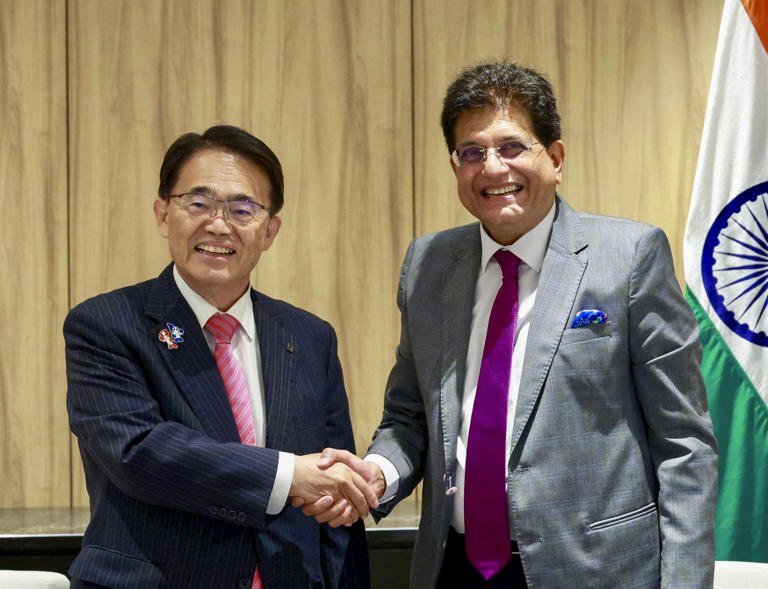
Union Commerce and Industry Minister Piyush Goyal released the Assocham report, titled India-Japan @75: From Enduring Friendship to Strategic Business Partnership, during an engagement in Japan.
The projection comes as India and Japan seek to deepen their economic relationship. Goyal has also called for a review and expansion of the existing Comprehensive Economic Partnership Agreement, or CEPA, to make it more relevant to current business conditions.
India-Japan trade could touch USD 50 billion
Assocham said bilateral trade between India and Japan could grow to USD 50 billion by 2030.
The report estimated that merchandise trade between the two countries stood at USD 27.47 billion in 2025-26.
This marks significant growth from USD 15.36 billion in 2020-21. Bilateral merchandise trade has increased by nearly 79% over the five-year period.
However, the report pointed out that India-Japan trade still remains below its full potential.
India’s share in Japan’s overall import market remains below 1%. This leaves substantial room for Indian companies to increase their presence.
Assocham believes that greater business engagement and a more diversified export basket can help unlock this potential.
Export diversification key to trade growth
The Assocham report identified several sectors where India could expand exports to Japan.
These include pharmaceuticals, chemicals, machinery and mechanical products, electronics and marine products.
Indian companies could strengthen their presence by focusing on higher-value products and meeting the requirements of the Japanese market.
The report noted that India has already established a stronger presence in some sectors.
India accounted for 6.33% of Japan’s imports of organic chemicals in 2025. Its share in automobiles and auto components stood at 4.4%.
These sectors could provide a foundation for further growth.
However, Indian exporters will need to expand into additional product categories to achieve the USD 50 billion target.
Trade deficit remains a major challenge
Despite the growth in bilateral trade, the trade balance continues to favour Japan.
India imported goods worth USD 21.43 billion from Japan during 2025-26. Its exports to Japan stood at USD 6.04 billion.
The figures highlight the wide gap between imports and exports.
Industry representatives have raised concerns about the growing trade deficit.
They have also pointed to difficulties faced by Indian businesses while accessing the Japanese market.
Regulatory requirements, certification processes and other market barriers can affect the ability of Indian companies to expand exports.
Addressing these issues could become crucial as both countries work towards deeper economic engagement.
Assocham calls for stronger business engagement
Assocham has stressed the importance of stronger ties between businesses in India and Japan.
The report said growing economic complementarities could support greater cooperation between companies in both countries.
Indian businesses can benefit from Japan’s advanced manufacturing capabilities and technological expertise.
Meanwhile, Japanese companies can find new opportunities in India’s expanding economy and manufacturing sector.
Greater collaboration could also strengthen supply chains and encourage investment.
The two countries have already developed partnerships in several strategic sectors.
These include technology, manufacturing, semiconductors and economic security.
A stronger business relationship could create new opportunities for trade and investment over the coming years.
India seeks review of Japan trade agreement
The Comprehensive Economic Partnership Agreement between India and Japan has become an important part of the discussion around expanding bilateral trade.
Goyal recently said India remains open to expanding the scope and scale of the agreement.
The government wants to make the pact more contemporary and better suited to present-day economic conditions.
India has also sought feedback from industry representatives about the challenges they face while exporting to Japan.
A review could address concerns related to market access and regulatory barriers.
Businesses have argued that changes may be necessary to create a more balanced and mutually beneficial trade relationship.
A modernised agreement could help Indian exporters gain greater access to Japan while opening new areas for economic cooperation.
High-tech manufacturing offers new opportunities
India and Japan are increasingly focusing on high-technology manufacturing and next-generation industries.
This shift could create fresh opportunities beyond traditional trade sectors.
Japanese companies have significant expertise in advanced manufacturing, electronics and industrial technology.
India, on the other hand, offers a large market and an expanding manufacturing ecosystem.
The two countries could strengthen cooperation in areas such as semiconductors, electronics and other strategic technologies.
Supply chain partnerships may also help companies reduce risks and diversify production.
These emerging sectors could contribute significantly to the future growth of India-Japan trade.
The expansion of economic cooperation may therefore depend not only on increasing existing trade but also on developing entirely new areas of business.
USD 50 billion target reflects untapped potential
The Assocham projection reflects the significant untapped potential in the India-Japan economic relationship.
At USD 27.47 billion, current bilateral trade remains far below the projected USD 50 billion target.
Reaching that level will require sustained growth in exports.
India will need to improve its presence in Japan’s import market.
Businesses will also need to adapt to quality standards and regulatory requirements.
At the policy level, both governments may need to address barriers that limit trade expansion.
The proposed review of CEPA could become an important step in this process.
Greater investment and stronger business-to-business engagement could also support the growth target.
India-Japan economic ties enter a new phase
The latest Assocham report comes as India and Japan look to strengthen their broader strategic and economic partnership.
Both countries see opportunities in manufacturing, technology and supply-chain cooperation.
India’s growing industrial base could attract greater Japanese investment.
At the same time, Indian companies are looking for opportunities to expand their presence in Japan.
The USD 50 billion trade projection provides an ambitious target for the next phase of the relationship.
Success will depend on export diversification, stronger market access and closer business cooperation.
A modernised trade agreement could further support these efforts.
For now, Assocham’s report underlines the significant potential that remains in the India-Japan trade relationship.
With bilateral trade already reaching USD 27.47 billion in 2025-26, the two countries will need to accelerate economic cooperation to reach the USD 50 billion milestone by 2030.