


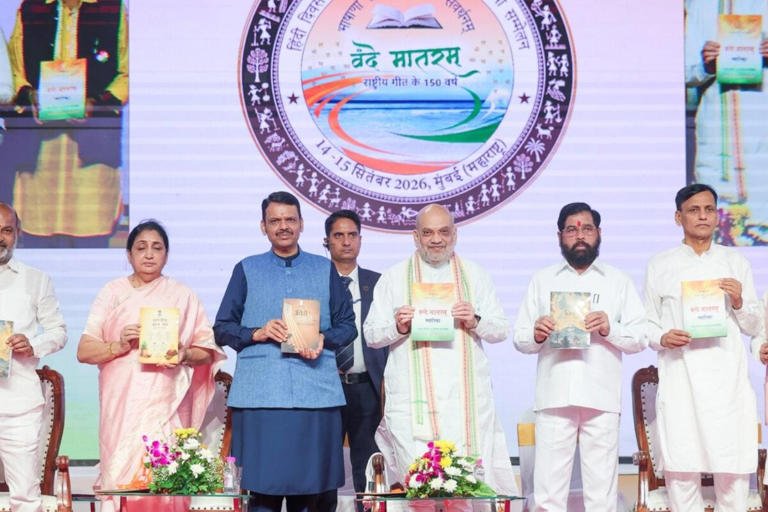
Union Home Minister Amit Shah stressed the importance of India’s linguistic diversity while calling for national unity at the Hindi Diwas 2026 celebrations in Mumbai.
Addressing the Hindi Diwas programme and the 6th All India Official Language Conference, Shah said India’s many languages represent different voices but share a common cultural and national spirit. He stressed that promoting Hindi should not come at the cost of other Indian languages.
His remarks focused on strengthening India’s languages together and using them in education, governance, science and technology.
Amit Shah Calls For Linguistic Unity
Shah said India has many languages and dialects, but the country’s collective voice must remain united. He said linguistic diversity is a strength and should not become a reason for division.
He described Indian languages as different notes that together create one larger national song. He also urged people to move away from political disputes over languages.
The Home Minister stressed that every Indian language carries its own history, culture and traditions. Protecting this diversity, he said, is important for India’s cultural identity.
Hindi As A Link Between Indian Languages
Shah presented Hindi as a language that can help connect people from different parts of the country. He said Hindi has developed through centuries of interaction with other Indian languages.
He also stressed that Hindi should not be viewed as a competitor to regional languages. Instead, he said, it can act as a bridge between them.
According to Shah, the government wants to strengthen Hindi while also enriching India’s other languages. The broader aim is to create stronger connections between India’s diverse linguistic traditions.
Regional Languages Must Continue To Grow
Shah said regional languages should receive respect and support in their respective regions. He compared India’s languages to the petals of a lotus, with each language contributing to the beauty of the whole.
He argued that the development of Hindi should happen alongside the protection of regional languages. This approach, he said, can strengthen rather than weaken India’s unity.
The message comes amid long-running debates over the role of Hindi in India’s multilingual society. Several non-Hindi-speaking states have raised concerns about attempts to promote Hindi at the expense of regional languages.
Mother Tongue Important For Children
The Home Minister also highlighted the importance of the mother tongue in a child’s development.
Shah said children can better understand their culture, history and surroundings when they learn through their mother tongue. He encouraged parents to communicate with their children in their native languages.
He also urged young people to learn additional Indian and global languages without abandoning their own linguistic roots.
According to Shah, learning another Indian language can strengthen the idea of “Ek Bharat, Shreshtha Bharat”. It can also help young people develop a broader understanding of the country’s cultural diversity.
Indian Languages In Education
Shah highlighted efforts to increase the use of Indian languages in education. He pointed out that major examinations such as JEE and NEET are now conducted in 13 languages.
The expansion of language options can make competitive examinations more accessible to students from different linguistic backgrounds.
The government has also promoted the use of Indian languages in technical and professional education. Shah said these efforts are part of a wider push to make Indian languages useful in modern education and knowledge systems.
Technology To Support Indian Languages
Technology was another major theme of Shah’s address. He highlighted the growing use of artificial intelligence and digital tools to support India’s languages.
The Home Minister mentioned initiatives such as LILA Rajbhasha, LILA Pravah and the AI-based “Bharti – Bahubhashi Anuvad Sarathi”. These initiatives aim to improve language learning, translation and communication.
He also highlighted the expansion of the Hindi Shabd-Sindhu dictionary. The dictionary has grown from around 51,000 words to more than eight lakh entries, with thousands of words from Indian languages incorporated into it.
Language And National Identity
Shah linked language with India’s cultural identity and the country’s broader development journey. He said language is more than a tool for communication because it carries a society’s history and traditions.
He also connected the promotion of Indian languages with the idea of moving away from a colonial mindset.
The government has increasingly promoted the use of Indian languages in administration, education and technology. Shah said these efforts can help Indians engage with modern knowledge while remaining connected to their cultural roots.
More Than Five Lakh Government Employees Trained
Shah also highlighted the government’s efforts to increase the use of Hindi in official work. He said more than five lakh government employees have received training in the Official Language.
He pointed to digital tools that can support government employees and improve communication in Indian languages.
The aim is to make language more accessible in governance while improving communication between citizens and public institutions.
Awards And Publications Released
The Hindi Diwas event also included the presentation of the Rajbhasha Kirti Awards and Rajbhasha Gaurav Awards.
Several publications were also released during the programme. These included special editions focused on Indian knowledge traditions, Shivaji Maharaj and Vande Mataram.
Shah also highlighted the historical role of Vande Mataram in India’s freedom movement. He described the song as an important force in awakening national consciousness.
India’s Many Languages, One Collective Voice
The central message of Shah’s address was that linguistic diversity and national unity can exist together.
He said India does not need to choose between Hindi and other Indian languages. Instead, he called for an approach that allows every language to grow while strengthening connections between them.
“India’s voice must remain one,” Shah said, stressing that different languages and dialects can coexist within a shared national identity.
Looking Ahead
Amit Shah’s Hindi Diwas address placed India’s linguistic diversity at the centre of the national unity debate. He called for stronger Hindi while also stressing the protection and promotion of regional languages.
The government’s focus is increasingly moving towards using technology to connect India’s languages. Education, governance and artificial intelligence could play an important role in this effort.
As India continues to embrace its multilingual identity, the challenge will be to promote communication and shared understanding without weakening the country’s rich regional languages. Shah’s message was clear: India can speak in many languages, but its shared cultural and national spirit should remain united.