


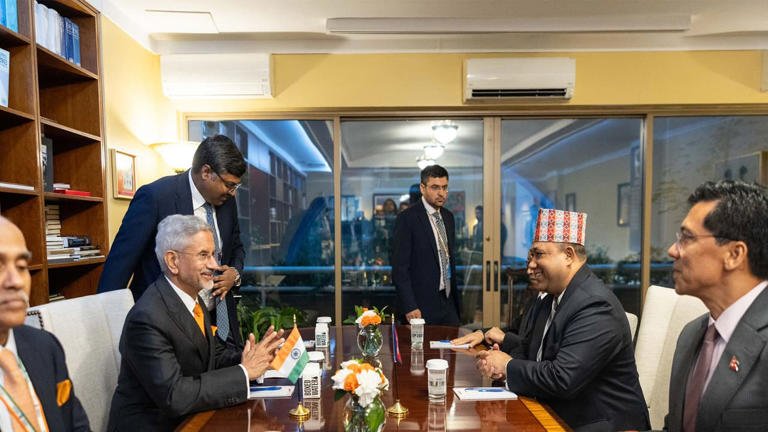
External Affairs Minister S Jaishankar met Nepal’s Foreign Minister Shisir Khanal on the sidelines of the 81st United Nations General Assembly in New York on September 23. The two ministers reviewed developments in India-Nepal relations, with a focus on development partnership and energy cooperation.
Jaishankar said the meeting followed up on bilateral developments since his previous meeting with Khanal in New Delhi in June. The discussions covered progress in areas that remain important to the long-standing relationship between the two neighbouring countries.
The meeting took place during the UNGA’s high-level week, when India is engaging with several countries on bilateral, regional and global issues.
Development Partnership Remains a Key Focus
Development cooperation featured prominently in the discussions. India and Nepal have worked together on infrastructure, connectivity, capacity building and other development projects over the years.
The latest meeting provided an opportunity to review the progress of these initiatives and discuss ways to strengthen cooperation further. Both sides also exchanged views on issues of mutual interest.
India has maintained that its engagement with Nepal is based on close people-to-people ties and a broad development partnership. The two countries share an open border and extensive social, cultural and economic connections.
Energy Cooperation Gets Attention
Energy cooperation was another major subject during the Jaishankar-Khanal meeting. Hydropower remains one of the most significant areas of economic cooperation between India and Nepal.
Nepal has significant hydropower potential, while India has a large and growing electricity market. Both countries have therefore expanded cooperation in power generation, transmission and electricity trade.
Recent discussions between the two sides have also focused on expanding clean-energy cooperation. Nepal has set ambitious targets for increasing its hydropower capacity, while India has emerged as an important market for Nepal’s electricity exports.
India Supports Nepal After Floods
During the meeting, Khanal also expressed appreciation for India’s assistance following devastating floods in Nepal last month.
The Permanent Mission of Nepal to the United Nations said the foreign minister thanked India for its solidarity and immediate critical support after floods affected the Bhotekoshi and Trishuli river basins.
India began sending relief assistance to Nepal on August 26. The relief effort included temporary shelters, blankets, hygiene kits, solar lamps and medicines. Nine dedicated aircraft were subsequently used to transport relief supplies, equipment and specialist personnel.
The assistance has added a humanitarian dimension to the countries’ ongoing bilateral engagement.
Broader India-Nepal Cooperation
India and Nepal are also working to strengthen cooperation in connectivity, infrastructure, trade and investment. These areas complement their growing energy partnership.
Recent discussions have included proposals to improve cross-border connectivity and expand economic engagement. Nepal has also sought greater Indian investment in areas such as clean energy, digitalisation, agriculture and tourism.
Moreover, the two countries continue to discuss arrangements that can facilitate trade and movement across their shared border.
Meeting Held During Busy UNGA Week
The Jaishankar-Khanal meeting was part of the Indian external affairs minister’s wider diplomatic engagements during UNGA 81.
Jaishankar has been holding meetings with foreign ministers from different regions while participating in discussions on multilateralism, development, energy security and global challenges. He is also scheduled to address the UN General Assembly’s General Debate on September 26.
The Nepal meeting allowed both sides to address bilateral priorities while participating in the wider diplomatic activity surrounding the UNGA.
India and Nepal Look to Strengthen Ties
The latest talks underline the continuing importance of India-Nepal relations. Development cooperation, energy and humanitarian assistance remain central areas of engagement.
For Nepal, hydropower and electricity exports offer opportunities for economic growth and regional energy cooperation. For India, stronger energy links with Nepal can contribute to cross-border electricity trade and wider regional connectivity.
Meanwhile, India’s assistance during Nepal’s recent floods has added another area of cooperation between the two countries.
The Jaishankar-Khanal meeting therefore provided an opportunity to review ongoing initiatives and discuss the next steps in the bilateral relationship. With energy, development and connectivity continuing to shape India-Nepal ties, both sides are expected to maintain engagement through established diplomatic channels.