


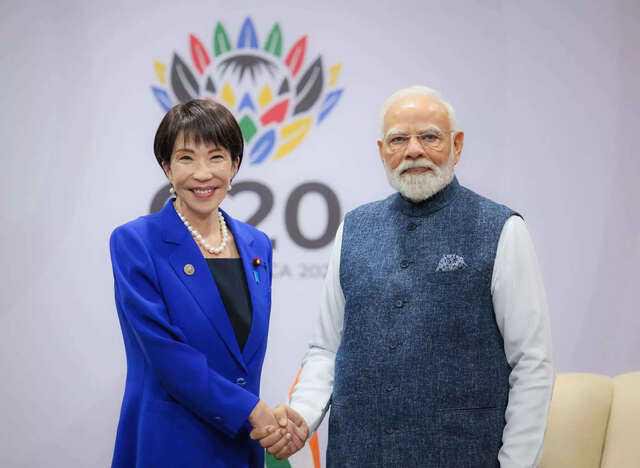
Japanese Prime Minister Sanae Takaichi has begun her first official visit to India to participate in the 16th India-Japan Annual Summit, reaffirming the commitment of both countries to further strengthen their Special Strategic and Global Partnership. The three-day visit, from July 1 to July 3, comes at the invitation of Prime Minister Narendra Modi and is expected to focus on expanding cooperation in trade, investment, defence, technology, infrastructure, clean energy, and regional security.
The annual summit serves as the highest-level bilateral dialogue between India and Japan, providing an opportunity for both leaders to review the progress of existing partnerships while identifying new avenues for collaboration in areas of mutual interest. The visit also underscores the growing strategic importance of India-Japan ties amid evolving geopolitical and economic developments in the Indo-Pacific region.
First official visit to India as Prime Minister
The visit marks Sanae Takaichi’s first official trip to India since assuming office as Japan’s Prime Minister. It follows Prime Minister Narendra Modi’s visit to Tokyo for the 15th India-Japan Annual Summit in August last year, during which both nations reaffirmed their commitment to strengthening bilateral cooperation across multiple sectors.
Officials from both countries have described the visit as an important milestone in maintaining the momentum of high-level political engagement between New Delhi and Tokyo.
The Ministry of External Affairs (MEA) said the summit reflects the shared determination of India and Japan to further deepen their long-standing strategic partnership based on common democratic values, mutual trust, and a shared vision for regional peace and prosperity.
Leaders to review comprehensive bilateral cooperation
During the summit, Prime Ministers Narendra Modi and Sanae Takaichi are expected to review progress across the full spectrum of India-Japan cooperation.
The discussions are likely to cover trade, investment, infrastructure development, manufacturing, digital technologies, defence cooperation, space, cybersecurity, healthcare, education, innovation, and people-to-people exchanges.
Officials indicated that both leaders will also assess the implementation of decisions taken during previous summits while exploring opportunities for expanding cooperation in emerging sectors such as artificial intelligence, semiconductor manufacturing, green technologies, and resilient supply chains.
The annual summit mechanism has played a crucial role in strengthening institutional cooperation and facilitating regular strategic dialogue between the two countries.
Trade and investment expected to dominate discussions
Economic cooperation is expected to remain one of the central themes of the summit.
Japan continues to be one of India’s largest foreign investors, with investments spanning manufacturing, automobiles, electronics, infrastructure, logistics, financial services, and technology. More than 1,400 Japanese companies currently operate in India, contributing significantly to industrial growth and employment generation. Bilateral trade reached approximately $27.5 billion during the 2025-26 financial year, reflecting the growing economic relationship between the two nations.
The leaders are expected to discuss measures to encourage greater investment, facilitate business collaboration, strengthen manufacturing partnerships, and improve supply chain resilience.
Officials believe that expanding economic engagement remains essential for achieving the ambitious investment targets agreed upon by both countries.
Infrastructure partnership continues to expand
Infrastructure cooperation has emerged as one of the strongest pillars of India-Japan relations.
Japan has played a major role in financing several flagship infrastructure projects in India, including the Mumbai-Ahmedabad High-Speed Rail Corridor, metro rail systems, industrial corridors, and urban development initiatives.
During the summit, both sides are expected to review ongoing infrastructure projects while exploring additional opportunities for collaboration in transportation, smart cities, logistics, sustainable urban development, and renewable energy.
Officials noted that infrastructure partnerships continue to strengthen connectivity, economic growth, and long-term development across India.
Defence and Indo-Pacific cooperation on agenda
Strategic and defence cooperation is also expected to feature prominently during the summit discussions.
India and Japan have steadily expanded their defence partnership through regular military exercises, maritime cooperation, defence dialogues, and increased security collaboration.
Both countries share a common vision for a free, open, inclusive, and rules-based Indo-Pacific, making regional security an important aspect of bilateral engagement.
As members of the Quad grouping alongside the United States and Australia, India and Japan continue to cooperate on issues relating to maritime security, regional stability, disaster response, cybersecurity, and resilient supply chains.
Officials indicated that both leaders are expected to exchange views on regional and global developments while reaffirming their commitment to maintaining peace and stability across the Indo-Pacific.
Focus on technology and emerging sectors
Apart from traditional areas of cooperation, the summit is expected to place considerable emphasis on emerging technologies.
Artificial intelligence, semiconductor manufacturing, digital transformation, green hydrogen, clean energy, innovation ecosystems, and advanced manufacturing are among the sectors where both countries see significant opportunities for future collaboration.
Officials believe that combining India’s technological capabilities and skilled workforce with Japan’s expertise in advanced manufacturing and innovation can create new avenues for economic growth.
The leaders are also expected to discuss cooperation in research, startup ecosystems, digital public infrastructure, and next-generation technologies.
Energy security and supply chain resilience
Energy cooperation is expected to receive renewed attention during the summit amid global supply chain uncertainties.
Reports indicate that India and Japan are expected to strengthen collaboration on energy security, including cooperation in liquefied natural gas (LNG) supplies and strategic energy resilience initiatives. Discussions may also include renewable energy, clean technologies, and long-term energy partnerships.
Officials have stressed that closer cooperation in the energy sector will contribute to greater economic resilience while supporting both countries’ transition towards sustainable development.
Strengthening a long-standing strategic partnership
The India-Japan relationship has evolved significantly over the past two decades into one of the most important strategic partnerships in the Indo-Pacific region.
Regular annual summits have strengthened cooperation across diplomacy, defence, economy, infrastructure, science and technology, education, and cultural exchanges.
Both governments continue to view each other as trusted partners committed to promoting democratic values, economic prosperity, and regional stability.
The visit also reflects the growing convergence of India’s Act East Policy and Japan’s vision for a free and open Indo-Pacific.
Summit expected to deepen India-Japan ties
Prime Minister Sanae Takaichi’s official visit to India for the 16th India-Japan Annual Summit marks another important milestone in the expanding partnership between the two countries. As Prime Ministers Narendra Modi and Takaichi engage in comprehensive discussions covering trade, investment, defence, technology, infrastructure, energy, and regional security, the summit is expected to further strengthen one of Asia’s most significant strategic relationships.
With both nations committed to expanding cooperation across traditional and emerging sectors, the summit is likely to reinforce the India-Japan Special Strategic and Global Partnership while opening new opportunities for economic collaboration, technological innovation, and regional stability. The outcomes of the discussions are expected to provide fresh momentum to bilateral ties and contribute to a stronger and more resilient partnership in the years ahead.