


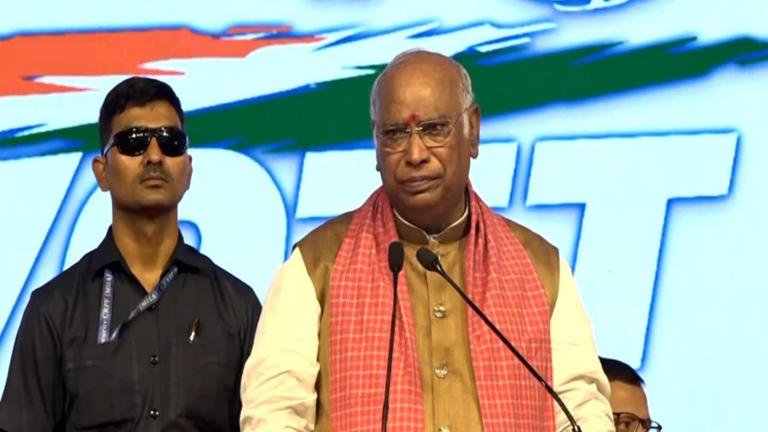
Congress president Mallikarjun Kharge launched a sharp attack on the Bharatiya Janata Party (BJP) and the Rashtriya Swayamsevak Sangh (RSS) during a public meeting in South Goa, accusing the two organisations of lacking a credible role in India’s freedom struggle. Kharge also took a personal swipe at Union Home Minister Amit Shah, saying he had entered electoral politics before Shah was even born.
Kharge’s remarks came amid a fresh political confrontation between the Congress and BJP over patriotism, the national song Vande Mataram and the legacy of India’s freedom movement. The Congress chief used his Goa visit to defend his party’s nationalist credentials while questioning the BJP’s claims of patriotism.
The remarks have added another layer to the continuing political battle between the two parties, with both sides accusing the other of failing to respect India’s national symbols and historical legacy.
Kharge Takes Dig at Amit Shah
Addressing the gathering in South Goa, Kharge mocked Amit Shah by highlighting the difference in their political experience.
Kharge said he had become an MLA before Shah was born. He used the comparison to challenge the BJP’s repeated criticism of Congress leaders and their political careers.
The Congress president also pointed to his own long political career. He said he had spent decades in public life, serving as an MLA and MP and holding several important responsibilities within the Congress.
Kharge’s comments were clearly aimed at Shah’s criticism of the Congress and its leadership. He argued that the BJP should not lecture the Congress on patriotism or political commitment.
BJP and RSS Face ‘Anti-India’ Charge
Kharge went further by accusing the BJP and RSS of being “anti-India”.
He questioned the contribution of BJP and RSS members to India’s independence movement and challenged the organisations to identify leaders from their ranks who had participated in the freedom struggle.
Kharge contrasted this with the Congress’s role in the independence movement. He referred to leaders such as Mahatma Gandhi and Jawaharlal Nehru, pointing to their involvement in the struggle against British rule.
The Congress president argued that his party’s historical contribution gives it a strong claim to India’s nationalist legacy.
His comments were part of a wider response to BJP criticism of the Congress over its position on national symbols and patriotism.
Vande Mataram Row Fuels Political Tension
The Goa meeting took place amid a controversy over Vande Mataram.
The BJP had criticised the Congress after an Independence Day event in Delhi, alleging disrespect towards the national song. The Congress rejected the criticism and accused the BJP of using patriotism as a political weapon.
In Goa, Congress workers responded by singing two stanzas of Vande Mataram at a meeting attended by Kharge.
The move served as a direct political response to the BJP’s criticism. Congress leaders sought to demonstrate that the party respects the national song and India’s national traditions.
The dispute has since developed into a larger argument over which political party can claim the stronger nationalist legacy.
Kharge Questions BJP’s Freedom Struggle Record
Kharge used the occasion to revisit the history of India’s independence movement.
He highlighted the sacrifices made by Congress leaders during the freedom struggle. He referred particularly to Gandhi’s role and Nehru’s imprisonment during the British period.
Kharge argued that the Congress had played a central role in India’s struggle for independence and later contributed to nation-building.
He then questioned the BJP and RSS’s contribution to that movement.
His remarks reflect a long-running political debate over the historical role of the RSS and its ideological organisations during India’s freedom struggle. The BJP and RSS have their own interpretations of their historical contribution and have repeatedly rejected Congress attempts to question their patriotism.
Congress Defends Its Nationalist Credentials
The Congress has faced repeated criticism from the BJP over issues involving nationalism and national symbols.
Kharge’s Goa speech attempted to reverse that narrative.
By singing Vande Mataram and highlighting Congress leaders’ participation in the freedom movement, the party sought to project itself as firmly committed to India’s national identity.
The strategy also allowed Kharge to directly challenge the BJP’s attempts to portray the Congress as insufficiently patriotic.
The Congress president argued that patriotism should not become a political monopoly and that no party should claim exclusive ownership of the country’s nationalist identity.
Kharge Calls BJP ‘Anti-Religion’
Kharge also attacked the BJP on religious grounds during his address.
He referred to an alleged “shuddhikaran” or purification ritual conducted at a venue in Haldwani, Uttarakhand, following a public meeting where he had spoken.
Kharge questioned the religious basis of such an act and accused the BJP of being “anti-religion”.
The allegation has already generated political controversy. Union minister J P Nadda had assured the Rajya Sabha that the matter would be examined to establish whether BJP members were involved in the alleged ritual.
Kharge used the incident to argue that the BJP’s interpretation of religion was inconsistent with the values it publicly claimed to defend.
Attack on BJP’s Goa Government
Kharge also targeted the BJP-led government in Goa.
He accused the ruling party of “kidnapping” MLAs to form its government, referring to the movement of legislators and political developments in the state.
The allegation reflects the Congress’s broader criticism of the BJP’s political strategies in states where governments have changed through defections or shifts in legislative support.
The BJP has rejected such characterisations and has maintained that political changes occur through constitutional and democratic processes.
The Goa political contest therefore remains another area of tension between the two parties.
BJP Youth Workers Protest Kharge’s Visit
Kharge’s Goa visit also witnessed a confrontation involving BJP youth workers.
According to reports, BJP youth wing members attempted to stop Kharge’s convoy outside Goa International Airport in Dabolim. They reportedly waved black flags over the Vande Mataram controversy.
Police and Kharge’s security personnel prevented the protesters from reaching the convoy. The incident briefly created tension between BJP youth workers and Congress supporters.
The protest demonstrated how sharply the national-symbol controversy had escalated in Goa.
Congress Uses Vande Mataram to Respond
The Congress’s decision to sing two stanzas of Vande Mataram at the Goa meeting was politically significant.
The party wanted to directly challenge the BJP’s criticism and demonstrate its respect for the national song.
Kharge used the occasion to argue that the Congress did not need lessons in patriotism from the BJP.
The move also gave the party an opportunity to shift the political conversation from allegations of disrespect to questions about the historical contributions of different political organisations.
Kharge Highlights His Political Experience
Kharge also highlighted his long political career during the speech.
He said he had spent 56 years in public life, including nine terms as an MLA and four terms as an MP. He also served two terms as a Rajya Sabha member.
His remarks about Amit Shah’s age and political experience were therefore part of a broader attempt to establish his own credentials as a veteran politician.
By contrasting his decades in public life with Shah’s comparatively later entry into electoral politics, Kharge sought to strengthen his argument that the BJP should not question the Congress’s political commitment.
Political Battle Intensifies
The latest exchange reflects the increasingly sharp rhetoric between the Congress and BJP.
The two parties have repeatedly clashed over nationalism, religion, the freedom movement and the interpretation of India’s history.
The Vande Mataram controversy has provided a new platform for that confrontation.
For the Congress, Kharge’s speech offered an opportunity to defend its nationalist credentials. For the BJP, the controversy has allowed it to question the Congress’s approach towards national symbols.
Both parties are likely to continue using these issues as they compete for public support.
Kharge’s Goa Attack Adds to National Debate
The Mallikarjun Kharge Goa speech 2026 has intensified the political debate over patriotism, the freedom struggle and the role of the BJP and RSS in India’s history.
Kharge’s remarks against Amit Shah were personal and sharply worded. His broader attack questioned the BJP and RSS’s contribution to the freedom movement and accused them of being “anti-India” and “anti-religion.”
At the same time, the Congress’s decision to sing Vande Mataram in Goa showed that the party intends to directly challenge the BJP’s narrative on nationalism.
With both sides continuing to trade accusations, the controversy is unlikely to end with Kharge’s speech. The debate has now expanded beyond a single political meeting to larger questions about patriotism, national identity and the historical legacy of India’s political parties.
For the Congress, Kharge’s message was clear: the party will not allow the BJP to claim exclusive ownership of patriotism. For the BJP, the response is likely to focus on the Congress’s conduct and its approach to national symbols.
The political battle over these questions is therefore set to continue, with Goa becoming the latest stage for a much wider national argument.