


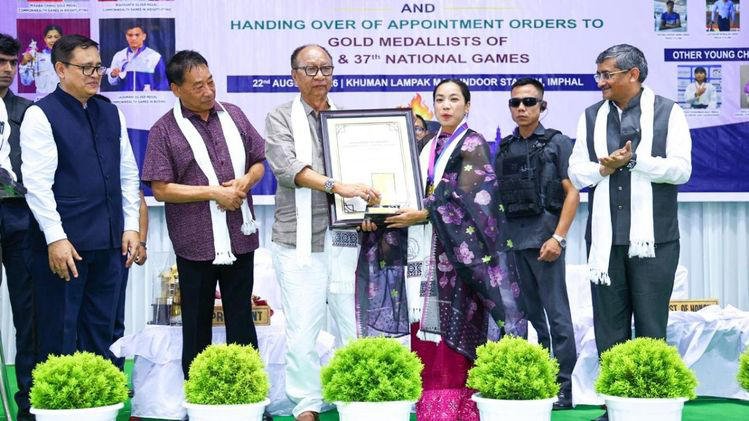
The Manipur government has expanded its sports quota policy to provide greater employment opportunities for athletes, with silver and bronze medallists now set to become eligible for government jobs alongside gold medallists.
The decision marks a significant step towards recognising the achievements of a wider group of sportspersons from the state, which has long been regarded as one of India’s leading centres for sporting talent.
Under the expanded policy, athletes who win silver and bronze medals in recognised competitions will also be able to seek government employment under the sports quota, widening the scope of benefits that were previously more limited.
The move is expected to encourage more young people to pursue sports professionally while offering successful athletes greater financial security and career opportunities after their competitive achievements.
Wider Recognition for Sporting Achievement
Manipur has produced some of India’s most prominent athletes across disciplines including boxing, weightlifting, football, hockey, archery and martial arts.
For many young athletes, however, pursuing a career in sports can involve financial uncertainty.
Training, travel, equipment and participation in competitions often require significant investment, while sporting careers can also be relatively short.
Government employment through a sports quota can provide athletes with greater long-term security.
By expanding eligibility to include silver and bronze medallists, the Manipur government is recognising that sporting excellence should not be limited only to those who finish at the very top of a competition.
Winning a medal at a recognised event requires years of training, discipline and commitment, regardless of whether it is gold, silver or bronze.
Silver and Bronze Medallists Included
The most important feature of the revised policy is the inclusion of athletes who win silver and bronze medals.
Earlier provisions focused more narrowly on top-level achievements and had limited the number of athletes who could benefit from government recruitment.
The expanded sports quota will now allow a larger number of successful sportspersons to become eligible for employment opportunities.
The decision is expected to particularly benefit athletes who consistently perform at high levels but may not always secure gold medals.
A silver or bronze medal can still represent a major achievement, particularly at national or international competitions where athletes compete against some of the strongest players in their disciplines.
The policy change acknowledges this wider spectrum of sporting excellence.
Boost for Young Athletes in Manipur
The decision is expected to provide additional motivation for young athletes across Manipur.
Sports play a major role in the social and cultural life of the state, with many children beginning training at an early age.
The possibility of government employment can provide an important incentive for talented young people and their families to invest time and resources in sporting careers.
Parents may also feel more confident supporting children who wish to pursue competitive sports if there is a clearer pathway towards long-term employment.
The expanded quota could therefore help strengthen the state’s sporting ecosystem by connecting athletic success with greater career security.
Financial Security After Sporting Success
One of the major challenges faced by athletes is maintaining financial stability throughout and after their competitive careers.
While a small number of elite athletes receive major sponsorships and prize money, many successful sportspersons continue to face financial difficulties.
Government jobs can provide a stable source of income and long-term security.
The expansion of the sports quota to include silver and bronze medallists could help a larger number of athletes build sustainable careers.
It may also reduce the pressure on athletes to abandon their sporting ambitions because of financial concerns.
For medal winners, the opportunity to secure a government position can serve as recognition not only of their achievement but also of the years of effort that led to it.
Strengthening Manipur’s Sporting Culture
Manipur has established a strong reputation as a powerhouse of Indian sports.
The state has produced athletes who have represented India at the Olympic Games, Asian Games, Commonwealth Games and several other major international competitions.
The new policy could help build on this tradition by encouraging the next generation of athletes.
A supportive policy environment can play an important role in identifying and retaining sporting talent.
When athletes know that their achievements can lead to employment opportunities, they may be more willing to continue training and competing at higher levels.
The government’s decision could therefore contribute to strengthening Manipur’s long-term sporting culture.
Government Jobs as Recognition for Athletes
Government employment under sports quotas is not only about financial assistance.
For many athletes, it also represents official recognition of their contribution to the state and the country.
Sportspersons who represent their state or nation often bring recognition and pride to their communities.
Providing employment opportunities can therefore be seen as a way of acknowledging their contribution.
The inclusion of silver and bronze medallists sends a message that sporting achievement exists at different levels and that athletes who reach the podium deserve recognition.
This broader approach could encourage a more inclusive sports policy.
Potential Impact on Different Sports Disciplines
The expanded quota is likely to benefit athletes from a variety of sporting disciplines.
Manipur has a strong presence in combat sports, athletics, football, weightlifting and other events.
Athletes from less commercially popular sports could particularly benefit from greater access to government jobs.
Unlike high-profile sports, many disciplines offer limited opportunities for sponsorship and professional earnings.
For athletes competing in these sports, government employment can provide much-needed financial stability.
The revised policy could therefore help encourage participation across a broader range of sporting disciplines.
Encouraging Continued Excellence
The promise of employment opportunities can also encourage athletes to continue competing and improving their performance.
Many young sportspersons face pressure to leave training and pursue other careers because of financial responsibilities.
A stronger sports quota can reduce this pressure by providing a more visible pathway from sporting success to employment.
The inclusion of silver and bronze medallists may also encourage athletes to view every podium finish as a meaningful achievement.
Rather than focusing exclusively on winning gold, athletes can receive recognition for reaching high levels of competition and securing other medal positions.
Policy Could Strengthen Sports Development
The Manipur government’s decision could have wider implications for sports development in the state.
Employment incentives are often most effective when combined with improved infrastructure, coaching and access to competitions.
Manipur already has a strong sporting tradition, and policies that provide additional security to athletes can help sustain this success.
The expanded quota could also encourage local sports academies and training centres to identify and support promising athletes.
As more young people see successful athletes receiving recognition and employment opportunities, interest in competitive sports may continue to grow.
A Broader Pathway From Podium to Profession
The decision to extend government job eligibility to silver and bronze medallists represents a broader approach to supporting sportspersons in Manipur.
It recognises that success in sports is not limited to winning gold and that athletes who secure other podium finishes also demonstrate exceptional skill and dedication.
The policy provides a clearer pathway from sporting achievement to professional security.
For athletes, this could mean greater confidence in pursuing long-term careers in sports.
For Manipur, it could help retain talent and strengthen the state’s position as one of India’s leading producers of elite athletes.
Manipur Strengthens Support for Its Athletes
By expanding the sports quota to include silver and bronze medallists, the Manipur government has widened the opportunities available to successful sportspersons.
The move is expected to provide greater financial security, encourage young athletes and recognise a wider range of sporting achievements.
As Manipur continues to produce athletes who compete at national and international levels, the revised policy could become an important part of the state’s broader sports development strategy.
The decision reinforces the idea that every podium achievement matters and that athletes who bring recognition to the state deserve meaningful support beyond the sporting arena.