


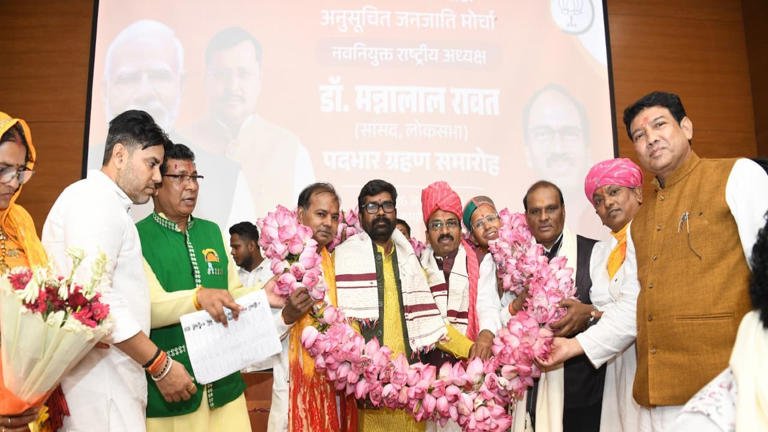
Bharatiya Janata Party leader Mannalal Rawat has formally taken charge as the national president of the BJP’s Scheduled Tribe Morcha, assuming responsibility for strengthening the party’s outreach among tribal communities across the country.
Rawat took charge at the party headquarters in New Delhi in the presence of senior BJP leaders and workers. His appointment gives him a key organisational role at a time when the BJP continues to focus on expanding its engagement with Scheduled Tribe communities.
The Scheduled Tribe Morcha serves as an important organisational wing of the BJP. It works to connect the party with tribal communities and promote awareness about government schemes and welfare programmes.
After assuming charge, Rawat is expected to focus on strengthening the organisation at different levels. The Morcha will also seek to increase its presence in tribal-dominated regions and build closer links with local communities.
The new responsibility places Rawat at the centre of the BJP’s wider tribal outreach strategy.
Mannalal Rawat formally assumes charge
Mannalal Rawat formally took charge as the national president of the BJP Scheduled Tribe Morcha.
Party leaders and workers attended the occasion at the BJP headquarters.
The ceremony marked the beginning of Rawat’s tenure in an important organisational position.
The Scheduled Tribe Morcha works as a bridge between the party organisation and tribal communities.
Its leadership plays a significant role in communicating the party’s policies and programmes at the grassroots level.
Rawat will now lead the Morcha’s activities across different states and Union Territories.
He will also work with state-level units to strengthen the organisation in areas with substantial tribal populations.
The BJP has traditionally treated tribal outreach as an important part of its organisational and political strategy.
Rawat’s appointment reflects the party’s continuing emphasis on this section of society.
BJP Scheduled Tribe Morcha plays key organisational role
The BJP Scheduled Tribe Morcha focuses on issues affecting Scheduled Tribe communities.
The organisation works to spread awareness about government schemes and development programmes.
It also provides the party with a platform to engage directly with tribal leaders and communities.
India has a diverse tribal population spread across several states.
The concerns of tribal communities can differ significantly depending on geography and local conditions.
Communities in central India may face different issues from those living in the Northeast or Himalayan regions.
As a result, the Morcha must adapt its outreach to regional realities.
Rawat will be expected to strengthen coordination between the national organisation and state units.
Local leaders can play an important role in identifying issues and communicating them to the wider party structure.
Focus likely to remain on grassroots outreach
Grassroots outreach is expected to remain a major focus under Mannalal Rawat’s leadership.
The BJP has built its political organisation through local networks and booth-level structures.
The Scheduled Tribe Morcha can support these efforts by developing stronger connections with tribal communities.
Rawat may encourage state units to organise awareness programmes, meetings and outreach campaigns.
Such initiatives can help communicate information about welfare schemes and government programmes.
Local engagement can also provide party leaders with feedback about issues affecting tribal areas.
Remote and geographically challenging regions often require a different approach.
Physical connectivity, education, healthcare and employment can remain important concerns in such areas.
The Morcha may focus on improving communication between communities and the party organisation.
Tribal welfare schemes likely to remain central
The BJP-led government has placed emphasis on welfare and development programmes targeting tribal communities.
Several initiatives focus on housing, education, healthcare, livelihoods and infrastructure.
The Scheduled Tribe Morcha can play a role in raising awareness about these programmes.
Many welfare schemes require beneficiaries to complete registration or meet specific eligibility requirements.
Effective outreach can help ensure that communities receive accurate information.
Rawat’s leadership may therefore focus on strengthening awareness at the local level.
The Morcha could work with party workers and community representatives to communicate the benefits of government programmes.
At the same time, the organisation may gather feedback about challenges in implementation.
This feedback can help party leaders understand local concerns.
BJP seeks stronger presence in tribal regions
Tribal-dominated regions remain politically important across several parts of India.
States in central and eastern India have significant Scheduled Tribe populations.
The Northeast also has a large number of tribal communities with distinct cultural and social identities.
The BJP has sought to expand its political presence in many of these regions.
The Scheduled Tribe Morcha can support this objective through sustained community engagement.
Rawat will be expected to work with state BJP units in areas where tribal communities play a decisive role.
However, outreach will require sensitivity to local traditions and aspirations.
Different communities have their own languages, cultural practices and social structures.
A national organisation must therefore allow space for regional approaches.
Mannalal Rawat’s new role carries political significance
Rawat’s appointment as the national chief of the Scheduled Tribe Morcha carries wider organisational significance for the BJP.
The party continues to seek greater engagement with social groups across the country.
The Morchas serve as specialised organisational platforms that focus on particular communities and issues.
As national president, Rawat will have the responsibility of shaping the Morcha’s programmes and priorities.
He may also coordinate major campaigns and meetings involving tribal communities.
His role could become particularly important ahead of future elections in states with large tribal populations.
Political outreach among tribal voters remains competitive.
The BJP will seek to consolidate its support while expanding into new areas.
The Morcha can provide the organisational structure needed for sustained engagement.
Development and cultural identity remain important issues
Tribal communities often place importance on both development and the protection of cultural identity.
Economic opportunities, infrastructure and access to education can be major priorities.
At the same time, communities may seek to preserve their languages, traditions and cultural practices.
Political organisations need to address both dimensions.
Rawat’s leadership will likely involve engagement with these varied concerns.
The Morcha can provide a platform for discussions on development and community aspirations.
The BJP has frequently highlighted its programmes for tribal welfare and development.
The organisation may continue to use these initiatives as part of its outreach.
However, local leaders will need to address concerns specific to their regions.
Strengthening state and district units will be a priority
A national organisation depends heavily on its state and district-level units.
Rawat may focus on strengthening the Morcha’s structure across states with large tribal populations.
Local committees can help the organisation maintain regular contact with communities.
They can also organise events and awareness campaigns.
District-level workers may have a better understanding of local issues.
Their feedback can help shape the national Morcha’s priorities.
Strengthening these networks could improve the party’s organisational reach.
Training programmes may also help workers understand government schemes and community concerns.
A strong local structure will be essential if the Morcha wants to maintain year-round engagement.
Coordination with BJP leadership remains crucial
The Scheduled Tribe Morcha functions within the wider BJP organisational structure.
Its leadership must coordinate with the party’s national and state units.
Rawat will likely work with senior leaders while developing the Morcha’s programmes.
This coordination can help connect community outreach with broader organisational goals.
The Morcha may also participate in major party campaigns.
Its workers can help take national messages to tribal communities.
At the same time, the organisation can bring local concerns to the attention of senior leaders.
This two-way communication remains one of the key functions of party wings.
Effective coordination could determine the impact of Rawat’s tenure.
Challenges remain across tribal regions
Despite progress in infrastructure and welfare delivery, tribal regions continue to face several challenges.
Remote areas can experience difficulties related to connectivity and access to public services.
Education and healthcare facilities may also require further improvement.
Employment opportunities remain another important issue.
Many tribal communities depend on agriculture, forests and local resources for their livelihoods.
Development policies often need to account for these economic realities.
The Scheduled Tribe Morcha may have to address these concerns through dialogue and outreach.
Rawat’s leadership will face the challenge of connecting national policy priorities with local expectations.
The diversity of India’s tribal population means that a single approach may not work everywhere.
Mannalal Rawat begins new organisational journey
Mannalal Rawat’s decision to take charge as the BJP Scheduled Tribe Morcha chief marks the beginning of a new organisational phase for the party’s tribal outreach wing.
His immediate focus is likely to remain on strengthening the Morcha’s grassroots presence.
The organisation may increase awareness campaigns and deepen engagement with tribal communities.
Rawat will also have to coordinate with state units and senior BJP leaders.
His leadership comes at a time when tribal welfare and political representation remain important issues across India.
The BJP will look to the Scheduled Tribe Morcha to strengthen its connection with communities in tribal-dominated regions.
At the same time, the organisation will need to address diverse local concerns.
Development, employment, education, healthcare and cultural identity will continue to shape discussions.
BJP Scheduled Tribe Morcha enters new phase
With Mannalal Rawat now at the helm, the BJP Scheduled Tribe Morcha is expected to focus on expanding its organisational reach and strengthening its engagement with tribal communities.
The new chief will play a key role in connecting the party’s welfare and development agenda with grassroots outreach.
His success will depend on building strong state and district-level networks.
Regular engagement with local communities will also remain essential.
The diversity of tribal India presents both an opportunity and a challenge for the organisation.
Rawat will need to ensure that the Morcha responds to regional concerns while maintaining a coordinated national strategy.
As he begins his tenure, the focus will remain on strengthening the BJP’s presence among Scheduled Tribe communities and expanding awareness about government initiatives.
The coming months will show how Rawat shapes the Morcha’s priorities and organisational strategy as the BJP continues its wider outreach among tribal communities across the country.