


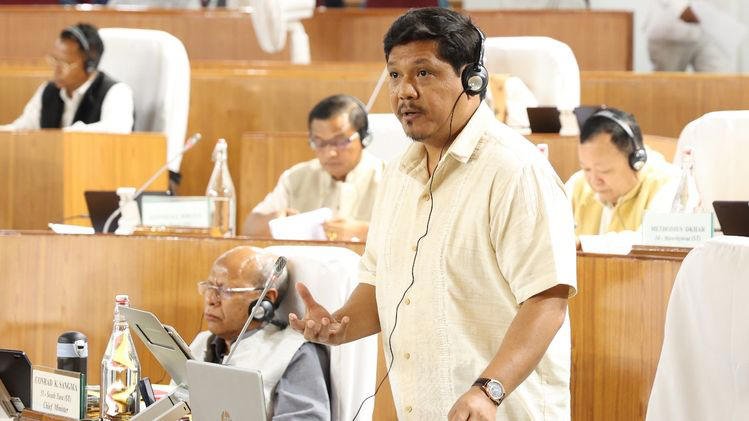
Meghalaya Chief Minister Conrad K Sangma has strongly defended the state government’s land acquisition process, rejecting allegations that public land is being sold to corporate interests through backdoor arrangements.
Speaking in the Meghalaya Assembly on August 25, Sangma said that every acre of land acquired by the state government for public and development projects follows a defined legal and administrative process. He maintained that there has been no attempt to bulldoze landowners or bypass established procedures to facilitate land transactions.
The chief minister said the government remains committed to balancing the need for development with the protection of Meghalaya’s traditional landholding systems and customary institutions.
Meghalaya CM Rejects ‘Backdoor Sale’ Allegations
Responding to concerns over land transactions and acquisition, Conrad K Sangma categorically rejected claims that the Meghalaya government was using indirect or backdoor methods to sell land.
He said land acquisition for public projects is carried out under the provisions of the Meghalaya Transfer of Land Regulation Act, 1971, with several stages of scrutiny and administrative approval involved before any transaction is completed.
Sangma stressed that the government does not arbitrarily acquire land and that the process begins with the willingness of landowners themselves. According to him, individuals interested in selling land for a proposed public project first submit their willingness and quote the price they expect for their property.
The government then moves forward with the necessary administrative and legal checks before proceeding with the acquisition.
Landowners Quote Their Own Prices, Says Sangma
Explaining the process in detail, the chief minister said land acquisition begins with an expression of interest from willing landowners.
Rather than the government simply identifying land and taking possession of it, Sangma said the process involves landowners coming forward and expressing their willingness to sell. They also quote the price they expect for their land.
The proposed acquisition is then subjected to further examination to ensure that the transaction follows the required procedures.
This, Sangma said, demonstrates that the government acquisition process is based on consent, documentation and scrutiny rather than coercion or arbitrary action.
The chief minister’s remarks came amid concerns over land ownership and the possible transfer of land for development and investment-related projects in Meghalaya, where land has significant social, cultural and customary importance.
No-Objection Clearances Are Part of the Process
After a landowner expresses willingness to sell, the government seeks the required no-objection clearances from the relevant authorities.
According to Sangma, this process includes obtaining clearance from the local headman and other concerned authorities wherever required.
These checks are intended to ensure that land transactions do not take place without the knowledge or involvement of the relevant local institutions.
Meghalaya has a distinct landholding system shaped by customary laws and traditional institutions. Sangma acknowledged the importance of these systems and said the government must remain sensitive to the state’s traditions while pursuing infrastructure and development projects.
The chief minister maintained that the acquisition process includes adequate safeguards and cannot be treated as a secretive or unilateral exercise.
Deputy Commissioner Conducts Public Hearing
Sangma further explained that the process does not end with the willingness of the landowner and the submission of required clearances.
The Deputy Commissioner subsequently conducts a public hearing and inquiry as part of the acquisition procedure.
The hearing is aimed at establishing important details related to the proposed land transaction, including whether the land is free from encumbrances and whether the price quoted for the property is reasonable.
Such administrative scrutiny, Sangma said, forms an important part of the government’s approach to acquiring land for public projects.
The involvement of the district administration and the public hearing process provides another level of examination before an acquisition is completed, he indicated.
Government Must Balance Development and Land Protection
While defending the government’s acquisition procedures, Sangma also emphasised the need to protect Meghalaya’s land and customary systems.
He said land is closely linked to the traditions, culture and social structure of the state. Therefore, the government has to strike a balance between the requirements of development and the responsibility of protecting the interests associated with land ownership.
Development projects often require land for infrastructure, public facilities and other initiatives. However, Sangma maintained that the need for development should not mean ignoring Meghalaya’s traditional institutions or bypassing established legal safeguards.
The chief minister said the government was conscious of the sensitivities surrounding land and was committed to ensuring that the acquisition process remains within the legal framework.
‘We Have Never Bulldozed,’ Says Chief Minister
Sangma also rejected suggestions that the state government had used force or coercive methods to acquire land.
He said there had never been a situation in which the government had “bulldozed” its way through the land acquisition process.
The chief minister also firmly denied that the government had used the “back door” to facilitate the sale or transfer of land.
His remarks were aimed at addressing criticism surrounding the government’s approach to land acquisition and concerns about whether land could be transferred without adequate transparency or consultation.
Sangma argued that the multiple stages involved in the acquisition process, including landowner consent, no-objection clearances, public hearings and administrative inquiries, ensure that the process remains on record and subject to scrutiny.
Legal Framework Governs Government Acquisitions
According to the chief minister, every acre of land acquired by the Meghalaya government for development projects is procured in accordance with the Meghalaya Transfer of Land Regulation Act, 1971.
The legal framework, combined with administrative procedures and consultations with relevant authorities, forms the basis of the government’s land acquisition process.
Sangma’s defence of the system comes at a time when land-related issues continue to generate public and political debate in Meghalaya. Questions surrounding land ownership, customary rights and the role of traditional institutions remain particularly sensitive in the state.
The chief minister sought to assure the Assembly that development projects would not be pursued at the cost of established procedures or the protections associated with Meghalaya’s landholding traditions.
Transparency and Customary Safeguards Remain Key
The latest statement by Conrad K Sangma places transparency and adherence to legal procedures at the centre of the Meghalaya government’s defence of its land acquisition policy.
By outlining the steps involved—from the willingness of landowners and price quotations to no-objection clearances and public hearings—the chief minister sought to counter allegations of secretive or backdoor land deals.
Sangma maintained that the state government would continue to pursue development while respecting the unique nature of Meghalaya’s land systems and customary institutions.
As debates over development, investment and land ownership continue, the government’s acquisition process is likely to remain under close public and political scrutiny. For the Meghalaya government, Sangma’s message was clear: land needed for public development projects will be acquired through established legal and administrative procedures, and not through coercion or a “backdoor” sale.