


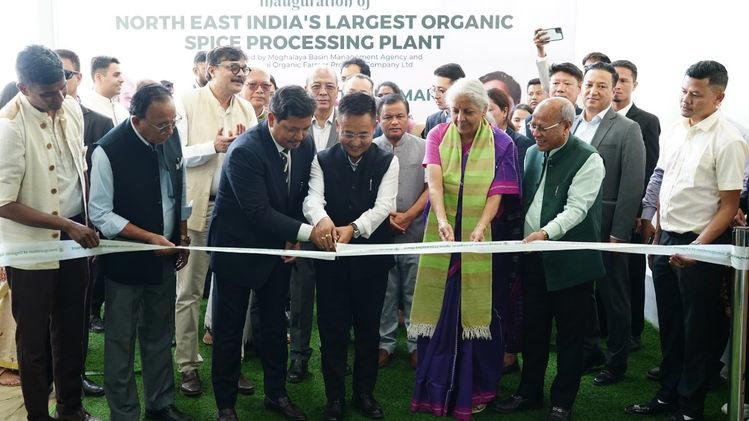
Meghalaya has achieved a significant milestone in its agricultural development journey with the inauguration of the Northeast region’s largest organic spice processing unit, a project expected to directly benefit around 5,500 farmers across the state. The facility, inaugurated during Union Finance Minister Nirmala Sitharaman’s visit to Meghalaya, is being hailed as a transformative initiative that will strengthen the organic farming sector, improve farmer incomes, and enhance the state’s position as a leading producer of premium organic spices.
The state-of-the-art processing unit is designed to handle a variety of spices cultivated in Meghalaya, including turmeric, ginger, black pepper, and other high-value organic products. The project is expected to significantly boost value addition, improve market access, and create new opportunities for farmers by enabling them to process and package their produce locally instead of relying on facilities outside the state.
The development marks another important step in Meghalaya’s efforts to promote sustainable agriculture and create a robust ecosystem for organic farming, an area where the state has already established a strong reputation.
Major Boost for Organic Farming
Organic farming has emerged as one of Meghalaya’s key strengths due to its favorable climatic conditions, traditional cultivation practices, and relatively low use of chemical fertilizers and pesticides. Over the years, the state government has actively encouraged farmers to adopt organic methods, recognizing both the environmental and economic benefits associated with sustainable agriculture.
The newly inaugurated organic spice processing unit is expected to further strengthen this sector by providing modern infrastructure for processing, grading, drying, packaging, and quality control. Such facilities are crucial for ensuring that agricultural products meet national and international standards.
Officials believe the plant will play a vital role in helping farmers maximize the value of their produce by reducing dependence on intermediaries and allowing products to reach markets in a more refined and market-ready form.
Benefiting More Than 5,500 Farmers
One of the most significant aspects of the project is its expected impact on farmers. Approximately 5,500 growers associated with spice cultivation are set to benefit directly from the facility through improved processing capabilities and better access to markets.
Farmers often face challenges related to post-harvest handling, including storage limitations, spoilage, and inadequate processing infrastructure. These issues can lead to financial losses and lower returns despite the production of high-quality crops.
The new processing unit is expected to address many of these concerns by offering a centralized facility equipped with advanced technologies. Improved processing and packaging will not only help preserve product quality but also increase shelf life, making the products more attractive to buyers.
In addition, farmers are expected to receive better price realization as value addition takes place within the state, enabling them to capture a larger share of the overall value chain.
Creating Employment and Economic Opportunities
Beyond its direct impact on farmers, the organic spice processing unit is expected to generate employment opportunities across multiple sectors. Activities such as processing, packaging, transportation, quality testing, warehousing, and marketing are likely to create jobs for local youth and women.
The project aligns with broader efforts to strengthen rural economies by promoting agro-based industries and encouraging entrepreneurship. Small-scale enterprises, producer groups, and cooperatives are expected to benefit from increased economic activity generated by the facility.
Experts believe that the multiplier effect of such infrastructure investments can contribute significantly to rural development by creating sustainable livelihoods and reducing dependence on traditional agricultural income alone.
The facility is also expected to encourage greater participation in the agricultural value chain by enabling local entrepreneurs to explore opportunities in branding, packaging, and marketing organic products.
Strengthening Meghalaya’s Market Presence
Meghalaya’s organic spices have gained recognition for their quality and distinctive characteristics. Products such as Lakadong turmeric, known for its exceptionally high curcumin content, have already earned a strong reputation in domestic and international markets.
The establishment of the largest organic spice processing unit in the Northeast is expected to further strengthen Meghalaya’s position as a leading supplier of premium organic spices. By improving processing standards and ensuring consistency in quality, the facility can help local products compete more effectively in high-value markets.
As consumer demand for organic and sustainably produced food continues to rise globally, Meghalaya stands to benefit from increasing opportunities in both domestic and export markets. The processing unit will play a crucial role in helping producers meet the quality and certification requirements necessary for expanding their market reach.
Promoting Value Addition Within the State
One of the longstanding challenges faced by agricultural producers in the Northeast has been the lack of adequate processing infrastructure. As a result, raw agricultural products are often transported outside the region for value addition, limiting income opportunities for local communities.
The new facility seeks to address this issue by enabling value addition within Meghalaya itself. Instead of selling raw produce, farmers can now benefit from processing activities that increase product value before reaching consumers.
This shift is expected to improve profitability while strengthening the overall agricultural economy. It also aligns with national efforts to encourage local manufacturing, reduce logistical inefficiencies, and create self-sustaining regional economies.
Government officials have highlighted that investments in processing infrastructure are essential for unlocking the full potential of the agricultural sector and ensuring long-term growth.
Supporting Sustainable Development
The organic spice processing unit reflects Meghalaya’s broader commitment to sustainable development. Organic farming not only helps protect soil health and biodiversity but also supports environmentally responsible agricultural practices that are increasingly valued by consumers worldwide.
By investing in modern infrastructure while promoting organic cultivation, the state is creating a model that combines economic growth with environmental stewardship. The facility demonstrates how technology and sustainability can work together to improve livelihoods without compromising ecological balance.
The project is also expected to encourage more farmers to adopt organic practices by providing them with reliable market opportunities and improved income prospects.
A Landmark Achievement for Meghalaya
The inauguration of the Northeast’s largest organic spice processing unit represents a landmark achievement for Meghalaya’s agricultural sector. It highlights the state’s growing focus on value-added agriculture, rural development, and sustainable economic growth.
For thousands of farmers, the facility offers the promise of better market access, improved earnings, and greater stability. For the state, it strengthens its reputation as a leader in organic farming and demonstrates the potential of strategic investments in agricultural infrastructure.
As the facility begins operations, expectations are high that it will transform the organic spice sector, create new economic opportunities, and contribute significantly to Meghalaya’s development goals. With more than 5,500 farmers set to benefit, the project is being viewed as a catalyst for long-term prosperity and a model for agricultural advancement across the Northeast region.