


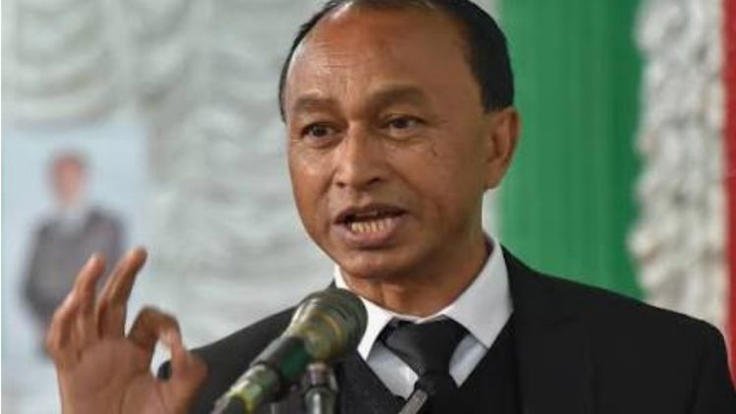
In another political development in Meghalaya ahead of the 2028 Assembly elections, Jowai South Member of District Council (MDC) Moonlight Pariat joined the Bharatiya Janata Party (BJP) on Saturday, October 3, along with his supporters.
Pariat was formally welcomed into the party by Meghalaya BJP president Rikman G. Momin. BJP legislators A.L. Hek and Sanbor Shullai, party spokesperson M. Kharkrang and other leaders were present during the induction.
His entry comes amid a series of political realignments in Meghalaya, where the BJP has been expanding its organisational presence ahead of the next Assembly polls. <Cite refs={[“turn157220search0″,”turn157220search7″,”turn157220search6”]}/>
Moonlight Pariat Joins BJP with Supporters
Pariat, a prominent political figure in the Jaintia Hills region, has served as an MDC from Jowai South on six occasions. He also previously held the position of Chief Executive Member (CEM) of the Jaintia Hills Autonomous District Council (JHADC).
His induction into the BJP was attended by senior state party leaders, including Meghalaya BJP president Rikman G. Momin, who welcomed him and his supporters into the organisation.
The development adds another regional political figure to the BJP’s expanding presence in the state.
From Independent MDC to BJP
Pariat won the Jowai South MDC seat as an Independent candidate in the 2025 district council elections.
Before that, he had contested the 2023 Meghalaya Assembly election from the Jowai constituency as a candidate of the United Democratic Party (UDP), but was unsuccessful. He left the UDP in the same year.
His latest move marks a new phase in his political journey, bringing him into the BJP ahead of the next state Assembly elections. <Cite refs={[“turn157220search0”]}/>
BJP Expands Its Political Presence in Meghalaya
Pariat’s induction comes shortly after eight UDP legislators joined the BJP in New Delhi on September 23, 2026.
The legislators included Lahkmen Rymbui, Kyrmen Shylla, Olan Singh Suin, Mathew Beyondstar Kurbah, Mayralborn Syiem, Pius Marwein, Synshar Thabah and Balajied Synrem.
Their entry increased the BJP’s strength in the 60-member Meghalaya Legislative Assembly from two to 10 MLAs, making it the second-largest party in the House after the National People’s Party (NPP). <Cite refs={[“turn157220search1″,”turn157220search3”]}/>
The political shift has also brought attention to several regional issues raised by the legislators, including the demand for Khasi and Garo languages to be included in the Eighth Schedule of the Constitution, coal mining, amendments to the Meghalaya Residents Safety and Security Act, and the relocation of the Harijan Colony in Shillong. <Cite refs={[“turn157220search3″,”turn157220search8”]}/>
Meghalaya Parties Prepare for 2028 Elections
The next Meghalaya Assembly elections are expected in 2028, and political parties have begun strengthening their organisational networks and engaging with leaders across the state.
The BJP’s recent inductions, including former legislators and regional political figures, form part of its ongoing expansion in Meghalaya.
The state is currently governed by the NPP-led Meghalaya Democratic Alliance, in which the BJP is also a coalition partner. Chief Minister Conrad K. Sangma has described the recent movement of UDP legislators to the BJP as an internal matter between the parties and said it would not affect the functioning of the coalition government. <Cite refs={[“turn157220search6″,”turn157220search11”]}/>
Political Realignment Continues in the Jaintia Hills
Pariat’s entry is another development in the evolving political landscape of the Jaintia Hills region, where district council politics and state-level electoral activity intersect.
His experience as a six-time MDC and former JHADC CEM brings a district council background to the BJP’s state organisation.
With the 2028 Assembly elections approaching, further political movements and organisational activities are likely to remain part of Meghalaya’s political discourse. However, the electoral implications of individual inductions will depend on future party decisions, local political dynamics and voter response.