


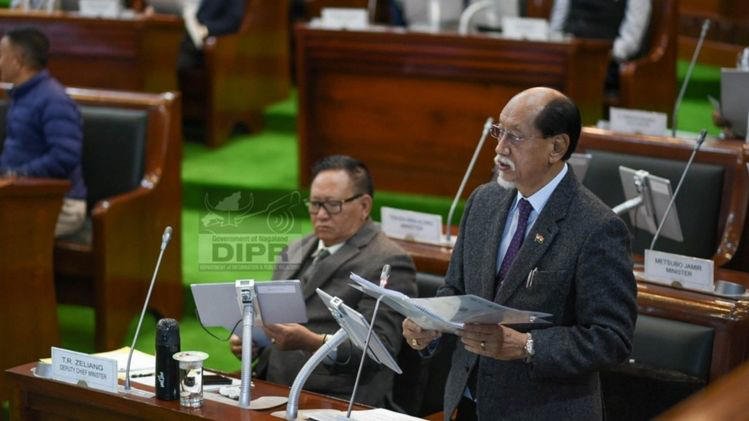
The Frontier Nagaland Territorial Authority bill has been tabled in the state assembly, marking a significant step toward addressing long-standing regional demands. The move comes as the government seeks to create a structured administrative mechanism for the eastern parts of the state.
Chief Minister Neiphiu Rio introduced the bill with the aim of ensuring equitable development and greater autonomy for the region. The proposed authority is expected to focus on governance, resource allocation, and infrastructure development.
Importantly, the bill reflects the government’s attempt to respond to the demands raised by the Eastern Nagaland People’s Organization, which has long advocated for a separate administrative arrangement.
Read More: Conrad Sangma Launches Shillong International Film Festival
Background of the Frontier Nagaland demand
The demand for a separate Frontier Nagaland Territorial Authority has been ongoing for several years. The eastern districts of Nagaland have often raised concerns about underdevelopment and lack of representation.
The Eastern Nagaland People’s Organization has been at the forefront of this movement. It has consistently highlighted issues such as poor infrastructure, limited economic opportunities, and inadequate governance mechanisms.
Over time, these concerns have gained political attention. Both the state and central governments have engaged in discussions to find a solution. The tabling of the bill represents a concrete step in that direction.
Key features of the proposed authority
The Frontier Nagaland Territorial Authority bill outlines the structure and functions of the proposed body. It aims to create an administrative framework that can address the unique challenges of the region.
The authority is expected to have powers related to planning and development. It will likely oversee projects in sectors such as infrastructure, education, and healthcare.
Additionally, the authority may be granted financial autonomy to manage funds allocated for regional development. This would enable more efficient implementation of schemes and projects.
Moreover, the bill emphasizes local participation in governance. By involving community representatives, the government aims to ensure that development initiatives reflect the needs of the people.
Government’s approach to regional balance
The tabling of the Frontier Nagaland Territorial Authority bill highlights the government’s focus on regional balance. Chief Minister Neiphiu Rio has reiterated the importance of inclusive growth.
According to the government, addressing regional disparities is essential for long-term stability. By creating a dedicated authority, it aims to bring targeted development to the eastern districts.
Furthermore, the move is seen as an effort to strengthen governance. Decentralization can improve efficiency and accountability in public administration. As a result, the proposed authority could play a key role in enhancing service delivery.
Political significance of the bill
The Frontier Nagaland Territorial Authority bill carries significant political implications. It reflects the government’s willingness to address sensitive regional issues through legislative means.
At the same time, the bill could influence political dynamics in the state. By responding to the demands of the Eastern Nagaland People’s Organization, the government may strengthen its support base in the eastern region.
However, the proposal may also lead to debates within the assembly. Different stakeholders may have varying views on the extent of autonomy and powers granted to the authority.
Despite these challenges, the bill represents a step toward resolving a long-standing issue. It shows that the government is open to dialogue and reform.
Challenges and concerns
While the Frontier Nagaland Territorial Authority bill has been welcomed by many, it also raises certain challenges. One key concern is the implementation of the proposed framework.
Ensuring adequate funding and administrative capacity will be crucial. Without proper resources, the authority may struggle to achieve its objectives.
Additionally, there may be concerns about overlapping jurisdictions. The relationship between the new authority and existing government structures needs to be clearly defined.
Moreover, maintaining unity within the state remains important. The government must ensure that the creation of the authority does not lead to further divisions.
Way forward for Frontier Nagaland
The success of the Frontier Nagaland Territorial Authority will depend on effective execution. The government will need to work closely with local communities and stakeholders.
Engagement with the Eastern Nagaland People’s Organization will remain crucial. Their support can help ensure smooth implementation and acceptance of the new system.
Furthermore, continuous monitoring and evaluation will be necessary. This will help identify challenges and make necessary adjustments.
The central government’s role will also be important. Support in terms of funding and policy guidance can strengthen the authority’s functioning.
A step toward inclusive governance
The Frontier Nagaland Territorial Authority bill marks an important milestone in the state’s governance journey. It reflects a commitment to addressing regional disparities and promoting inclusive development.
Under the leadership of Neiphiu Rio, the government has taken a significant step toward resolving a long-standing demand. While challenges remain, the proposed authority offers a framework for progress.
In conclusion, the bill represents both an opportunity and a responsibility. If implemented effectively, it could transform the eastern region of Nagaland and strengthen the state’s overall development trajectory.
Read More: Nagaland budget 2026-27 shows Rs 337.04 crore deficit