


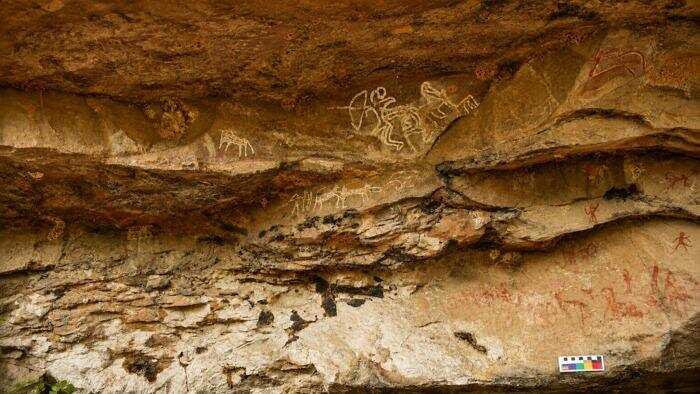
A group of students from Nagpur University has made a remarkable archaeological discovery by identifying prehistoric rock art at a site in Madhya Pradesh, shedding fresh light on India’s rich prehistoric cultural heritage. The discovery, made during an academic field study, is expected to contribute significantly to ongoing research into early human settlements, artistic traditions, and prehistoric life in central India.
The rock art site reportedly features a collection of ancient paintings and engravings believed to date back thousands of years. Archaeologists and researchers have described the finding as an important addition to the growing inventory of prehistoric rock art sites found across the Indian subcontinent.
The discovery has generated interest among historians, archaeologists, conservationists, and academic institutions, highlighting the importance of student-led field research in uncovering valuable aspects of India’s ancient past.
Discovery Made During Academic Field Survey
The prehistoric rock art was discovered during a field exploration conducted by students as part of their academic research and practical training. Guided by faculty members and archaeological experts, the team surveyed remote areas known for their geological and historical significance.
During the survey, students identified rock shelters containing ancient paintings and engravings that displayed several artistic motifs. Preliminary observations suggest that the artwork includes depictions of human figures, animals, hunting scenes, geometric designs, and other symbolic representations commonly associated with prehistoric communities.
Researchers noted that such discoveries often emerge through systematic fieldwork and close observation of landscapes that have remained relatively undisturbed for centuries.
Insights into Prehistoric Human Life
Experts believe the newly identified rock art has the potential to provide valuable information about the lives, beliefs, and daily activities of prehistoric communities that once inhabited the region.
Rock paintings serve as important visual records, offering clues about hunting practices, social organisation, rituals, wildlife, environmental conditions, and artistic expression during prehistoric times.
The newly discovered images may help researchers better understand how early human societies interacted with their surroundings and expressed cultural identity through visual art.
Detailed scientific studies are expected to determine the approximate age, artistic style, and historical significance of the site while comparing it with other prehistoric rock art locations across India.
Importance of Rock Art in Archaeological Research
Prehistoric rock art represents one of the earliest known forms of human artistic expression. Archaeologists consider such sites invaluable because they preserve evidence of early human creativity long before the development of written language.
Rock paintings and engravings help researchers reconstruct aspects of prehistoric life that cannot be understood through archaeological artefacts alone. They provide insights into belief systems, symbolic communication, environmental adaptation, and technological development.
The discovery in Madhya Pradesh further reinforces the region’s reputation as one of India’s most important centres of prehistoric archaeological heritage.
Officials believe continued exploration may reveal additional rock art sites yet to be documented.
Madhya Pradesh’s Rich Archaeological Heritage
Madhya Pradesh is widely recognised for its rich archaeological and cultural heritage, with numerous prehistoric sites, ancient monuments, rock shelters, and historical settlements spread across the state.
Its rugged terrain, sandstone formations, forests, and river valleys have preserved evidence of human occupation spanning thousands of years.
The latest discovery adds to the state’s impressive archaeological landscape and highlights the importance of continued research in lesser-explored regions.
Archaeologists have long considered central India a significant area for understanding prehistoric human evolution, settlement patterns, and artistic traditions due to the abundance of well-preserved archaeological remains.
Student Research Receives Appreciation
The achievement has been widely appreciated by university authorities, faculty members, and researchers, who described it as an excellent example of the value of experiential learning and field-based academic research.
Officials observed that practical exposure allows students to develop research skills while contributing meaningfully to archaeological knowledge.
Faculty members praised the students’ careful observation, dedication, and scientific approach during the field survey.
The discovery demonstrates how academic institutions can play an important role in documenting and preserving India’s cultural heritage through collaborative research involving students and experts.
The university is expected to continue encouraging similar field-based research initiatives in the future.
Scientific Documentation and Conservation Planned
Following the discovery, experts are expected to undertake detailed documentation of the rock art using modern archaeological techniques. High-resolution photography, digital mapping, three-dimensional documentation, and scientific analysis will help preserve accurate records of the paintings.
Researchers also plan to study the pigments, geological formations, weathering patterns, and surrounding archaeological context to establish the chronology and significance of the site.
Conservation experts have emphasised the importance of protecting the newly discovered rock art from natural deterioration and human interference.
Appropriate measures may be considered to ensure that the heritage site remains preserved for future generations while allowing continued academic research.
Promoting Heritage Awareness
The discovery also highlights the importance of raising public awareness about India’s prehistoric heritage. Archaeologists believe that educating local communities and students about archaeological conservation can significantly contribute to protecting such sites from vandalism and environmental damage.
Educational institutions are increasingly incorporating field studies into archaeology, history, anthropology, and heritage management programmes to encourage practical learning and cultural preservation.
Experts noted that involving students in archaeological exploration helps create a new generation of researchers committed to documenting and safeguarding India’s ancient heritage.
Public awareness campaigns may also encourage local participation in identifying and protecting previously undocumented archaeological sites.
A Valuable Addition to India’s Prehistoric Legacy
The discovery by Nagpur University students represents an important contribution to India’s expanding record of prehistoric rock art. Every newly documented site adds valuable information that enhances scholarly understanding of early human history, artistic traditions, and cultural development.
Researchers expect that further investigation of the site may reveal additional paintings, archaeological artefacts, or evidence of prehistoric habitation that could deepen knowledge of the region’s ancient past.
The discovery also demonstrates the continuing potential for archaeological exploration in India’s diverse landscapes, where numerous historically significant sites remain undocumented.
Preserving the Past for Future Generations
The identification of prehistoric rock art in Madhya Pradesh by Nagpur University students stands as a significant achievement in archaeological research and heritage conservation. Beyond its academic value, the discovery reinforces the importance of preserving India’s rich prehistoric legacy through scientific documentation, responsible conservation, and continued exploration.
As researchers begin detailed studies of the newly discovered site, the findings are expected to contribute meaningfully to the understanding of prehistoric societies that once inhabited central India. The achievement also highlights the role of universities in promoting research excellence while inspiring students to actively participate in uncovering and protecting the nation’s invaluable cultural and archaeological heritage.