


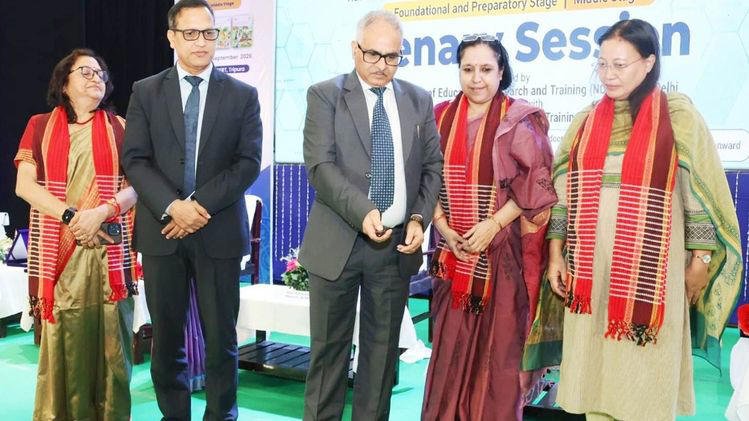
National Council of Educational Research and Training (NCERT) Director Prof Dinesh Prasad Saklani has said that the National Education Policy (NEP) has brought a new perspective to India’s education system.
Saklani made the remarks in Agartala on September 22. He was speaking at the inauguration of a five-day training programme for school teachers. The programme aims to improve teaching skills and classroom practices in Tripura.
The training programme took place at the Hapania International Fair Ground. NCERT organised it with the State Council of Educational Research and Training (SCERT) under the National Initiative for School Heads’ and Teachers’ Holistic Advancement (NISHTHA) programme.
Teachers Have Key Role in NEP Implementation
Saklani stressed the important role of teachers in implementing NEP 2020. He said the teachers taking part in the training would contribute directly to putting the policy’s ideas into practice.
The training focuses on professional development and better teaching methods. It also aims to support the holistic development of students.
According to Saklani, education should encourage students to explore their surroundings and develop their creativity. This approach becomes especially relevant for children living in remote areas.
He noted that students in such areas often learn through their interaction with nature and their local environment. Therefore, education should recognise these experiences and encourage students to build on their natural curiosity.
Five-Day Training Programme Begins
The five-day programme began on September 22 and focuses on strengthening the professional capabilities of school teachers.
NCERT and SCERT organised the programme under NISHTHA. The initiative aims to improve the quality of teaching and help educators adopt approaches that support students’ overall development.
Several senior education officials and NCERT representatives attended the opening session. Tripura School Education Department Secretary Dr Milind Ramteke also addressed the gathering.
SCERT Director L Darlong delivered the welcome address. Prof Ranjana Arora, Head of the Department of Curriculum Studies and Development at NCERT, also participated in the programme. Prof Sarad Sinha, Head of the Department of Teacher Education at NCERT, attended as the guest of honour.
Creativity and Learning in Focus
The NCERT director placed particular emphasis on creativity in education.
NEP 2020 seeks to move education beyond a narrow focus on memorisation. The policy promotes holistic learning and encourages students to develop critical thinking, creativity and other skills.
NCERT’s current work also reflects this approach. Its educational programmes focus on making learning more inclusive, learner-centred and relevant to students’ developmental needs.
In addition, the policy promotes learning experiences that match the needs of students at different stages of development. NCERT’s framework includes the 5+3+3+4 curricular structure, which covers different stages from foundational education to secondary schooling.
Feedback Can Improve Education Programmes
Saklani also highlighted the importance of feedback in education.
He said feedback and suggestions from teachers taking part in the workshop could help improve future programmes. Regular reviews can help education authorities understand what works in classrooms and where further changes may be required.
Such feedback can also help teachers share their experiences. As a result, education programmes can respond better to classroom realities.
The approach places teachers at the centre of educational improvement. Their practical experience can provide useful information for curriculum development and teacher training.
Tripura Focuses on School Education
The training programme has placed particular emphasis on primary and school education.
School Education Department Secretary Milind Ramteke said the programme would help strengthen the professional capabilities of teachers. He also highlighted Tripura’s position in the country’s literacy landscape.
According to Ramteke, Tripura currently ranks third among Indian states in literacy rate. He expressed hope that the training would further improve the quality of school education in the state.
The focus on teacher development comes as Tripura continues to implement different aspects of NEP 2020.
NEP Emphasises Inclusive Education
NEP 2020 also places emphasis on access, equity and inclusion. NCERT says the policy seeks to provide meaningful educational opportunities to learners regardless of their social, economic or geographical background.
This focus has particular relevance for the Northeast. Remote and geographically difficult areas often face different educational challenges.
For that reason, teachers need approaches that can respond to local conditions. Regional languages, community knowledge and local environments can also form part of meaningful learning experiences.
Digital Learning Gains Importance
Technology also forms an important part of NEP 2020. NCERT has highlighted platforms such as DIKSHA and SWAYAM as tools that can support teaching, learning and teacher development.
Digital resources can help teachers access training materials and educational content. They can also expand learning opportunities for students in areas where access to educational resources remains limited.
At the same time, digital education works best when schools have reliable connectivity and teachers receive proper training.
Northeast States Discuss NEP Implementation
The discussion in Tripura comes soon after an Education Conclave held in the Northeast. The two-day conclave focused on the implementation of NEP 2020 in the region.
Participants discussed regional cooperation, skill development, research and stronger links between educational institutions and industry. The discussions also highlighted the need to make education more relevant to students in remote areas.
Such discussions show the importance of adapting educational implementation to regional needs while maintaining the broader objectives of NEP 2020.
Teacher Training Remains Central to Reform
The Tripura programme highlights the role of teachers in India’s ongoing education reforms.
A policy can achieve its objectives only when teachers have the necessary training and resources. Continuous professional development can therefore help educators understand new curricula, teaching methods and assessment approaches.
The five-day NISHTHA programme in Agartala aims to support that process. Through training, discussion and feedback, educators can share classroom experiences and explore new teaching approaches.
As Tripura continues its NEP implementation, teacher development will remain an important part of efforts to improve school education. The NCERT programme has provided a platform for educators to strengthen their skills and contribute to the changing education system.