


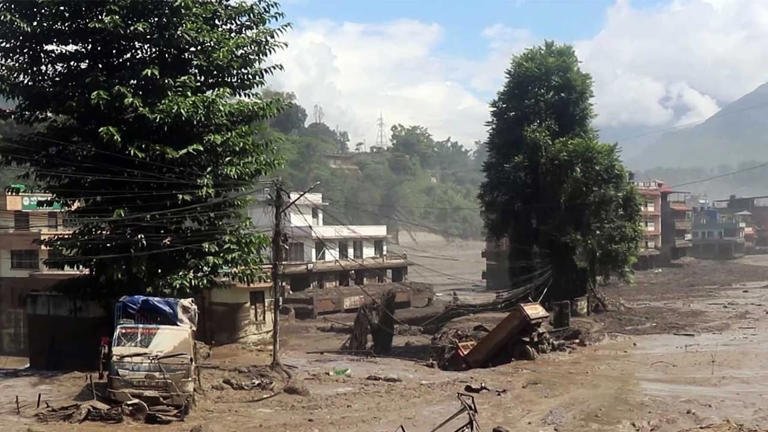
A devastating flash flood disaster in Nepal has claimed at least 157 lives and left nearly 400 people missing, prompting the Indian Embassy in Kathmandu and several state governments to activate emergency helplines for stranded Indian citizens and their families.
The catastrophe struck areas along Nepal’s Bhote Koshi River near the Nepal-Tibet border. The sudden floods swept away homes, roads, vehicles and other critical infrastructure, severely disrupting rescue operations.
Among those reported missing are foreign nationals, including Indian citizens and pilgrims travelling in the Himalayan region. Authorities have launched extensive search and rescue operations, although difficult terrain, damaged roads and disrupted communication networks continue to hamper efforts.
The disaster has triggered a major humanitarian response. India has stepped up assistance and activated emergency contact channels to help citizens affected by the tragedy.
Indian helplines activated for Nepal flood victims
The Embassy of India in Kathmandu has activated emergency helplines to assist Indians stranded or affected by the Nepal flood disaster.
Families who have lost contact with relatives travelling in the affected areas can also seek assistance through these emergency channels.
The activated helpline numbers are:
- +977 985 131 6807
- +977 970 910 7500
- +977 981 032 6117
The numbers are also available through WhatsApp, according to reports.
Several Indian state governments have also activated their own emergency mechanisms to identify and assist residents who may be stranded in Nepal or nearby areas.
Karnataka, for instance, activated its State Emergency Operation Centre and began collecting information about residents affected by the disaster. Other authorities have also coordinated with central agencies and the Indian Embassy as rescue efforts continue.
Nepal floods kill 157, leave nearly 400 missing
The flash floods have emerged as one of the deadliest disasters to strike the Himalayan region in recent years.
Initial reports put the death toll at 157, while around 400 people remained missing. The missing include foreign tourists, pilgrims, local residents and security personnel.
The numbers may change as rescue teams continue to reach isolated locations and authorities verify information from affected districts.
Later reports indicated that the wider disaster zone could involve a significantly higher number of missing people, with casualties also reported across the border in Tibet.
The scale of the tragedy has made it difficult for authorities to establish a final and definitive casualty figure.
Rescue workers continue to search through debris and flood-hit settlements as families wait for information about their missing relatives.
Indian nationals among those unaccounted for
The disaster has caused particular concern in India because several Indian citizens were travelling through the affected Himalayan region.
Many of them were reportedly pilgrims heading towards Mount Kailash and the Kailash Mansarovar region. Others were tourists travelling through Nepal’s mountainous areas.
Reports have indicated that more than 100 Indian nationals may be among those missing. The exact number remains subject to official verification as authorities gather information from tour operators, families and local agencies.
Communication failures have made the situation more complicated.
In several areas, the floods damaged roads, electricity networks and communication infrastructure. As a result, families have struggled to contact relatives who were travelling through the affected region.
The emergency helplines aim to create a direct channel for families seeking information and assistance.
Glacial collapse linked to catastrophic flooding
Authorities and experts have linked the disaster to a major collapse involving ice, rock and debris in the Himalayan region.
The collapse triggered a powerful surge of water and debris that rushed through valleys and settlements near the Nepal-Tibet border.
The sudden nature of the event left little time for communities and travellers to move to safety.
The floodwaters destroyed homes, bridges and roads. Several vehicles and structures were swept away as the surge moved downstream.
Experts have warned that the Himalayan region faces increasing risks from unstable glaciers, landslides and extreme weather events.
The latest catastrophe has once again highlighted the vulnerability of communities living in mountain valleys and along major river systems.
Investigators will continue to study the precise sequence of events that triggered the disaster.
Rescue operations face difficult conditions
Thousands of personnel have joined rescue and relief operations in the affected region.
However, the challenging geography has slowed the response.
Many roads and bridges have suffered severe damage. Some areas remain difficult to access because of mud, debris and unstable mountain slopes.
Helicopters have played an important role in delivering emergency supplies and reaching isolated communities.
Rescue teams are also searching for people who may have been trapped or swept away by the floods.
Power and communication disruptions have further complicated coordination.
Authorities are working to restore essential services while continuing the search for survivors.
The number of missing people and the extensive destruction have made the operation particularly challenging.
India sends humanitarian assistance to Nepal
India has moved to provide humanitarian assistance following the disaster.
The first batch of relief materials has been dispatched to support Nepal’s rescue and relief operations.
The assistance includes essential supplies for people affected by the floods.
Indian authorities have also expressed solidarity with Nepal as it confronts the humanitarian crisis.
The disaster has strengthened the need for close coordination between the two neighbouring countries.
India’s geographical proximity could help ensure the faster movement of relief supplies, technical assistance and emergency personnel if further support is required.
The Indian government has indicated its readiness to assist Nepal during the crisis.
Families urged to use official emergency channels
Authorities have urged families who have lost contact with relatives in Nepal to use official helpline numbers and provide accurate information.
Details such as the traveller’s full name, passport information, travel itinerary and last known location can help officials coordinate with local authorities.
Families should also avoid relying on unverified social media claims during the ongoing rescue operation.
The situation remains fluid, and casualty figures may change as authorities receive new information.
Tour operators and travel agencies are also working with officials to identify missing tourists and pilgrims.
The Indian Embassy in Kathmandu remains an important point of contact for affected citizens and their families.
The activated helplines are expected to support coordination as authorities continue their efforts to trace missing Indians.
Flood damage disrupts roads and essential infrastructure
The flash floods have caused extensive damage across the affected areas.
Homes, roads, bridges and power infrastructure have suffered severe destruction.
The damage has isolated some communities and made it difficult for emergency teams to reach survivors.
Transport disruptions have also affected tourism and trade in the region.
The affected area serves as an important route for travellers heading towards Himalayan destinations.
The destruction of roads and bridges could delay recovery even after the immediate rescue operation ends.
Nepal will face a significant reconstruction challenge once the emergency phase concludes.
Restoring transport links, electricity and communication systems will require substantial financial and technical resources.
Nepal disaster highlights Himalayan vulnerability
The latest tragedy has drawn attention to the growing environmental and geological risks facing the Himalayan region.
Mountain communities live with the constant threat of landslides, floods and other natural disasters.
Changing climatic conditions have also increased concerns about glacial instability.
Experts have repeatedly stressed the importance of stronger monitoring and early-warning systems.
Remote regions require reliable communication networks and emergency evacuation plans.
Cross-border cooperation may also become increasingly important because rivers and mountain systems extend across national boundaries.
The Nepal flood disaster could renew calls for greater regional coordination on disaster preparedness and climate resilience.
Search continues as death toll may change
Rescue teams continue to search for survivors as authorities assess the full scale of the disaster.
The confirmed toll of 157 deaths and nearly 400 missing reflects the situation reported during the initial stages of the emergency response.
However, later reports have indicated that casualty and missing-person figures could rise as authorities expand their assessment across Nepal and neighbouring Tibet.
For now, the priority remains saving lives, locating missing people and providing immediate assistance to those stranded.
India’s activated helplines offer a crucial lifeline for citizens and families affected by the catastrophe.
As Nepal continues its rescue operation, close coordination between the two countries will remain essential.
The coming days will be critical for families waiting for news of missing loved ones and for authorities attempting to restore access to communities devastated by one of the region’s worst recent flood disasters.