


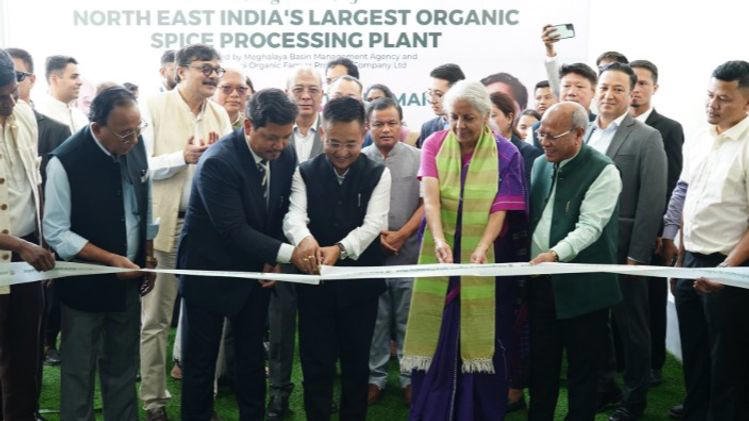
Union Finance Minister Nirmala Sitharaman has asserted that Northeast India possesses the potential to emerge as the country’s next major growth engine through sustainable agriculture, highlighting the region’s unique strengths in organic farming, biodiversity, traditional knowledge systems, and high-value agricultural products. Speaking during her visit to Meghalaya, Sitharaman emphasized that the Northeast’s vast agricultural potential, if harnessed effectively, could significantly contribute to India’s economic growth while ensuring environmental sustainability and inclusive development.
Her remarks come at a time when the Central Government is increasingly focusing on the Northeast as a key driver of national development. Improved connectivity, infrastructure investments, agricultural modernization, and policy support have created new opportunities for the region, which is home to abundant natural resources and rich cultural diversity.
Sitharaman noted that sustainable agriculture offers a pathway for the Northeast to achieve economic progress while preserving its ecological wealth and traditional farming practices.
Northeast’s Natural Advantage in Agriculture
The Northeast region enjoys several natural advantages that make it uniquely suited for sustainable agriculture. Fertile soil, abundant rainfall, diverse climatic conditions, and relatively low dependence on chemical fertilizers provide an ideal environment for cultivating organic crops.
Sitharaman pointed out that many communities in the region have traditionally practiced environmentally friendly farming methods long before organic agriculture gained global prominence. These practices have helped maintain soil health, conserve biodiversity, and support sustainable livelihoods for generations.
According to her, the Northeast is well-positioned to capitalize on the growing global demand for organic and naturally cultivated agricultural products. With increasing consumer preference for healthy and sustainably produced food, the region can become a major supplier of premium agricultural commodities both within India and abroad.
She emphasized that the combination of traditional wisdom and modern technology can create a powerful foundation for agricultural transformation.
Organic Farming as a Growth Catalyst
Organic farming has emerged as one of the strongest pillars of agricultural development in the Northeast. Several states in the region have actively promoted organic cultivation and sustainable farming practices over the years.
Sitharaman highlighted that organic agriculture not only supports environmental conservation but also creates opportunities for farmers to earn higher incomes through premium pricing. Products such as organic spices, fruits, vegetables, tea, and medicinal plants have strong market potential and can contribute significantly to rural prosperity.
The Finance Minister observed that the region’s reputation for producing high-quality organic products gives it a competitive advantage in domestic and international markets. By strengthening processing facilities, branding, certification mechanisms, and market linkages, farmers can derive greater benefits from their produce.
She stressed that investments in agricultural value chains are essential for unlocking the full economic potential of the sector.
Importance of Value Addition
A recurring theme in Sitharaman’s address was the need to move beyond raw agricultural production and focus on value addition. She noted that many farmers often sell their produce without processing, limiting income opportunities and reducing profitability.
Value-added agriculture involves activities such as grading, processing, packaging, branding, and marketing, all of which can significantly increase the market value of agricultural products. The recently inaugurated organic spice processing unit in Meghalaya was cited as an example of how infrastructure investments can strengthen agricultural value chains.
According to Sitharaman, developing such facilities across the region can help farmers retain a larger share of profits while creating employment opportunities in rural areas.
She stated that value addition would play a crucial role in transforming agriculture from a subsistence activity into a more commercially viable and sustainable sector.
Empowering Farmers and Rural Communities
The Finance Minister emphasized that sustainable agriculture must ultimately translate into better livelihoods for farmers and rural communities. Agriculture continues to be the primary source of income for a large segment of the population across the Northeast, making its growth critical for regional development.
She highlighted the importance of providing farmers with access to modern technologies, financial services, training programs, and market information. Such support can help improve productivity, reduce risks, and enhance income generation.
Sitharaman also stressed the need to encourage farmer-producer organizations, self-help groups, and cooperatives that can strengthen collective bargaining power and improve market access.
By empowering rural communities and supporting entrepreneurship, sustainable agriculture can become a key instrument for reducing poverty and creating inclusive growth.
Creating Export Opportunities
Global demand for organic and sustainably produced food products has expanded rapidly over the past decade. Sitharaman noted that the Northeast has a significant opportunity to tap into these growing markets.
Products such as Lakadong turmeric, organic ginger, black pepper, tea, bamboo products, and specialty fruits have already gained recognition for their quality and uniqueness. With proper certification and quality assurance systems, these products can achieve greater penetration in international markets.
The Finance Minister emphasized that exports can become a major driver of growth for the region, generating higher incomes and attracting investments into agriculture-related industries.
She called for stronger collaboration between governments, exporters, and private sector stakeholders to build globally competitive agricultural value chains.
Sustainability and Environmental Conservation
One of the key advantages of sustainable agriculture, Sitharaman observed, is its ability to balance economic growth with environmental conservation. The Northeast is one of India’s most biodiverse regions, and protecting its ecological wealth remains a national priority.
She noted that sustainable farming practices can help preserve forests, maintain soil fertility, protect water resources, and reduce greenhouse gas emissions. Such approaches are increasingly important as countries around the world seek to address climate change and promote environmentally responsible development.
The Finance Minister emphasized that agriculture and conservation should not be viewed as competing priorities. Instead, they can complement each other when supported by appropriate policies and community participation.
This balance, she said, is essential for ensuring long-term prosperity and resilience.
Government Support for Agricultural Transformation
Sitharaman highlighted the various initiatives being implemented by the Central Government to support agricultural development in the Northeast. Investments in infrastructure, transportation, storage facilities, digital services, and market connectivity have helped create a more enabling environment for farmers.
Improved road, rail, and air connectivity are making it easier for agricultural products to reach larger markets, while financial inclusion initiatives are expanding access to credit and insurance services.
The government is also supporting innovation, entrepreneurship, and skill development to encourage the growth of agriculture-based industries. These measures are expected to strengthen the region’s agricultural ecosystem and enhance competitiveness.
According to Sitharaman, continued collaboration between the Centre, state governments, and local communities will be crucial for achieving long-term success.
A Vision for the Future
Sitharaman’s vision for the Northeast positions agriculture not merely as a traditional occupation but as a powerful engine of economic growth and transformation. By leveraging its natural advantages, promoting organic farming, investing in value addition, and strengthening market linkages, the region can emerge as a leading contributor to India’s development story.
The Finance Minister expressed confidence that sustainable agriculture can generate employment, increase incomes, attract investments, and improve living standards while preserving the region’s rich ecological and cultural heritage.
As the Northeast continues to gain prominence in national development strategies, agriculture is expected to play a central role in shaping its future. Sitharaman’s remarks underscore the belief that with the right policies, infrastructure, and community participation, the region has the potential to become India’s next growth engine, driven by sustainability, innovation, and inclusive prosperity.