


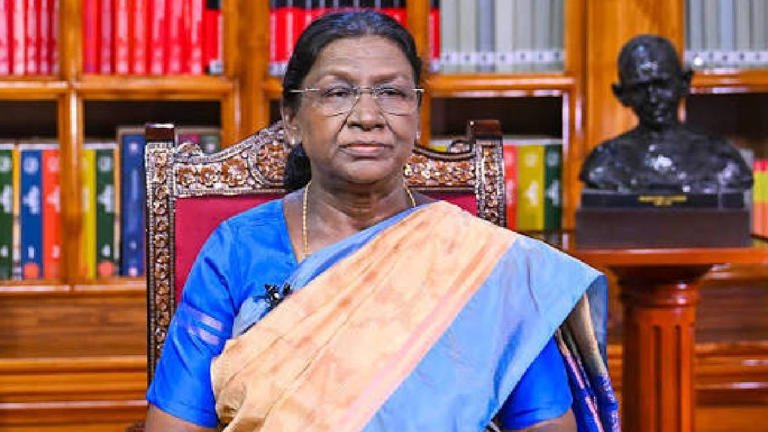
President Droupadi Murmu, on the occasion of Teachers’ Day, called for nurturing a scientific outlook among students while encouraging them to place the interests of the nation above all else.
Addressing the importance of education and the role of teachers in shaping the future of India, the President emphasised that schools and educational institutions must help students develop rational thinking, curiosity and a strong sense of responsibility towards the country.
President Murmu highlighted the crucial role teachers play in shaping not only the academic abilities of students but also their values, character and outlook.
She said education must prepare young people to think scientifically and independently while remaining committed to the larger interests of society and the nation.
Her remarks came as India marked Teachers’ Day on September 5, celebrating the contribution of teachers and commemorating the birth anniversary of former President and renowned philosopher Dr Sarvepalli Radhakrishnan.
President Murmu Highlights Teachers’ Role in Nation Building
President Murmu underlined the importance of teachers in India’s journey towards social and national development.
Teachers play a central role in guiding students during some of the most important years of their lives.
Their influence often extends beyond classrooms and textbooks.
Teachers help students develop confidence, discipline and a sense of responsibility.
They can also encourage students to question, explore and develop new ideas.
The President’s message highlighted the need for educators to prepare students for a rapidly changing world.
Young people today face new opportunities and challenges created by technology, globalisation and changing economic conditions.
Education must therefore help students acquire knowledge while also developing the ability to think critically.
A strong scientific outlook can help students examine information rationally and make decisions based on evidence and reason.
Call for a Strong Scientific Outlook
The President’s emphasis on scientific thinking reflected the growing importance of innovation and technology in modern society.
A scientific outlook encourages people to remain curious and open to new ideas.
It also promotes logical thinking and evidence-based decision-making.
Students need these skills in almost every field.
Science and technology continue to influence healthcare, agriculture, communication, industry and education.
However, a scientific outlook does not remain limited to laboratories and classrooms.
It can also shape the way individuals approach everyday problems.
Students who learn to examine facts carefully can develop stronger problem-solving abilities.
They can also become more capable of distinguishing reliable information from misinformation.
President Murmu’s message placed teachers at the centre of this process.
Educators can encourage students to ask questions and explore different perspectives.
They can create learning environments where curiosity receives encouragement.
Nation-First Spirit Must Guide Young Citizens
Alongside scientific thinking, President Murmu called for a strong nation-first spirit.
The idea encourages citizens to consider the wider interests of the country and society.
For students, this spirit can begin with a sense of responsibility towards their communities.
Young people can contribute through education, innovation and public service.
They can also contribute by respecting others and participating responsibly in society.
The President’s message highlighted the importance of balancing personal ambition with collective responsibility.
India’s future depends on the capabilities and values of its young population.
Students who develop professional skills can contribute to economic growth.
Students who also develop a strong sense of social responsibility can contribute to a more inclusive and united society.
Teachers can play an important role in encouraging this balance.
Teachers Shape Values Beyond the Classroom
Teachers often influence students beyond academic lessons.
A classroom can teach mathematics, science, history and languages.
However, the educational experience can also help students develop important values.
Teachers can encourage honesty and discipline.
They can promote respect and empathy.
They can also help students understand the importance of responsibility.
President Murmu’s Teachers’ Day message recognised this wider contribution.
The relationship between a teacher and a student can influence the way young people view themselves and the world around them.
A supportive teacher can inspire confidence.
An encouraging teacher can motivate a student to overcome difficulties.
For this reason, teaching remains one of the professions with the greatest influence on future generations.
Education Must Prepare Students for a Changing World
The modern world is changing rapidly.
Artificial intelligence, digital technologies and scientific innovation are transforming workplaces and societies.
Students will need to adapt to new technologies throughout their lives.
Education must therefore prepare them for continuous learning.
President Murmu’s call for a scientific outlook becomes particularly relevant in this context.
Students need to develop curiosity and adaptability.
They need the confidence to learn new skills.
They also need the ability to understand complex information.
Teachers can guide students through these changes.
They can help them use technology responsibly.
They can also ensure that students develop strong human values alongside technical knowledge.
Education should not simply focus on employment.
It should also prepare young people to become responsible and informed citizens.
Teachers’ Day Celebrates Dr Radhakrishnan’s Legacy
India observes Teachers’ Day every year on September 5.
The day marks the birth anniversary of Dr Sarvepalli Radhakrishnan, India’s second President and a respected philosopher and teacher.
The occasion celebrates the contribution of teachers to society.
It also provides an opportunity to reflect on the importance of education.
Dr Radhakrishnan believed that teachers played a crucial role in shaping society.
His legacy continues to influence the significance attached to Teachers’ Day in India.
Schools and educational institutions across the country organise programmes to honour teachers.
Students often use the occasion to express gratitude to educators who have guided and supported them.
President Murmu’s message added to these celebrations by highlighting the broader responsibility teachers carry in building the nation’s future.
Scientific Thinking Can Strengthen Society
A scientific outlook can benefit society in several ways.
It encourages people to question assumptions.
It promotes the examination of evidence.
It also helps individuals make informed decisions.
In a world where information spreads rapidly, these abilities have become increasingly important.
Students often encounter large amounts of information through digital platforms.
They need the ability to assess whether information is reliable.
Critical thinking can help them avoid misinformation.
Scientific reasoning can also encourage innovation.
Many of the world’s major challenges require new ideas and solutions.
Young people with strong problem-solving abilities can contribute to addressing these challenges.
Teachers can help develop these abilities by creating classrooms that encourage discussion and inquiry.
Teachers Can Inspire Innovation and Responsibility
India’s educational system has a large responsibility because of the country’s young population.
The nation needs skilled professionals, researchers, entrepreneurs and innovators.
It also needs responsible citizens.
Teachers can contribute to both goals.
They can encourage students to pursue science and innovation.
They can also help students understand the social impact of their work.
A nation-first spirit can encourage young people to use their abilities for wider development.
Innovation can help improve public services.
Scientific research can address national challenges.
Entrepreneurship can create employment.
Education can therefore connect individual achievement with national progress.
President Murmu’s message reflected this connection between knowledge, values and responsibility.
Teachers Remain Central to India’s Future
Despite rapid technological change, the role of teachers remains essential.
Digital tools can provide students with access to vast amounts of information.
However, teachers provide guidance and context.
They help students understand how to use knowledge.
They can identify the strengths and challenges of individual learners.
They can also provide encouragement during difficult periods.
The human connection between teachers and students remains an important part of education.
As schools increasingly adopt new technologies, teachers will continue to guide students in using these tools effectively and responsibly.
The future of education may involve greater use of technology.
However, strong teachers will remain central to the learning process.
President Murmu’s Teachers’ Day Message Looks Towards India’s Future
President Droupadi Murmu’s Teachers’ Day message placed the focus on two important qualities: a scientific outlook and a nation-first spirit.
Together, these values can help prepare students for the future.
Scientific thinking can encourage curiosity, innovation and rational decision-making.
A nation-first approach can encourage young citizens to use their knowledge and abilities responsibly.
Teachers stand at the centre of this effort.
They shape the minds of students and influence their values.
Their contribution extends from classrooms to communities and ultimately to the nation.
As India marked Teachers’ Day, President Murmu’s message served as a reminder that education involves more than academic achievement.
It must help students become thoughtful, capable and responsible citizens.
By promoting scientific thinking and a strong sense of national responsibility, teachers can help prepare a generation capable of contributing to India’s progress in the years ahead.