


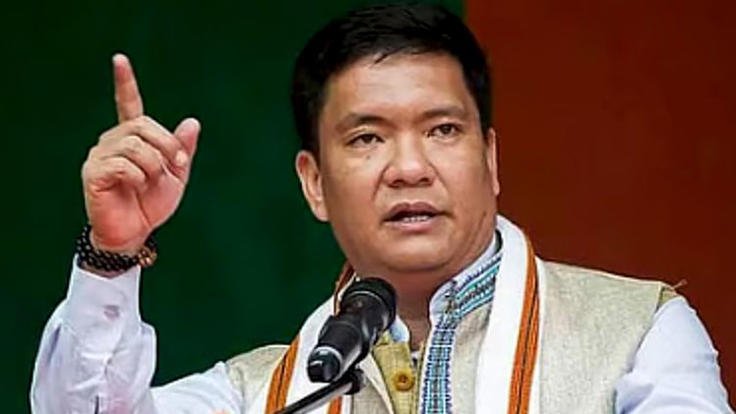
Arunachal Pradesh Chief Minister Pema Khandu has defended the Election Commission of India (ECI) over the ongoing controversy surrounding the Special Intensive Revision (SIR) of electoral rolls.
Khandu said official records of the poll panel indicate that the decision to undertake the SIR was taken collectively by the three Election Commissioners. His remarks come amid opposition criticism of Chief Election Commissioner Gyanesh Kumar and questions over the decision-making process within the ECI.
Khandu Cites ECI Records
Khandu said the Election Commission’s records provide evidence that the SIR decision was not taken by the Chief Election Commissioner alone.
According to the Arunachal Pradesh Chief Minister, the official record shows participation by all three members of the Commission in the decision-making process.
His statement comes after reports and political claims suggested that there were differences among the Election Commissioners over aspects of the electoral-roll revision.
SIR Becomes Political Flashpoint
The Special Intensive Revision has become a major point of political debate.
The exercise involves the verification and revision of electoral rolls. Election authorities have said such processes are intended to ensure that electoral rolls contain eligible voters and that entries are updated when circumstances change.
Opposition parties have raised concerns about the procedure, documentation requirements and possible effects on voters whose records require additional verification.
The Election Commission has defended the process and said appropriate mechanisms are available for voters to submit claims and objections.
ECI Says Decision Was Unanimous
The Election Commission has itself rejected suggestions that the SIR decision was imposed by the Chief Election Commissioner.
The poll panel has stated that decisions relating to the SIR exercise received the unanimous approval of all three Election Commissioners.
This clarification came after media reports raised questions about differences among the commissioners. The ECI said its decisions were taken collectively in accordance with its institutional procedures.
Khandu’s comments echo that position.
Opposition Questions Election Commission
Opposition parties have continued to question the functioning of the Election Commission.
Congress and other opposition leaders have criticised the SIR exercise and demanded greater transparency from the poll panel. Some leaders have also questioned the neutrality of the Election Commission under Gyanesh Kumar.
The opposition’s allegations are part of an ongoing political dispute. The Election Commission has rejected claims that it is acting in favour of any political party.
Debate Over Electoral Roll Revision
At the centre of the controversy is the process of revising electoral rolls.
Electoral rolls require periodic updating because new voters become eligible, people change residences and some entries may need correction or deletion under applicable rules.
The SIR process involves additional verification of electoral-roll entries. Where voters receive notices or face questions regarding their records, election authorities provide procedures for submitting documents and making claims.
The opposition has raised concerns about whether the process could create difficulties for some voters, while the ECI has maintained that safeguards are available.
Khandu Defends Institutional Process
Khandu’s statement focuses on the institutional aspect of the controversy.
By referring to the ECI’s official records, he said the available documentation shows that the SIR decision involved the Commission as a whole.
The Chief Minister’s remarks also come amid a broader debate over the independence of constitutional institutions and the role of political parties in scrutinising their decisions.
He has sought to counter the impression that the SIR exercise was the result of an individual decision by the CEC.
Political Debate Intensifies
The controversy has intensified as opposition parties continue to demand accountability from the Election Commission.
Congress leaders have called for Gyanesh Kumar’s resignation and organised protests over issues connected with electoral rolls and the SIR exercise.
The government has defended the poll panel and said its constitutional role should be respected. Union ministers have also rejected allegations that the ECI is acting with political bias.
The Election Commission has maintained that it follows established procedures in carrying out its responsibilities.
Arunachal Pradesh CM Highlights Official Record
Khandu’s intervention adds to the government’s broader defence of the Election Commission.
His argument is based on the ECI’s stated position that the SIR decision was approved unanimously by all three commissioners.
The claim is particularly relevant because the political dispute has partly centred on reports about internal differences within the poll panel.
While opposition parties have cited reports of disagreements, the ECI has maintained that the formal decisions on SIR were collective.
SIR Process Continues
The electoral-roll revision process continues in the states and Union Territories where the ECI has ordered the exercise.
Officials are processing applications, verifying records and considering claims and objections submitted by voters.
The process will eventually lead to publication of revised electoral rolls after the completion of the prescribed stages.
For voters, election authorities have stressed the importance of responding to notices and using the available mechanisms to correct or clarify their electoral details.
ECI Controversy Remains in Focus
Khandu’s remarks have added another political voice to the debate over the Election Commission and the SIR exercise.
The Chief Minister says the ECI’s records demonstrate that the decision was collective, while opposition parties continue to question the poll panel’s functioning and seek greater transparency.
The Election Commission, for its part, has maintained that all three commissioners approved the SIR decisions unanimously.
As the revision process continues, the dispute over electoral transparency, institutional decision-making and the role of the Election Commission is likely to remain part of the wider political discussion.