


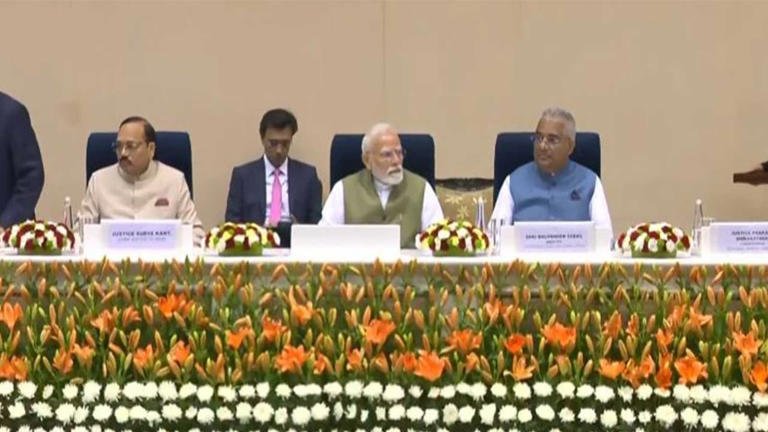
Prime Minister Narendra Modi on Saturday inaugurated the two-day international conference “The Future of Environment and Climate Dynamics” in New Delhi. The National Green Tribunal (NGT) organised the conference at Vigyan Bhawan on September 19 and 20.
The conference brings together judges, environmental experts, policymakers and senior officials from India and abroad. Judicial representatives from 17 countries are also taking part in the discussions.
The event aims to strengthen dialogue on climate change and environmental protection. It also seeks to improve cooperation between judicial, scientific and government institutions.
PM Modi Opens Two-Day Climate Conference
PM Modi inaugurated the conference at around 10 am at Vigyan Bhawan. The event focuses on major environmental and climate challenges facing countries across the world.
The NGT designed the conference as a platform for exchanging judicial approaches, scientific knowledge and environmental governance practices. Participants will also discuss institutional experiences from different jurisdictions.
The discussions will examine gaps in policy formulation, implementation and enforcement. They will also explore ways to strengthen environmental governance.
Judges and Experts From 17 Countries Participate
The conference has attracted participation from several countries. Eminent judges and judicial representatives from 17 countries are attending the event.
Participants include judges from the Supreme Court and High Courts, district court judges and senior government officials. Secretaries from various ministries are also taking part.
Representatives from State Judicial Academies and State Legal Services Authorities are participating as well. Environmental institutions such as State Expert Appraisal Committees, State Environment Impact Assessment Authorities and State Wetland Authorities are also represented.
This broad participation provides a platform to compare approaches to environmental law and governance.
Chief Justice Surya Kant Among Key Dignitaries
Chief Justice of India Justice Surya Kant attended the inaugural session. Union Environment, Forest and Climate Change Minister Bhupender Yadav was also present.
Attorney General R. Venkataramani and NGT Chairperson Justice Prakash Shrivastava attended the opening session as well. Their participation underlined the conference’s focus on the relationship between environmental governance and justice.
The conference brings judicial institutions and environmental authorities together. This can help improve coordination on complex environmental disputes.
Four Technical Sessions to Address Climate Issues
The conference will feature four technical sessions. These sessions will examine important environmental and climate-related issues.
The NGT has identified climate change and resilience, circular economy, biodiversity and ecosystem services, and sustainable energy solutions among the key themes.
These areas cover some of the major challenges linked to environmental protection. They also connect climate policy with economic development and resource management.
The discussions are expected to examine both existing challenges and emerging environmental risks.
Focus on Environmental Governance
Environmental governance remains a central theme of the conference.
The NGT said the event will examine gaps in policy formulation, implementation and enforcement. Participants will discuss ways to improve institutional cooperation and environmental decision-making.
Environmental regulations often involve several agencies. Better coordination can help institutions implement policies more effectively.
The conference therefore provides an opportunity for different stakeholders to share experiences and identify possible areas of cooperation.
India’s Climate Approach Discussed
During the inaugural event, PM Modi highlighted India’s approach to environmental protection and climate action.
According to reports, Modi said India has historically guided the world on environmental issues. He also said the country is working to provide solutions to modern climate challenges.
Modi also referred to India’s per capita carbon emissions. He said India’s per capita emissions remain below half the global average.
His remarks placed India’s climate policies within the wider global debate over climate responsibility and sustainable development.
NGT Mobile App Launched
The conference also featured the launch of the NGT Mobile App.
The app is intended to improve access to information related to the National Green Tribunal. Digital tools can help improve communication and make judicial information more accessible to citizens and stakeholders.
The move also reflects the wider use of technology in judicial and environmental governance systems.
Environment, Development and Justice
The conference brings environmental protection into discussions about development and justice.
Climate change affects multiple sectors. These include agriculture, water resources, energy, biodiversity and urban development.
Environmental disputes can also involve communities, businesses and government institutions. Judicial mechanisms therefore play an important role in resolving disputes and enforcing environmental regulations.
The conference allows judges and environmental experts to exchange experiences on these complex issues.
International Cooperation on Climate Challenges
Climate change crosses national borders. Environmental challenges in one region can affect ecosystems, economies and communities elsewhere.
International cooperation therefore remains important for developing effective climate responses. The participation of judicial representatives from 17 countries creates an opportunity to compare legal and institutional approaches.
The conference also includes participation from international organisations and institutions. The NGT’s official programme lists organisations including the United Nations Environment Programme and the Asian Development Bank among the international participants.
Conference to Continue on September 20
The conference will continue on September 20 with further technical discussions. The programme will conclude with a valedictory session.
President Droupadi Murmu is scheduled to attend the concluding session. Other dignitaries include Union Minister Manohar Lal and senior members of the judiciary.
The two-day event is expected to contribute to discussions on environmental justice and climate governance.
Strengthening India’s Environmental Governance
The NGT international conference provides a platform for discussions on some of the most pressing environmental issues.
Its focus extends beyond climate change. It also covers biodiversity, sustainable energy, circular economy and environmental justice.
By bringing together judges, scientists, policymakers and environmental institutions, the conference aims to strengthen institutional cooperation.
PM Modi’s inauguration has placed the event at the centre of India’s ongoing discussions on climate policy and environmental governance. The proceedings on September 19 and 20 are expected to generate further dialogue on how institutions can respond to present and emerging environmental challenges.